
India honours the bravery, dedication and nautical prowess of our Indian Navy. A navy that protects over 7,500 kilometres of large coastline and the mighty Indian Ocean Region (IOR) on 4th December every year. Traditionally, Navy Day tributes emphasise India’s strategic maritime power, operational readiness and the bravery of naval personnels. However, in recent years, the Indian Navy has distinguished itself also as a pioneer of green technologies and environmental stewardship. Driven by the belief that sustainability and security are intertwined. The Navy has undertaken a number of flagship projects to lower emissions, reduce energy intensity and safeguard delicate maritime habitats.
Advancing Renewable Energy Adoption
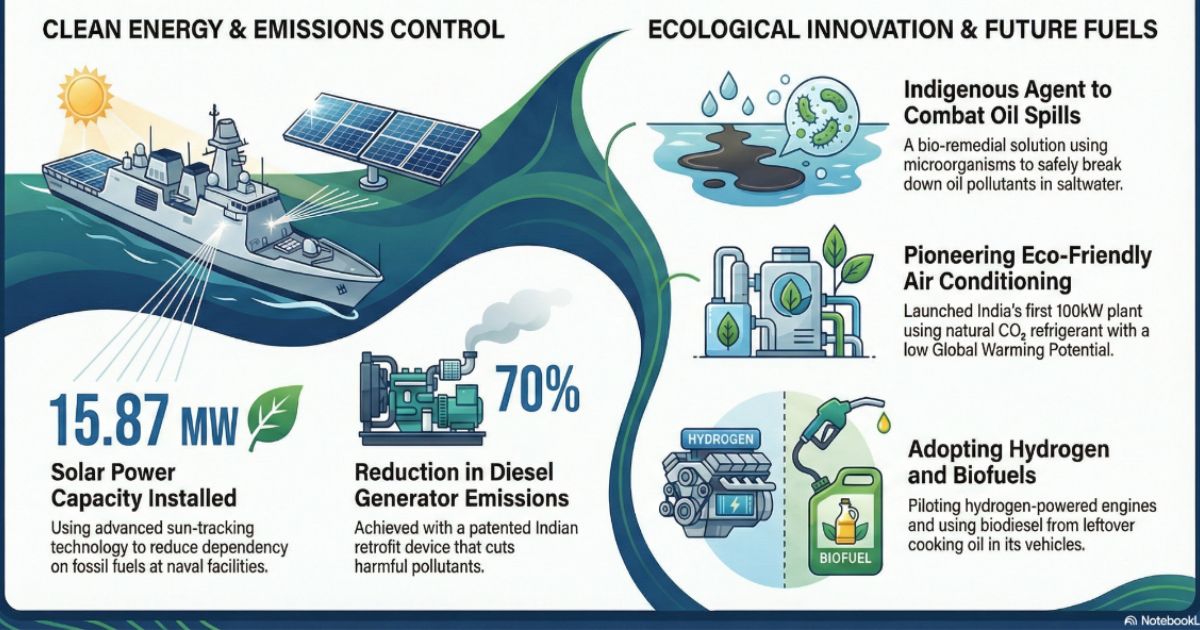
A significant component of the Navy’s initiative is the large-scale deployment of solar energy systems across its base. As part of the Government of India’s National Solar Mission (JNNSM), the Navy has already put into service solar power plants. It has a combined capacity of 15.87 MW. These state-of-the-art installations use single-axis sun-tracking technology. They have also computerised monitoring and control systems to ensure optimal performance. Additionally, 16 MW of Solar Photovoltaic (SPV) capacity is being built. This development reflects a long-term effort to maximise sustainable energy utilisation, reduce dependency on fossil fuels, and increase energy security within naval facilities.
Cutting Emissions Through Indigenous Innovation
In a groundbreaking engagement with India’s innovation ecosystem, the Navy introduced a patented retrofit device designed by Chakr Innovations. It was designed specifically to control pollution from diesel generators. After being installed on a shore-based generator for prolonged testing. The device produced impressive results, demonstrating a 70% decrease in emissions of hydrocarbons (HC), carbon monoxide (CO) and particulate matter. The Navy is now implementing these retrofit systems for all land-based diesel gensets motivated by their success. This is a huge leap towards reducing carbon emissions and establishing cleaner operational environments.
Safeguarding Marine Ecology with Bio-Remedial Technologies
Oil spills in ports and naval harbours pose a major hazard to marine life and coastal ecosystems. Acknowledging this, the Navy has created an indigenous marine bio-remedial agent in collaboration with the Naval Materials Research Laboratory (NMRL). It is a significant accomplishment in the maritime sector. This environmentally beneficial method breaks down several kinds of oils, such as diesel, lubricants and sludge, using a mix of microorganisms and growth stimulants. By organically dissolving oil pollutants in saltwater, the method reduces ecological damage and helps maintain healthier habitats near the harbour.
Pioneering Natural Refrigerant-Based Cooling
The Navy has operationalized India’s first 100 kW air conditioning plant using CO2. A natural refrigerant was designed in partnership with the Indian Institute of Science (IISc), Bengaluru. Unlike traditional HCFCs with significant Global Warming Potential (GWP), CO₂ has a GWP of just 1, making it one of the lower impact alternative refrigerants available. The facility, which was installed at INS Shivaji’s Centre of Excellence (Marine Engineering), has successfully operated for more than 850 hours now. This initiative corresponds to India’s commitments under the Kigali Amendment (2016) to phase down high-GWP refrigerants. This further highlights the Navy’s forward-thinking approach to sustainable engineering.
Adoption of Alternative Fuels and Hydrogen Technologies
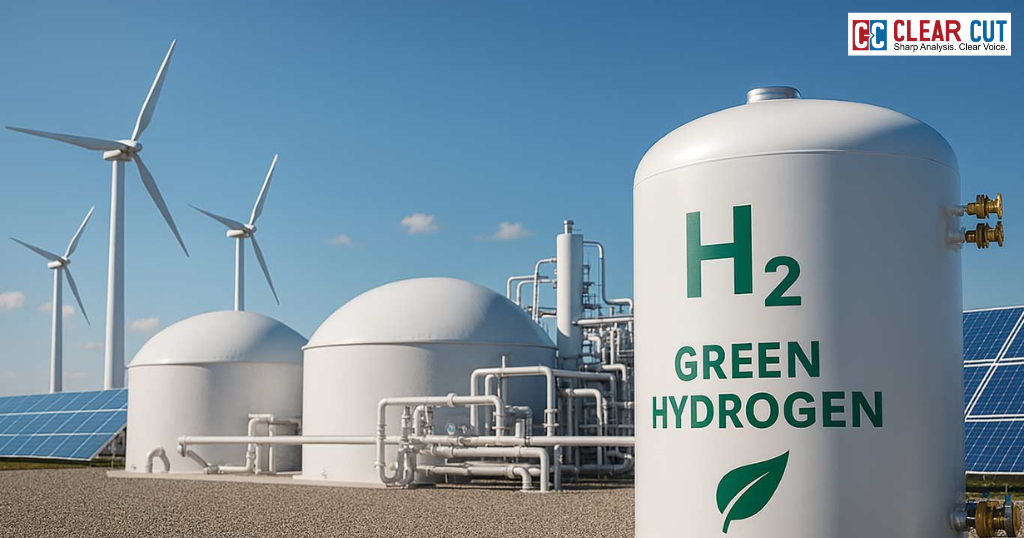
The Navy has been exploring Green Hydrogen as a possible clean fuel to help decarbonise its operations. A hydrogen-aspirated diesel engine has shown improved combustion and significantly lower CO emissions in successful shore trials. Now that the technology has advanced to pilot trials on a Navy vessel, there are encouraging prospects for future fleet-wide applications. In parallel, the Navy is working with Indian shipyards to construct ferry ships fueled by hydrogen fuel cells. This is to support the country’s aim to promote green solutions in the maritime sector contributing to Make in India. In addition, the Navy has greatly ramped up its use of biodiesel. It used 192 KL of B-7 blend biodiesel in its fleet of motor vehicles during the course of the previous year. It reduced vehicle emissions and promoted circular economy principles by using leftover cooking oil.
Conclusion
The Indian Navy’s green transformation reflects a deep-rooted understanding that environmental security is vital to national security. The Navy’s dedication to sustainability sets an impressive standard as one of India’s most energy-intensive defence forces. It operates cutting-edge ships, submarines, planes, and facilities. From renewable energy generation and emission-control technology to bioremediation, natural refrigerants and hydrogen-based advances, the Navy is aggressively reinventing itself as a future-ready environmentally responsible marine force. As we celebrate the bravery, tenacity, and commitment of our naval troops on this Indian Navy Day, it is also critical to acknowledge the Navy’s leadership in promoting environmentally friendly activities. Its actions not only help India’s climate goals but also conserve our oceans ensuring that future generations inherit a cleaner, safer and more sustainable marine environment.
Clear Cut Climate Desk
New Delhi, UPDATED: Dec 04, 2025 12:54 IST
Written By: Nidhi Chandrikapure