

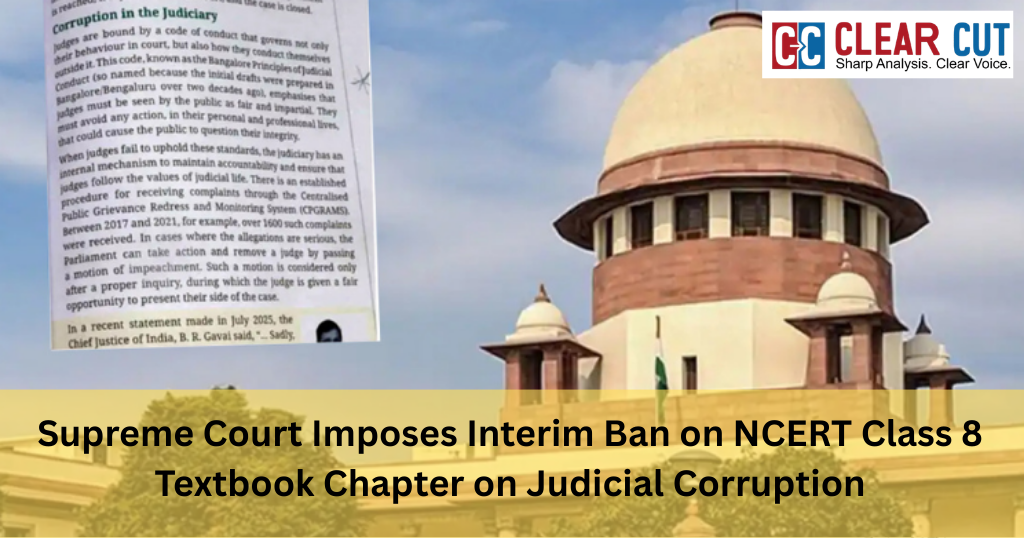
The Supreme Court of India imposed an interim ban on an NCERT Class 8 textbook chapter discussing judicial corruption and initiated suo motu proceedings. The case has sparked debate over academic freedom, institutional respect, and possible implications under the Contempt of Courts Act, 1971.
Key Highlights
• Supreme Court imposed interim ban on NCERT Class 8 textbook chapter discussing judicial corruption.
• Court initiated suo motu proceedings.
• Notice issued to NCERT Director seeking explanation.
• Court examined whether content could amount to contempt but has not yet held NCERT guilty.
• Debate emerged on academic freedom versus institutional respect.
• Case may influence future textbook guidelines.
The Supreme Court of India has temporarily banned the distribution of a Class 8 textbook published by NCERT after controversy erupted over a chapter discussing alleged corruption in the judiciary. The Court initiated suo motu proceedings and issued a notice to the NCERT Director, seeking an explanation regarding the content and its framing.
A chapter in a Class 8 civics or social science textbook referred to issues related to corruption in the judiciary. The Supreme Court objected to certain portions of the content and ordered that the book should not be circulated until further review. The Court is now examining whether the material undermines public confidence in the judicial system.
This development has sparked a national debate on academic freedom, institutional accountability, and the limits of criticism in school education.
What Triggered the Supreme Court’s Action?
Concerns were raised about the language used in the chapter, which reportedly discussed instances of judicial corruption. The Supreme Court took suo motu cognisance of the issue. Suo motu means the Court initiated proceedings on its own, without a formal petition.
The Bench questioned whether the chapter presented the judiciary in a negative light without adequate context. The judges expressed concern that such content, if not carefully framed, could damage the credibility of the judicial institution in the minds of young students.
The Court then ordered an interim ban on the textbook containing the disputed chapter and issued a notice to the Director of the National Council of Educational Research and Training (NCERT), asking for clarification about the drafting process and approval mechanism.
What Is NCERT and Why Does This Matter?
The National Council of Educational Research and Training (NCERT) is a government body responsible for preparing school textbooks and academic curriculum guidelines in India. Millions of students across central and state board schools rely on NCERT books.
Any controversy involving NCERT affects a large student population. Changes in its content influence classroom teaching, examinations, and learning outcomes nationwide.
When the Supreme Court intervenes in educational material, the matter shifts from academic debate to constitutional scrutiny. It raises larger questions about the relationship between education policy and judicial authority.
Legal Concerns Raised by the Court
The Supreme Court examined whether the chapter’s content could potentially amount to “scandalising the judiciary,” which falls under contempt law. However, the Court has not declared NCERT guilty of contempt at this stage.
Instead, the Bench issued a notice seeking an explanation from NCERT officials. The Court asked whether the content was appropriately contextualised and whether it presented allegations as established facts.
Under the Contempt of Courts Act, 1971, contempt includes acts that lower the authority of the judiciary or interfere with the administration of justice. The Court clarified that constructive criticism is permissible in a democracy. However, it questioned whether the textbook balanced criticism with institutional safeguards and corrective mechanisms.
The proceedings remain at the stage of examination and clarification. No final ruling on contempt has been delivered yet.
Academic Freedom vs Institutional Respect
The case has triggered a wider debate about academic freedom in India.
Education experts argue that civic education must discuss institutional weaknesses, including corruption. Students need to understand how democratic systems function and how accountability mechanisms operate.
However, critics argue that textbooks meant for middle-school students must handle sensitive topics with precision and balance. Inadequate framing may create mistrust rather than informed awareness.
The Court’s intervention signals that freedom of expression in educational material must operate within constitutional limits.
The Social Dimension: How Students Perceive Democracy
Civics textbooks shape how young citizens view democracy. They influence perceptions about Parliament, the executive, and the judiciary.
If students learn about corruption without learning about judicial reforms, disciplinary mechanisms, and constitutional safeguards, they may develop cynicism. On the other hand, avoiding discussion of institutional flaws may present an incomplete picture of governance.
The challenge lies in presenting judicial accountability in a fact-based, balanced manner. Education must promote critical thinking without weakening institutional trust.
Public confidence in democratic institutions depends partly on how they are represented in classrooms.
Impact on Curriculum and Schools
The interim ban requires schools to suspend use of the affected textbook until further orders.
This creates practical challenges:
• Teachers must adjust lesson plans.
• Students preparing for examinations may face uncertainty.
• School administrations must wait for revised guidelines.
Education boards may issue temporary instructions while the Supreme Court reviews the matter.
Broader Constitutional Implications
The Supreme Court’s action reflects its constitutional authority to protect institutional integrity. At the same time, it raises important questions about judicial oversight in academic content.
The Supreme Court of India has historically defended free speech while also safeguarding the dignity of the judiciary through contempt jurisdiction.
Legal scholars suggest that this case could set a precedent for how textbooks discuss constitutional bodies. It may lead to stricter editorial scrutiny for future curriculum development.
What Happens Next?
The Court will review NCERT’s response and examine the chapter’s content in detail. Possible outcomes include:
• Directing revisions to specific portions.
• Mandating editorial corrections.
• Issuing broader guidelines for textbook drafting on sensitive topics.
Until a final decision is delivered, the interim ban remains in effect.
Conclusion
The controversy over the NCERT Class 8 textbook highlights the delicate balance between education, free speech, and institutional credibility.
The Supreme Court has not yet delivered a final verdict on contempt. It has sought clarification and temporarily halted distribution while reviewing the matter.
The case raises fundamental questions about how democracies educate young citizens about accountability and reform. Education must encourage informed criticism while preserving institutional respect.
The final judgment will likely influence the future of civic education in India and define the boundaries between academic freedom and constitutional responsibility.
Clear Cut Education, Research Desk
New Delhi, UPDATED: Feb 28, 2026 01:00 IST
Written By: Samiksha Shambharkar