

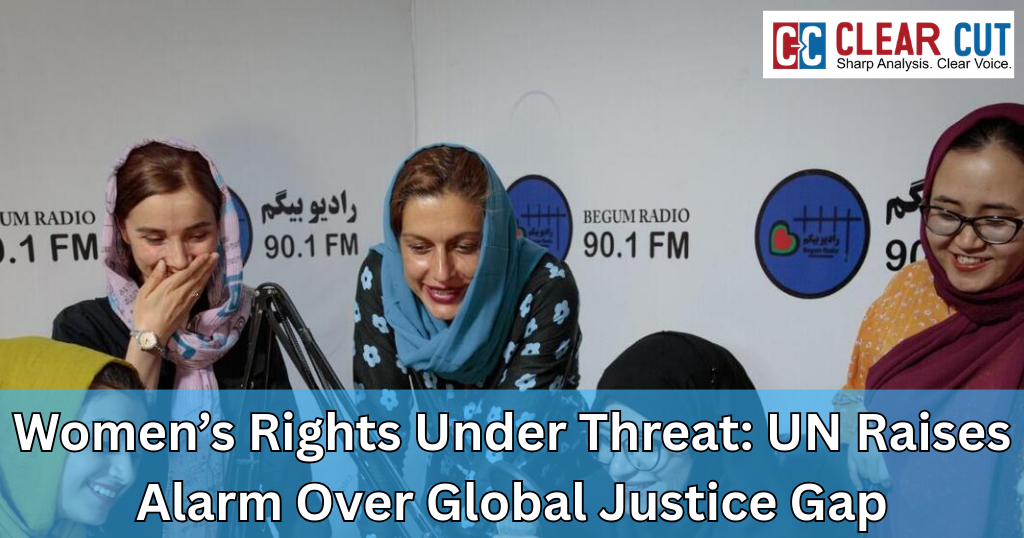
A new UN report warns that women worldwide have only 64% of the legal rights of men, highlighting major gaps in justice systems, weak law enforcement, and rising violence against women and girls.
On International Women’s Day 2026, the United Nations delivered a message that was anything but celebratory. UN Women issued a global alert warning that justice systems meant to uphold rights and the rule of law are failing women and girls everywhere. The alarm came attached to hard numbers. Women globally hold just 64 per cent of the legal rights of men, exposing them to discrimination, violence, and exclusion at every stage of their lives.
This is not a projection or a trend. It is the present reality for billions of people in 2026.
The Numbers Behind the Crisis
The findings come from the United Nations Secretary General’s report titled Ensuring and Strengthening Access to Justice for All Women and Girls. The data it presents is deeply concerning.
In more than half of the world’s countries, about 54 percent, rape is still not legally defined based on the principle of consent. In nearly three out of four countries, national laws still allow girls to be married. In addition, in about 44 percent of countries, the law does not guarantee equal pay for work of equal value.
At the current pace, closing the global legal protection gap could take as long as 286 years. This is not simply a slow reform process. It reflects a delay that could extend across many generations.
Sarah Hendriks, UN Women’s Director for Policy, Programme and Intergovernmental Division, confronted reporters directly at the report’s launch in New York. “As the world navigates democratic backsliding, rising conflicts, economic pressures and shrinking of civic space, there is an increasingly organised pushback at gender equality and regression of women’s rights,” she said. “Justice systems do not stand apart from those pressures. They actually reflect them.”
She went further. “Where power remains unequal, justice rarely operates neutrally. This is where retreat from gender equality becomes very visible,” Hendriks said.
Conflict Is Making It Worse
The report does not just document old failures. It tracks an active deterioration.
In 2024, 676 million women and girls lived within 50 kilometres of a deadly conflict, the highest figure since the 1990s. As a result, there has been a reported 87 per cent increase in conflict-related sexual violence violations.
Hendriks was blunt about what that means in practice. “Across the world today, violations of the rights of women and girls are indeed accelerating in a growing culture of impunity. This spans courts. It spans also online spaces and, of course, conflict, and also increasingly enabled by backlash against gender equality,” she said at the press briefing.
Digital spaces have become a new battlefield. “Digital technologies are being weaponized, through harassment, through abuse, through deep fakes that silence women, that force women to deplatform, and far too often, perpetrators face absolutely no consequences,” Hendriks warned.
The Gap Between Law and Reality
Even where laws exist on paper, enforcement is largely absent. The World Bank’s Women, Business and the Law 2026 report found a stark implementation crisis running in parallel to the UN findings.
Laws designed to ensure equal economic opportunities for women are only half-enforced on average across the world. Even if the laws were fully enforced, women would still enjoy barely two-thirds of the legal rights of men.
Tea Trumbic, Manager for the World Bank’s Women, Business and the Law project, framed the stakes in economic terms. “Over the next decade, 1.2 billion young people, half of them girls, will enter the workforce. Many will come of age in regions where women face the biggest barriers, and where the GDP boost that would result from their participation is most needed. Ensuring equal opportunity for women here, and everywhere, benefits societies as a whole, not just women. It’s an economic must-have, not just a nice-to-have,” she said.
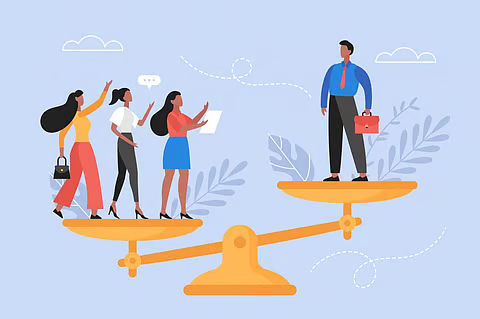
The World Bank estimates that ending legal barriers to women’s work and entrepreneurship could raise global GDP by more than 20 per cent and roughly double the pace of global growth over the next decade.
Funding Is Collapsing When It Is Needed Most
The crisis is compounding because the organisations meant to respond to it are running dry. Nearly 90 per cent of organisations working to end violence against women report cuts to essential services, and only 5 per cent believe they can sustain operations for more than two years without increased support.
Hendriks put the human cost of that plainly. “When justice fails women and girls, the damage goes far beyond any single story, any single woman’s life. Communities lose faith, public trust erodes and justice institutions lose legitimacy,” she said.
A Call to Act – Starting Now
UN Women Executive Director Sima Bahous delivered the clearest demand from the top. “When women and girls are denied justice, the damage goes far beyond any single case. Public trust erodes, institutions lose legitimacy, and the rule of law itself is weakened. A justice system that fails half the population cannot claim to uphold justice at all,” she said.
Bahous also issued a direct call to action ahead of CSW70, the UN’s 70th Session of the Commission on the Status of Women, which opens March 9 in New York. “Now is the moment to stand up, show up, and speak up for rights, for justice, and for action, so that every woman and girl can live safely, speak freely, and live equally,” she said.
There are signs that reform, when pursued seriously, works. Since 1970, family law reforms have led to more than 600 million women accessing new economic opportunities, all because the law was reformed on the family, Hendriks noted.
Between 2023 and 2025, 68 economies enacted 113 legal reforms strengthening women’s economic opportunities, according to the World Bank. Progress is possible. But the pace remains far too slow to meet the scale of the problem.
The theme of this year’s International Women’s Day, “Rights, Justice, Action for All Women and Girls,” is more than a message. It is a demand for immediate change.
Clear Cut Gender Desk
New Delhi, UPDATED: March 09, 2026 01:00 IST
Written By: Ayushman Meena