

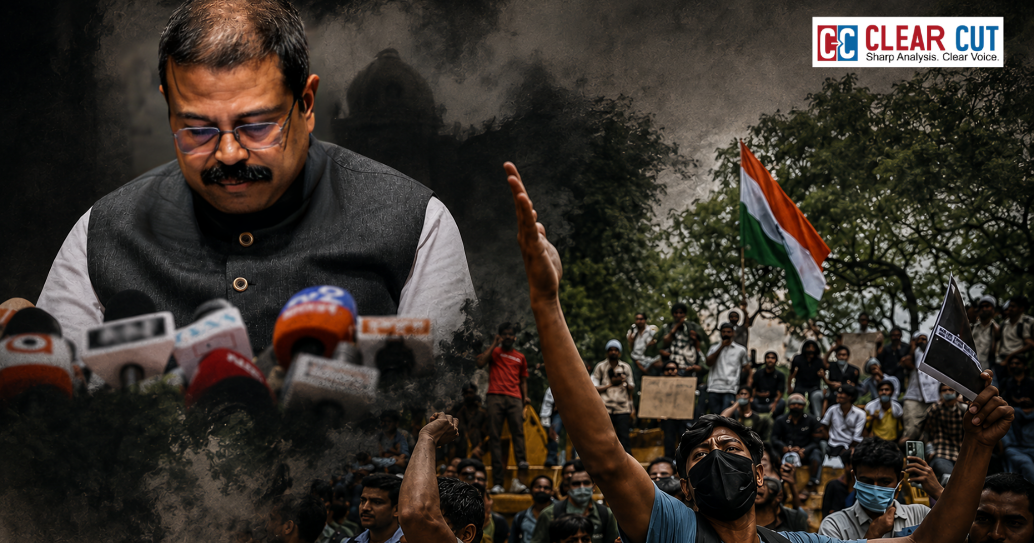
- Education Minister Dharmendra Pradhan resigned after nationwide protests over exam paper leaks, but the article argues that replacing a minister alone cannot fix India’s deeper examination system crisis.
- The article highlights structural issues such as paper leaks, malpractice, overdependence on high-stakes exams, and declining public trust, calling for transparent governance, stronger security, and institutional reforms.
- It concludes that lasting change requires improving learning outcomes, reducing reliance on single entrance exams, and rebuilding trust through a stronger education system rather than crisis management alone.
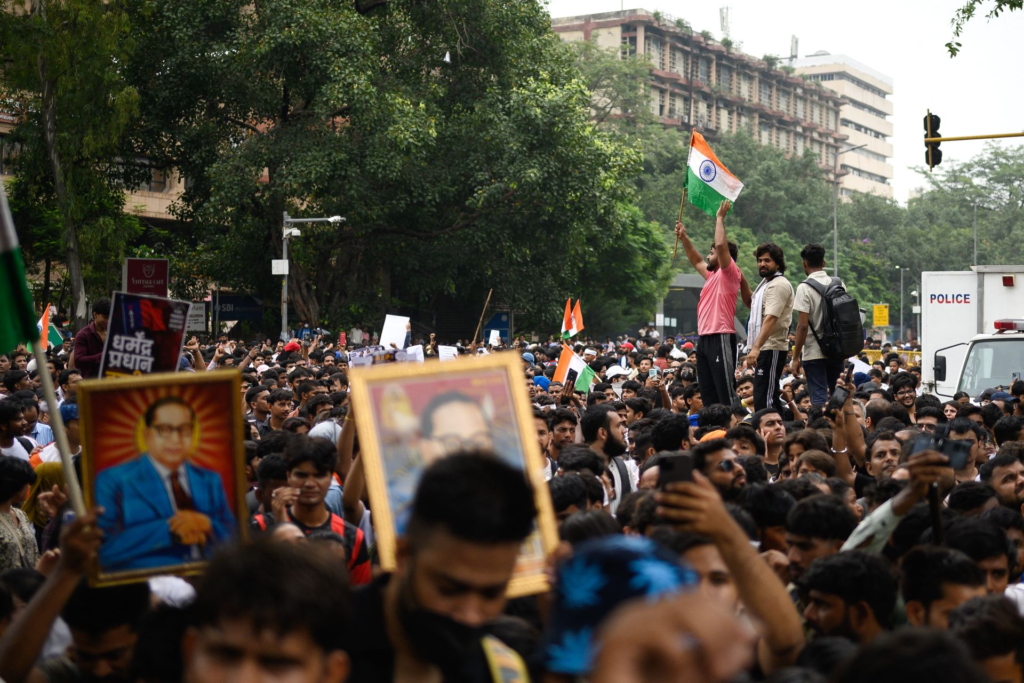
After weeks of student protests over leaked papers and rigged entrance exams, Education Minister Dharmendra Pradhan finally resigned on Saturday. He called it taking moral responsibility. But replacing a politician does nothing to repair the broken engine of India’s examination system.
For any democracy, a minister’s resignation is a visible act of accountability. But for India’s education system, the more important question lies elsewhere.
Will changing the minister change the system? That question deserves far more attention than the political headlines.
A crisis years in the making
The current protests may have been triggered by examination controversies, but they are symptoms of a much deeper institutional problem.
India today conducts one of the world’s largest examination ecosystems.
Every year, millions of students appear for NEET, JEE, CUET, UGC-NET, board examinations, recruitment tests and numerous state-level entrance examinations. Even a minor administrative failure affects thousands of lives; a major failure shakes public confidence across the country.
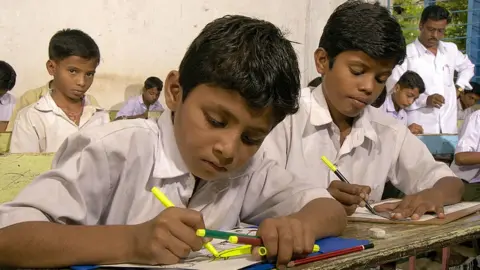
The National Testing Agency (NTA), established in 2018 to professionalise entrance examinations, now conducts several of India’s largest national tests. The idea was simple: one specialised institution, better technology, standardised processes and greater transparency.
Yet the past few years have repeatedly exposed vulnerabilities, like paper leaks, allegations of malpractice, last-minute cancellations, litigation, grace-mark controversies and repeated demands for re-examinations. As they say, “Trust, once lost, is difficult to rebuild.”
The scale of the stakes
Education in India is no longer merely about schools and colleges and securing a degree. It is the gateway to employment, social mobility and economic security.
According to UDISE+, India has over 24 crore school students enrolled across more than 14 lakh schools. Every year, millions transition from school to higher education through a handful of extremely competitive examinations.
For medical education alone, NEET has become one of the world’s largest entrance examinations. When such examinations fail—or are perceived to have failed—the consequences extend far beyond administrative inconvenience.
Families, along with students, spend years preparing. Students invest enormous emotional energy. Many spend substantial amounts on private coaching.
A cancelled or compromised examination is therefore not simply a governance failure; it becomes a crisis of public trust.
The accountability should not stop at resignation
Dharmendra Pradhan’s resignation is politically significant because ministerial accountability has become relatively uncommon in contemporary Indian politics. Reports suggest he accepted moral responsibility while defending many of the reforms undertaken during his tenure.
Focusing exclusively on one minister or an individual, risks overlooking the institutional nature of the problem. Paper leaks are not new. It has occurred under different governments, across multiple states and involving different recruitment agencies. Several state recruitment examinations have faced similar controversies over the past decade.
What does this tell us? This suggests that India’s examination crisis is structural rather than personal.
Replacing one minister without reforming the institutions would merely postpone the next
crisis.
A balanced assessment of Pradhan’s tenure
History doesn’t judge the ministers by a single event. Dharmendra Pradhan’s tenure witnessed important developments. For example:
- Implementation of the National Education Policy (NEP) 2020 gathered momentum.
- Foundational Literacy and Numeracy received unprecedented policy attention through the NIPUN Bharat Mission.
- Digital learning platforms expanded.
- The Ministry also initiated reforms in the functioning of the National Testing Agency following earlier controversies, including appointing expert committees to recommend structural improvements.
But a lot of challenges remained. For example:
- Learning outcomes continue to worry educators.
- ASER surveys consistently show that many children struggle with basic reading and arithmetic despite years of schooling.
- Higher enrolment has not automatically translated into higher learning.
- Private coaching continues to flourish because parents often lack confidence that schools alone can prepare students for competitive examinations.
We measure marks. We rarely measure learning.
India has become exceptionally good at measuring inputs.
We count enrolments. We count schools. We count teachers. We count scholarships. We count digital devices.
But do we put similar attention to measuring whether students actually learn? And this distinction matters. This matters because, a credible examination system cannot exist independently of a credible learning system.
Because when learning gaps widen, the competition for a seat will intensify. When competition intensifies, coaching systems expand. When stakes become extraordinarily high, incentives for malpractice also increase.
The next minister’s real agenda
Whoever succeeds Pradhan will inherit a trust deficit. Restoring that trust requires reforms beyond tighter security arrangements.

India needs an assessment ecosystem that is predictable, transparent and professionally governed.
That means stronger examination governance, independent audits, modern cybersecurity, robust logistics, real-time monitoring and clearly defined accountability for every stage of the examination process.
Equally important is reducing excessive dependence on one high-stakes examination.
Many countries increasingly combine multiple indicators. These include school performance, aptitude assessments, interviews and continuous evaluation, to reduce the pressure associated with a single test.
It is understandable that India’s scale makes such reforms difficult. But difficulty cannot become an excuse for delay.
Beyond examinations lies the larger question
Perhaps the greatest lesson from this episode is that India’s education debate remains dominated by examinations. The public conversation begins when question papers leak. It rarely begins when children fail to learn.
Yet the latter is the more fundamental problem. An examination system merely reflects the health of the education system beneath it.
If schools consistently invest in learning, and produce confident learners, examinations become less frightening.
That is why India’s education reforms must move beyond protecting examination papers.
They must protect learning itself.
The resignation is the beginning—not the conclusion
Dharmendra Pradhan’s resignation will undoubtedly occupy political headlines for days and weeks. But history is unlikely to remember this episode simply because a minister stepped down. It will remember whether India used this moment to rebuild confidence in one of the world’s largest education systems.
A resignation can surely restore political accountability. But only institutional reform can restore public trust. The next education minister should not merely be judged by how efficiently examinations are conducted. She or He should be judged by whether India finally shifts its attention from administering examinations to improving learning.
Because ultimately, students do not need a better crisis-management system.
They need an education system that earns their trust long before they enter the examination hall.
Clear Cut Education Desk
New Delhi, UPDATED: July 25, 2026 21:00 IST
Written By: Paresh Kumar