
Experts argued that India must spend on what strengthens learning systems, fund behaviour changes with patient capital, and build sustainability in from day one
Education financing in India needs to shift from spending more to spending on what strengthens learning, and corporate social responsibility (CSR) can catalyse change but cannot carry the system, panellists remark at the Clear-Cut Education Summit 2026, “Financing Learning – Who Pays for Better Outcomes?”, on 30 September.
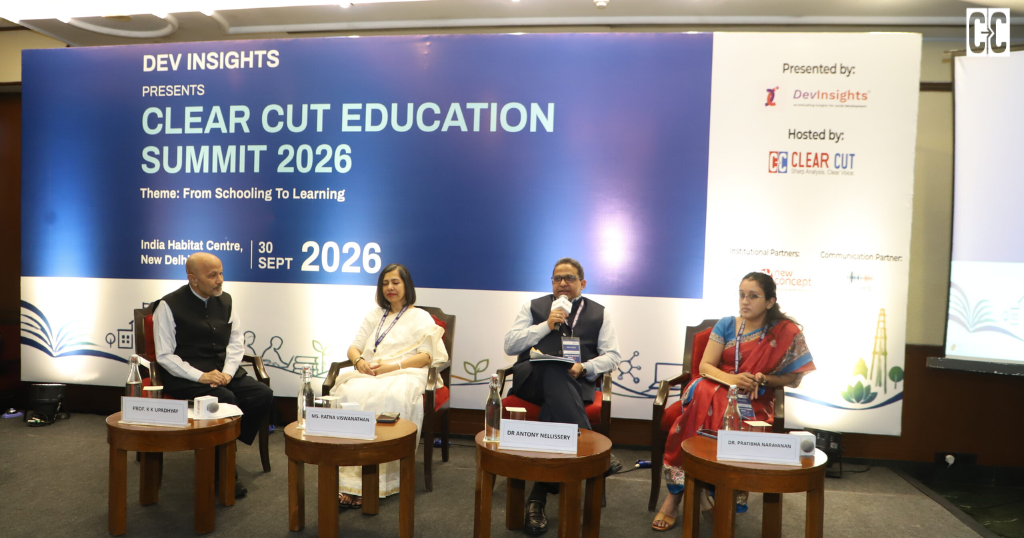
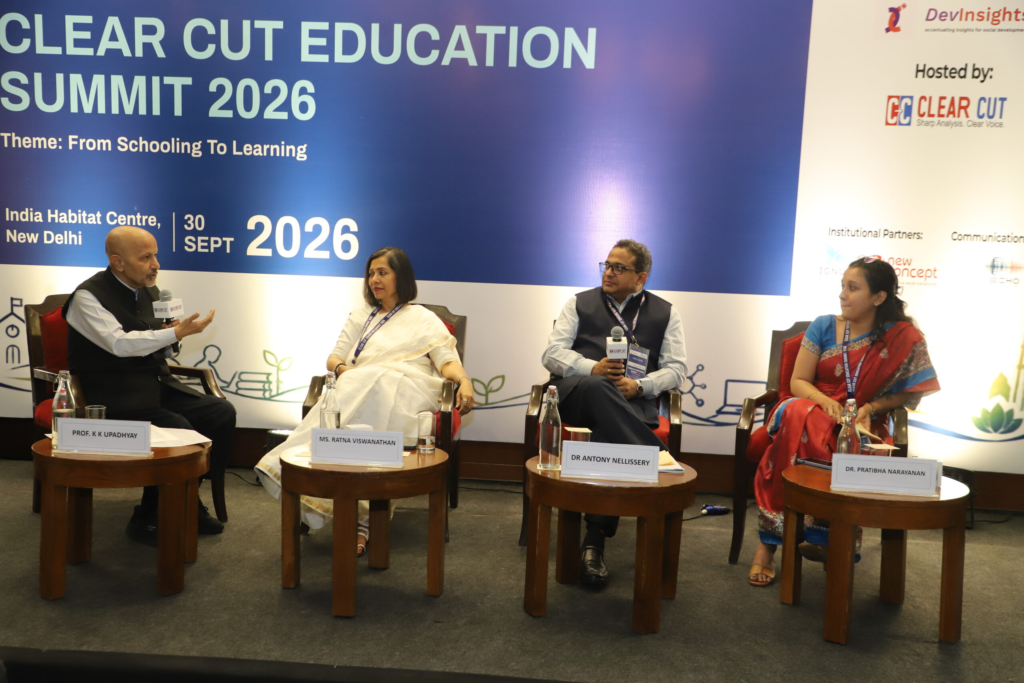
Moderated by KK Upadhyay, Professor of Sustainability and CSR at BIMTECH, the session asked how government, CSR, philanthropy and development partners can finance learning outcomes, not just education inputs and activities. The panellists were Ratna Viswanathan, a former civil servant with the Government of India and co-founder and CEO of Reach to Teach Foundation Society; Dr Antony Nellissery, Head of Group CSR at Sterlite Electric, Resonia, and Serentica, and Head of Sterlite EdIndia; and Dr Pratibha Narayanan, co-founder of Involve Learning Solutions Foundation.
Government remains the primary funder, the panel noted, while CSR and philanthropy work with different mandates and priorities. The difference in scale is stark. Centres and states were budgeted to spend ₹9.2 lakh crore on education in 2024-25, according to the Economic Survey, a figure that includes sports, arts and culture and has hovered around 2.7 to 2.9 percent of GDP, against the National Education Policy’s 6 percent target.
The Ministry of Education’s broader count put it at 4.12 percent in 2021-22. CSR spending on education in 2023-24 was about ₹12,000 crore, roughly 1.3 percent of the public budget. “CSR funding can only be catalytic; it can never solve the problem,” Dr Narayanan said. The panel urged alignment on the outcomes being pursued rather than on the assumption that a single funding model can meet every need.
Spending more is not the same as spending well. Panellists questioned whether investments always go to the factors that improve learning and pointed to system strengthening, teacher capacity, foundational learning, and the effective use of data as more fundamental than trend-driven spending. “I want to change ‘education for all’ to ‘gain for all’. A lot of money can be saved when you focus on the right aspects,” said Dr Nellissery.
Time horizons matter too. Meaningful change cannot be captured only through numbers or short-term outputs. Funding has to support changes in behaviours and practices while continuing to measure whether they are happening. “Even now calculations are in numbers – but if we are to create change, we need to start funding inputs and most importantly funding behaviour change,” said Dr Narayanan. Dr Nellissery added, “It cannot be an afterthought. “We need to look at sustainability from day one and not when the funding is ending.”
Funding tied to results has precedent in India. In Rajasthan’s Bhilwara district, Educate Girls’ development impact bond, the world’s first in education, linked investor returns to independently verified outcomes. It achieved 116 percent of its enrolment target and 160 percent of its learning target on a project budget of about $270,000.
Viswanathan’s emphasis was on data and the wider system. The panel called for better data management, timely disbursement of funds and a more rational approach to deciding what should be funded and why. “Unless there is a system focus to look at the big picture, we will be wasting money and time of stakeholders,” she said.
The session ended with “Let’s start listening more to our young people, asking what they need,” said Dr Narayanan. “Keep listening with empathy,” Viswanathan added. The panel’s answer to “who pays” was less a single name than a method: government as the anchor, CSR and philanthropy as catalysts, and decisions informed by what young people say they need. Dr Nellissery closed on a resolution. “Yes, we can, let’s do it.”
Clear Cut Awards & Events Education Desk
New Delhi, UPDATED: October 10, 2026 15:53 IST
Written By: Yatharth Pathak