
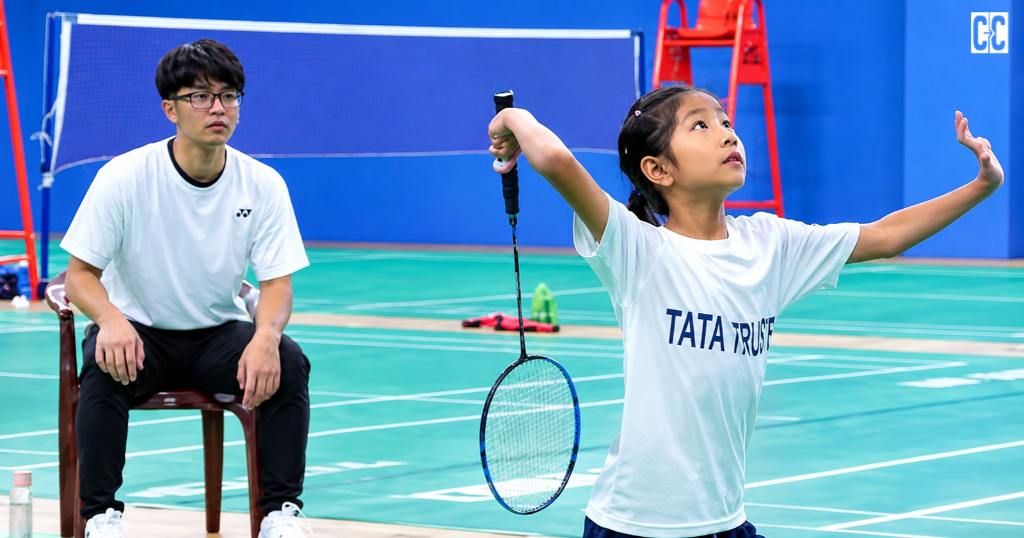
The Mizoram Badminton Initiative, launched by Tata Trusts in 2018, has helped develop grassroots badminton centres and support young players through regional training and scholarships. While players from the programme have achieved national and international recognition, questions remain about centre closures, coaching incomes and long-term livelihood opportunities.
BWF World Junior Championships Of the 40 grassroots badminton centresx set up in Mizoram under a Tata Trusts programme, 28 remain active, according to the Trusts’ February 2026 account. That figure is rarely the headline. The headline came in October 2025, when two Mizoram players, Lalthazuala Hmar and Lalramsanga, were part of India’s first-ever medal at the BWF World Junior Mixed Team Championships, a bronze won in Guwahati.
Independent reports confirm the medal. India lost the semi-final to Indonesia after beating Korea in the quarter-final, and Lalramsanga played in the mixed doubles. Sportstar reported that Lalthazuala, then 18, also became the first Mizoram player to win a junior national championship, taking the Under-17 boys’ singles title in 2023. Whether the programme caused these results cannot be established, but both players came through its regional centre in Aizawl, according to the Trusts.
How the model works
The Mizoram Badminton Initiative began on 8 October 2018 with the Pullela Gopichand Badminton Foundation, the Mizoram Badminton Association and the Mizoram State Sports Council. The Trusts’ North East Initiative Development Agency implements it. The structure has three tiers: grassroots centres, two regional development centres and scholarship places at residential academies, including the Gopichand academy in Hyderabad and the badminton centre at ITM University in Raipur. A senior bureaucrat posted in Mizoram pushed for the idea, building on a state where, the Trusts say, almost every locality has an indoor hall.
Each grassroots centre is run by a committee of community members, a local coach and a district representative. Fees set by the committee are reinvested in upkeep. The 2018 press release said local committees would take over operations completely after three years. The Trusts say that by the second phase, launched in 2021, many centres were paying trainer salaries from local fees.
The Trusts report several results. Of more than 50 players trained at the regional centres, 18 have won full scholarships to residential academies. A statewide league has given over 300 players regular competition. Four Mizoram players have become national champions, and the state’s boys team moved from bronze to gold at the national championships in one year, with five of its seven members from the initiative. These numbers come from the Trusts’ own magazine, and they were not checked against independent records.
From court to career
The livelihood question is where the evidence thins. In a March 2026 opinion piece, Neelam Babardesai, head of sports at Tata Trusts, describes a framework called S.C.O.R.E. (Sports Career Orientation, Readiness and Empowerment). It aims to show young people careers on and off the field. She writes that Mizoram youth are building careers as coaches, referees, sports physiotherapists and programme managers, and that a planned residential centre would combine coaching with education. The piece offers no count of people employed and no income ranges. “Livelihood pathway” is, for now, a design supported by examples, not a measured outcome.
The attrition figure matters here. If 12 of 40 centres have stopped, the trainer jobs they supported have stopped too. The Trusts do not explain why those centres closed. Hall access, committee turnover, a coach leaving or low enrolment would each point to a different remedy. Nor is it reported whether the 28 active centres pay trainers a stable income.
The scholarship ratio carries a similar caution. Eighteen scholarships from more than 50 regional trainees means that, at most, roughly a third moved to residential academies. What happened to the rest is not described. Sport selects heavily, and a livelihood programme has to account for those who do not reach the top.
State involvement may help durability. In June 2025, Mizoram’s Minister of State for Sports and Youth Services met Pullela Gopichand and Tata Trusts officials to discuss longer-term collaboration, and Gopichand said Mizoram had the atmosphere and hunger for excellence. Sportstar noted that the state government had launched an Empowering Mizoram Sports programme the same year.
The Trusts have taken the model to rural Maharashtra, through a programme called Grassroots Kreedakul. The Mizoram result may depend on a condition that is not universal: a ready-made network of community halls. Whether the approach works where that network does not exist is an open question. The next evidence worth publishing is simple: why 12 centres closed, what coaches earn at the 28 that remain, and what became of trainees who did not win scholarships.
Clear Cut Livelihood Desk
New Delhi, UPDATED: November 24, 2026 23:00 IST
Written By: Tanmay J. Urs