
Bagapatia in Odisha was developed to resettle families displaced by coastal erosion in Satabhaya, but relocation has not resolved many of their challenges. Residents continue to face limited healthcare, inadequate water and drainage infrastructure, livelihood losses, migration and exposure to flooding. The case raises questions about whether climate relocation programmes should be measured by housing alone or by the long-term quality of life and rehabilitation they provide.
A journey that ended on the road
A funeral procession moved through the lanes of Bagapatia, a resettlement colony in Odisha’s Kendrapara district, for an 18-year-old pregnant woman. Dialogue Earth reported the case in February 2026 and gave her name as Kashmira, noting that it is not her real name. The report says she developed an emergency, and that the nearest hospital able to treat her was two hours away. She died while being taken there. A resident told the reporter that the young woman gave birth and died the same day (Behal, 2026).
One death does not establish a pattern. It does expose a question that official accounts of the colony leave open. Bagapatia was presented as an example of a state planning for climate displacement. Whether relocation has amounted to rehabilitation depends on what the colony provides after families arrive.
Why the families moved
Satabhaya, the coastal settlement the families left, once had seven revenue villages. The sea has largely taken them. The National Centre for Coastal Research found that 36 per cent of Kendrapara’s 136-kilometre coastline experienced some erosion between 1990 and 2018 (Behal, 2026). The Odisha government identified Bagapatia as the resettlement site in 2008, and relocation had reportedly been discussed as early as 1992. By 2018, 571 families had been moved (Behal, 2026; The Tribune, n.d.).
Official numbers are hard to reconcile. Dialogue Earth also cites a statement that by April 2024 officials had resettled 17,049 displaced people. The sources examined do not explain how this figure relates to the 571 families.
Houses without livelihoods
The colony sits roughly 10 to 12 kilometres inland on low, swampy ground near Bhitarkanika National Park, on land that once held prawn farms (Earth Journalism Network, 2018; Behal, 2026). Residents told Dialogue Earth that the soil does not support farming. Families that once grew vegetables and caught fish now buy their food. One member of the local panchayat samiti summed up the outcome as houses without livelihoods.
Work has moved away from the village. A Climate Action Network South Asia report noted that around 2,000 residents had migrated for work by 2021, as cited by Dialogue Earth. Interviewees described young women leaving for garment factories in Kerala, more than 2,000 kilometres away, for wages as low as ₹10,000 a month. No published count of migration from the colony was identified in the sources examined.
Services that fall short
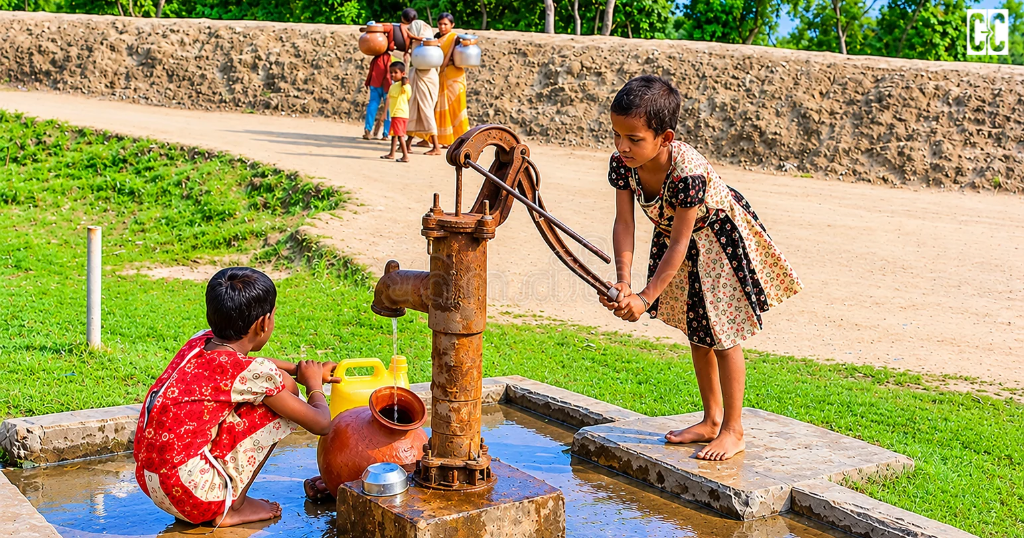
The colony has one community health centre. Its community health officer told Dialogue Earth that a doctor visits once a week from Rajnagar and that a pharmacist is the only other staff member on duty. Skin disease and diarrhoea are common in the rains because of waterlogging. The report also states that there is no piped water supply or drainage, and that the village’s single school doubles as a cyclone shelter that cannot hold all 571 families (Behal, 2026).
The conditions have drawn official attention. In May 2025 the National Human Rights Commission sought an action taken report from the Kendrapara collector on poor living conditions and missing amenities at the colony (The New Indian Express, 2025). The collector’s response could not be located in public records. Dialogue Earth reported that the district magistrate and the state’s housing and urban development department did not reply to its requests for comment.
The picture is not uniform. After a 2018 report by Earth Journalism Network grantee Priya Ranjan Sahu, authorities stepped up resettlement, and a local journalist later described better electricity and water supply and a tube well in the colony (ICSF, n.d.). Some families have built cement houses over several years.
Hazard follows the move
Cyclone Dana struck in late 2024. A resident described floodwater entering homes and fields and roads being cut off for days (Behal, 2026). Residents also fear that erosion will eventually reach the colony. One resident put the timescale at 20 to 30 years, an estimate and not a projection.
Loss has also reached heritage. A Down To Earth essay reports that residents sent photographs on 31 August 2026 showing the last remains of the Panchubarahi temple, long served by Dalit women priestesses from the fishing community, disappearing into the sea (Down To Earth, 2026).
A policy gap
Two private members’ bills on climate displacement were introduced in Parliament in 2022. Neither passed (Behal, 2026). Odisha-based climate activist Ranjan Panda told Dialogue Earth that India still lacks a comprehensive rehabilitation policy. Without statutory standards, success is judged administratively. The public record examined for Bagapatia counts families moved. It does not report emergency travel times, income, school attendance or migration after the move.
The unresolved question is concrete. If a settlement is counted as a success once families are housed, what would count as failure? A post-relocation audit covering emergency travel time, water supply, income and out-migration would answer it. Until one is published, Bagapatia is an unfinished test and not a template.
Clear Cut Climate, Livelihood Desk
New Delhi, UPDATED: November 26, 2026 23:00 IST
Written By: Tanmay J. Urs