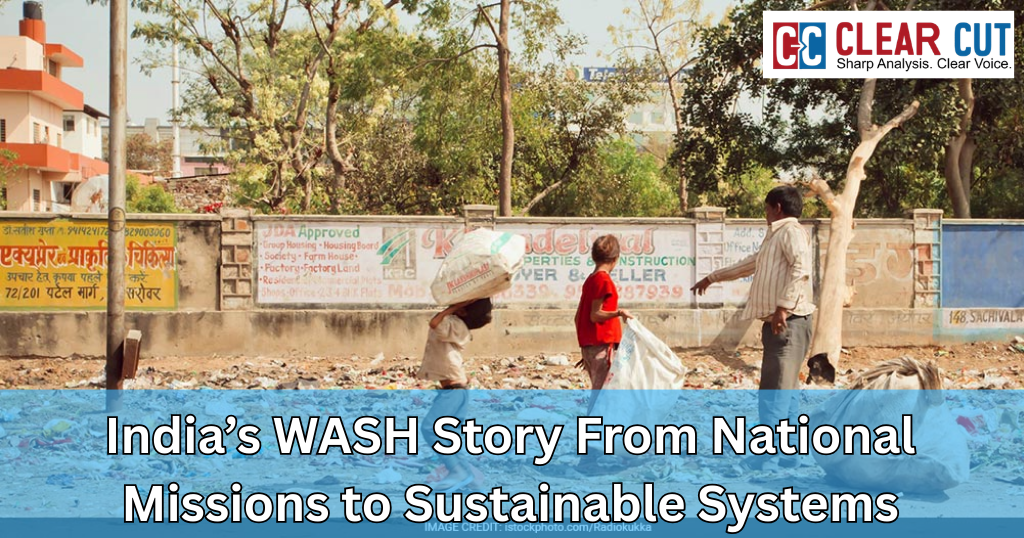
India’s WASH transformation through the Swachh Bharat Mission and Jal Jeevan Mission has significantly expanded sanitation and safe drinking water access, improving public health, gender equality, and rural livelihoods. The next phase focuses on sustaining these gains through resilient systems, community ownership, and climate-sensitive water management.
Water, Sanitation and Hygiene (WASH) is not only a matter of health and dignity; it is directly linked to socio-economic development like education outcomes, economic productivity, gender equality, and
environmental sustainability. Within the framework of Human Development Index (HDI), access to safe drinking water and sanitation has a direct impact on life expectancy and the standard of living,
making Joint Monitoring Programme (JMP) findings a crucial lens for assessing human development worldwide.
Globally recognised under Sustainable Development Goal (SDG) 6 for universal access to safe water and sanitation, WASH interventions have high public health returns while reducing disease burden, enhancing nutrition, and promoting gender equity. Over the past two decades, many countries across Asia, Africa, and Latin America have implemented large-scale WASH programmes with varying degrees of success such as Ethiopia’s One WASH National Programme , Bolivia WATCH , Sustainable Urban and Rural Water, Sanitation, and Hygiene (SURWASH) Program.
India’s WASH Journey in the Global Context
India’s recent WASH journey, marked by unprecedented scale and innovation, stands out as one of the most significant national transformations in the global WASH landscape. India’s WASH programs, Swachh Bharat Mission (SBM) and Jal Jeevan Mission (JJM), drive national efforts toward sustainable
access, with SBM focusing on sanitation and JJM on safe drinking water.
Swachh Bharat Mission: Transforming Sanitation at Scale
At the heart of India’s WASH narrative lies the Swachh Bharat Mission (SBM), a monumental behaviour and infrastructure programme launched on 2 October 2014 with the vision of achieving an Open
Defecation Free (ODF) India. By 2019, India had constructed over 100 million household toilets and declared more than 600,000 villages ODF, a feat unmatched in scale anywhere in the world. Followed
by, Swachh Bharat Mission (SBM) Phase II launched in 2020 with a ₹1.4 lakh crore outlay, it sustains Open Defecation Free (ODF) status while advancing to ODF Plus through solid/liquid waste management
and visual cleanliness, targeting completion by 2025-26. Key achievements include constructing over 12 crore toilets, saving nearly 3 lakh children under five from sanitation-related diseases per a World Health Report, and declaring 3.6 lakh villages ODF Plus as of mid-2025.
Jal Jeevan Mission: Securing Rural Drinking Water
Similarly, Jal Jeevan Mission (JJM), started in 2019 with an initial ₹3.60 lakh crore outlay, provides 55 litres of clean, safe drinking water per person per day through a household tap to every rural household via functional connections, extended to 2028 per the 2025-26 Budget. Key indicators also show dramatic improvement in access to drinking water, driven by the Jal Jeevan Mission (JJM), which has enabled tap water connections to nearly 15.7 crore rural households, significantly transforming daily life and health in rural communities.
These achievements have placed India prominently within global WASH discourse:
- India’s reduction in open defecation by hundreds of millions of people represents one of the largest behaviour changes in human history, according to global monitoring reports.
- The scale of sanitation infrastructure delivery and citizen engagement has become a model for developing countries, attracting international delegations to study India’s approach.
Evolution of India’s WASH Missions From Infrastructure Expansion to Systems Sustainability
As India moves closer to universal coverage under both SBM and JJM, the focus of WASH programming is increasingly shifting from infrastructure creation to systems sustainability, equity, and resilience. Both
missions have demonstrated a clear ability to adapt to emerging challenges such as climate stress, urbanisation, behavioural sustainability, and inclusion of vulnerable populations making them more relevant to present and future development contexts.
The Swachh Bharat Mission (SBM) has evolved from a toilet-construction campaign into a comprehensive sanitation and environmental cleanliness programme. SBM Phase II emphasises sustaining behaviour change, solid and liquid waste management, maintenance of public and institutional toilets, and
cleaner villages and cities. This shift recognises that sanitation outcomes require continuous community engagement, strong local governance, and sustained financing. Greater convergence with health, nutrition, women and child development, and urban ministries has reinforced sanitation as a core determinant of public health and dignity.
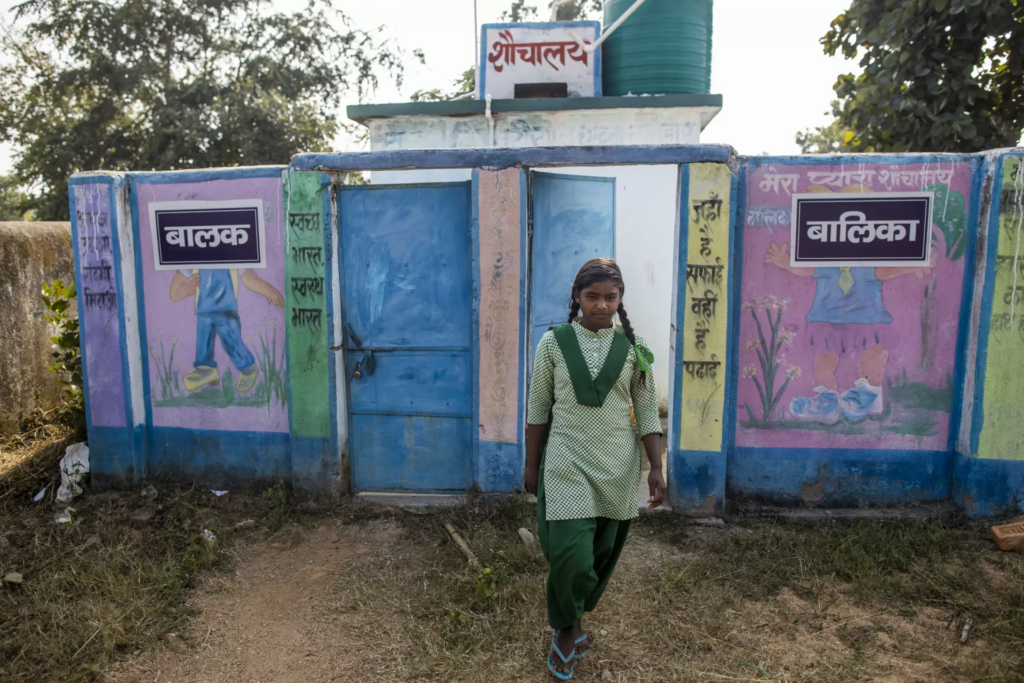
Similarly, the Jal Jeevan Mission (JJM) has moved beyond rapid tap connections toward ensuring water quality, service reliability, source sustainability, and community ownership. States are adopting context-specific models, addressing groundwater stress, and integrating climate-resilient practices such
as rainwater harvesting. Strengthened Village Water and Sanitation Committees reflect a shift to decentralised governance and long-term service delivery.
Both missions combine flexible, stateled implementation with campaign-mode governance, using mass communication and mobilisation, real-time monitoring, and political leadership to sustain
momentum and accountability.
Advancing Gender Equality and Climate Action through WASH
Another distinguishing feature of India’s evolving WASH approach is its explicit integration of gender and social inclusion, an area where global WASH programs often remain under-addressed. Evidence from WHO and UN Women highlights that inadequate sanitation and water access disproportionately affect
women and girls through time poverty, safety risks, and health impacts. SBM’s focus on dignity, menstrual
hygiene management, and safety, along with JJM’s reduction of water collection burdens, directly contributes to SDG 5 (Gender Equality) by enabling greater participation of women in education,
livelihoods, and local governance.
Increasingly, both SBM and JJM are also responding to climate-related risks, aligning with SDG 13 (Climate Action).
The World Bank and WHO have emphasised that climate variability poses a significant threat to WASH
infrastructure, water sources, and service reliability, particularly in water-stressed and flood-prone regions. India’s focus on source sustainability, groundwater recharge, greywater management, and waste treatment reflects a growing recognition of WASH as a climate-sensitive system rather than a standalone service.
India’s Global Leadership and the Way Forward
Taken together, the Swachh Bharat Mission (SBM) and Jal Jeevan Mission (JJM) represent a rare national transition from rapid infrastructure expansion to more integrated, resilient, and people-centred WASH systems. By evolving beyond access-focused delivery into broader development platforms, both missions
have demonstrated how large-scale WASH programmes can remain effective and relevant over time. Their strong convergence across sectors, adaptability to diverse local contexts, and responsiveness
to emerging risks such as climate variability, urban waste pressures, and behavioural sustainability have reinforced their significance in a rapidly changing socio-economic and environmental landscape.
Distinct Features | India stands out for
- Unmatched scale (hundreds of millions impacted in a decade)
- Mission-mode governance
- Behaviour change as a national movement
- Integration of WASH eith dignity, gender, and development narratives
This evolution closely aligns with global guidance from WHO, UNICEF, and the World Bank, positioning India as an important reference point for countries seeking to embed WASH within broader health, gender, and climate agendas while advancing SDG 6.
In global comparison, India’s WASH journey marks a paradigm shift in how national governments can mobilise political leadership, public participation, and administrative systems for social transformation.
It demonstrates that WASH outcomes can be achieved at scale when political commitment, community mobilisation, and systems strengthening converge.
This leadership was visible at the World Economic Forum (WEF) 2025 in Davos, where India showcased its WASH innovations through a high-profile session on climate and water sustainability. The scale, speed, and visibility of SBM and JJM—combined with their emphasis on behaviour change, social norms,
and accountability—have influenced global WASH discourse and informed approaches adopted by other countries and development partners. While many nations excel in specific areas such as community ownership or urban systems, India’s distinctive contribution lies in proving that water and sanitation can be elevated to a national priority at scale.
Looking ahead, the next phase of India’s WASH journey will depend on moving from mission-mode success to system maturity. Global experience underscores the need to institutionalise WASH within
routine governance, health, and education systems; shift decisively from access to service quality and safely managed services; deepen community ownership and local accountability; address urban sanitation
holistically; and embed behaviour change as a long-term social norm.
Global Experiences | Key learning areas for India
Move from campaign to system – Embed WASH deeply into routine governance, health, and education systems.
Strengthen service quality – Shift focus from access to safely managed services (water quality, sludge treatment).
Deepen community ownership – Reduce reliance on top-down messaging; strengthen local accountability mechanisms.
Address urban sanitation holistically – Learn from Latin American cities on sewerage and waste treatment models.
Institutionalise behaviour change – Move beyond awareness to habit formation and social norm reinforcement.
Together, these priorities will help ensure that India’s transformative gains translate into sustainable, equitable, and resilient WASH systems delivering lasting public health and development benefits.
About the writer: Sonali Maheshwari is a senior social development professional with over two decades of experience designing and leading large-scale, multi-stakeholder programmes in India and South Asia.
She specialises in behaviour change, policy engagement, and systems strengthening across child protection and safety, women’s empowerment, adolescent and youth development, public health, social
inclusion, and workforce wellbeing. Her work aligns closely with ESG priorities and the Sustainable Development Goals, with a strong emphasis on measurable impact, institutional accountability,
and long-term sustainability.
Clear Cut WASH Desk
New Delhi, UPDATED: March 11, 2026 05:50IST
Written By: Sonali Maheshwari