
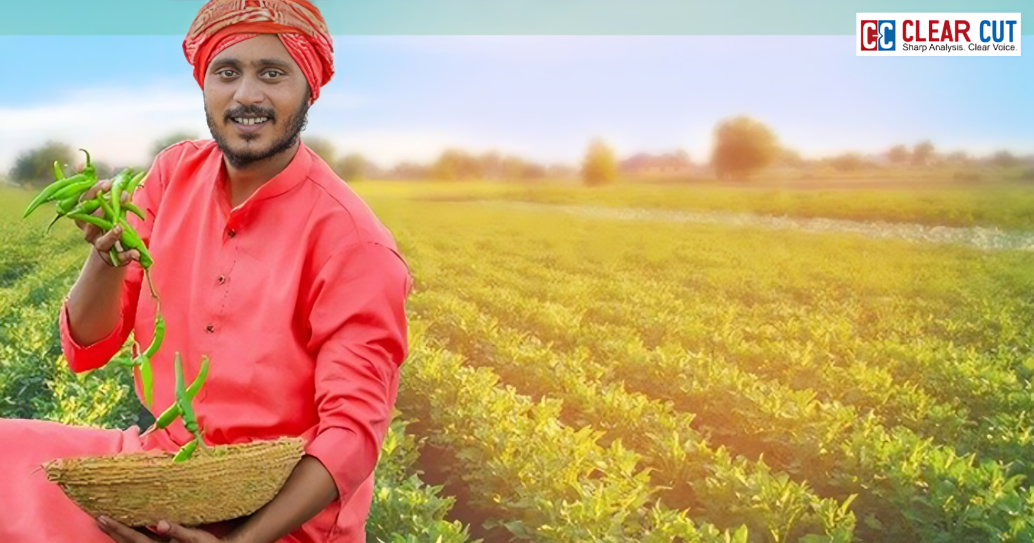
- DeHaat, founded by Shashank Kumar, is transforming Indian agriculture by helping smallholder farmers access quality inputs, AI-driven advisory, and direct market connections.
- Starting with just 14 farmers in Bihar, DeHaat has expanded across multiple states, reaching millions of farmers through its network of rural entrepreneurs and digital farming infrastructure.
- By improving price transparency, crop planning, and supply-chain access, DeHaat is building a more sustainable and profitable future for farmers in India.
There is a particular kind of ambition that builds for the field, the village lane, the farmer who has never once seen his soil analysed or his crop priced fairly. Shashank Kumar has carried that ambition since 2012. It is the same year he walked away from a career in management consulting.
He gave up the salary, the firm’s clientele, and the comfortable distance from rural India that his IIT Delhi degree had made available to him. He was in his mid-twenties. What unsettled him was not a crisis report or a policy document. It was something far simpler, and therefore far heavier.
He had gone home to Bihar. He had watched farmers who woke before dawn, who understood their soil in ways no algorithm could replicate, and who still could not get a fair price for what they grew. The seeds they bought were counterfeit. The advice they received was generic.
The go-betweens who bought their harvest set the price. The farmer, who bore all the risk, received the smallest share of the reward. Shashank Kumar did not look away from that picture. He walked toward it. He has been walking in that direction ever since.
A Problem That Refused to Stay Invisible
India grows food for 1.4 billion people. It is one of the world’s largest agricultural producers, contributing 18% of its GDP and employing 44% of its workforce. Yet for decades, the farmer at the centre of this system has been its most underserved participant. The average smallholder in Bihar, where DeHaat was born, cultivated less than 0.5 hectares of land, and earned Rs 70,000 annually. Access to structured credit was available to fewer than eight percent of farmers. Counterfeit seeds circulated freely. Crop advisory, when available, was generic and disconnected from what a specific farmer had planted in a specific season. When it was time to sell, farmers had no mechanism to verify market prices and no bargaining power against layers of intermediaries who extracted margin at every step.
That professional vantage point showed him the institutional buyer’s side: large companies unable to source quality, traceable produce directly from farmers. The gap was mutual. And it was structural. Nobody had built anything to close it.
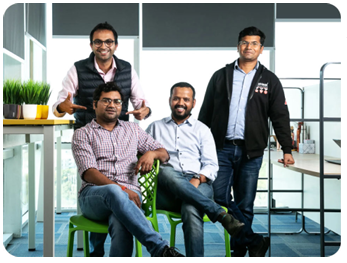
In 2012, he and his co-founders, Amrendra Singh, Adarsh Srivastava, Shyam Sundar Singh, and Manish Kumar, alumni of IIT, NIT, and IIM institutions, incorporated Green Agrevolution Pvt. Ltd. and launched the DeHaat concept. The name itself was a statement. DeHaat means rural area in Hindi. They were not building for urban consumers or institutional investors. They were building for the farmer who had, for decades, been the least consulted person in the agricultural supply chain.
The Fourteen Farmers Who Started Everything
No headline captures a beginning as faithfully as its actual numbers. DeHaat’s first year of active field work, in 2010 under the predecessor initiative FarmsnFarmers, began with fourteen farmers in Vaishali district, Bihar. These were not early adopters in the technology sense. They were skeptical men who had inherited their skepticism honestly. Every previous promise made to Indian farmers by extension services, government schemes, and input dealers had arrived incomplete. Why would a 24-year-old from IIT Delhi be any different? The early DeHaat team answered that question not with presentations but with presence. They went into villages. They sat with farmers through crop cycles. They conducted soil testing. They helped farmers shift from commodity crops to higher-value alternatives based on actual market demand.
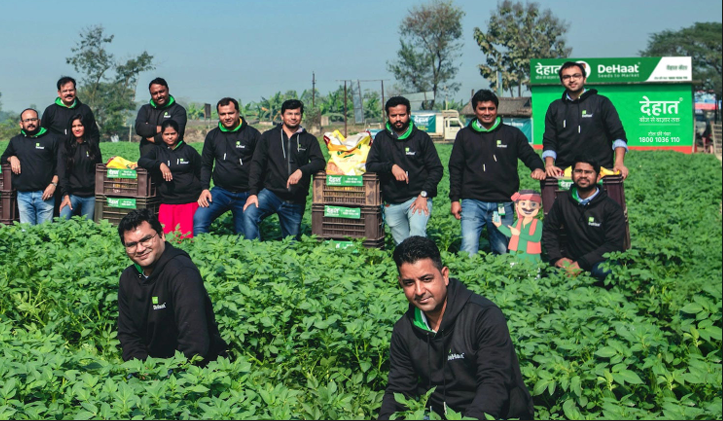
In one district, farmers who grew baby corn and sweet corn instead of traditional maize reduced their harvest cycle from 150 days to 60-100 days and improved their returns per unit of land. The yield improvement across early adopters was documented at 20 percent. The cost saving on inputs was 10 to 15%. The farm-gate price discovery improved by 12 to 15%.
The Architecture of a Full-Stack Solution
Most platforms pick a part of a problem. DeHaat picked the whole thing. The platform was designed from the start as a full-stack agricultural solution, integrating every touchpoint in a farmer’s annual cycle: soil analysis, crop planning, procurement of quality inputs, real-time advisory, access to credit and insurance, aggregation of produce, and connection to institutional buyers. The phrase they use internally is “seeds to market.” It is not a slogan. It is a literal description of the service architecture.
The physical infrastructure of DeHaat is built on a franchise model using local micro-entrepreneurs, called DeHaat Centres, run by people who are often from the same villages as the farmers they serve. This is not incidental. It is strategic. Trust in rural India is relational and local.
A DeHaat Centre operator who grew up in the same district as his customers is not a service agent. He is a peer. Each centre covers a catchment area of six to eight kilometres and serves up to one thousand farmers. The operator earns a sustained livelihood by acting as a last-mile service provider for inputs, advisory, and procurement.
Layered over this physical network is a digital infrastructure of significant scale. DeHaat’s AI-enabled platform delivers crop advisory in multiple regional languages for over 30 crop varieties. It integrates weather data, pest alerts, soil health information, and market price intelligence into personalised recommendations for individual farmers. The platform has been built iteratively, trained on years of ground-level crop and input data collected through the DeHaat Centres before any algorithm was deployed.
From Bihar’s Blocks to Twelve States
By 2019, DeHaat had grown to serve approximately 65,000 farmers across Bihar, Uttar Pradesh, and Odisha. Revenue had reached Rs. 42 crore. The first institutional funding round of Rs. 30 crore, led by Omnivore, had arrived. The model had reached its product-market fit. What followed was a deliberate and disciplined expansion. By FY2021, revenue had grown eightfold to Rs. 358 crore. The platform crossed 400,000 registered farmers. By FY2024, total revenue had reached Rs. 2,720 crore, representing a 36 percent year-on-year increase. The company had expanded to 15,000 DeHaat Centres across 11 states. Daily farm produce aggregation had doubled to 6,000 metric tonnes.
The number of farmers served had grown to 2.7 million. The acquisition of the digital advisory platform AgriCentral pushing total farmer reach to over 13 million, approximately 15% of India’s farming population. Total funding raised has crossed USD 222 million, with investors including Temasek, Prosus Ventures, and Trifecta Capital. The company’s last reported valuation was USD 700 million.
These numbers stand for compounded decisions, not compounded luck. Field pilots preceded each state expansion. Each acquisition was chosen to fill a specific capability gap, whether in export infrastructure, digital advisory, or food processing. The co-founders have described the acquisition philosophy as integration without erasure: keeping the people, the local knowledge, and the organisational culture of every company they absorbed.
The Supply Chain That Was Never Transparent
Before DeHaat, the supply chain connecting Indian farmers to Indian consumers had a specific dysfunction. It was invisible to the farmer. He grew the crop. A chain of intermediaries — commission agents, traders, brokers, wholesalers — moved it to market. At each step, a margin was extracted. The farmer received what was left after every other participant had taken their share. He had no access to price discovery. He had no alternative channel. He had no documentation that could help him borrow against his produce.
DeHaat’s market linkage infrastructure changed this in a quantifiable way. By aggregating produce through its network of centres and FPOs, the platform provides farmers with price transparency and direct access to institutional buyers. Buyers on the platform include companies across FMCG, food processing, export, and retail sectors.
The daily aggregation of 6,000 metric tonnes of farm produce running through the network represents a volume that gives farmers genuine bargaining presence. Inputs sold through DeHaat — more than 3,000 stock-keeping units from over 2,000 agribusiness companies — are vetted for quality, addressing the counterfeit problem that had eroded farmer trust in the input market for decades.
The export dimension is equally significant. DeHaat’s produce reaches over 15 countries, including the UK, European markets, Russia, the Middle East, and Thailand. For a smallholder farmer in Bihar who previously sold his vegetables to the nearest district mandi at a price set by a trader, access to international price benchmarks represents a structural shift in economic positioning.
The Micro-Entrepreneur Who Changed His Village
There is a dimension of DeHaat’s impact that aggregate statistics do not fully capture. It is the one at the level of the individual DeHaat Centre operator. These are young men and women, typically from the same villages they serve, who have been trained and equipped by DeHaat to run viable agri-service businesses.
They are not employees. They are franchisees. They earn based on the transactions they facilitate inputs sold, produce aggregated, advisory delivered.
The model creates a specific kind of rural entrepreneur. One who does not need to migrate to a city to build a livelihood. One whose success is materially aligned with the success of the farmers around him. The network of more than 11,000 such centres, spread across 126,000 villages, represents one of the largest experiments in structured rural entrepreneurship in India’s private sector.
The model creates a specific kind of rural entrepreneur. One who does not need to migrate to a city to build a livelihood. One whose success is materially aligned with the success of the farmers around him. The network of more than 11,000 such centres, spread across 126,000 villages, represents one of the largest experiments in structured rural entrepreneurship in India’s private sector.
The Political Arithmetic of Farmer Welfare
India’s agricultural policy debate has, for decades, oscillated between two poles: price support mechanisms that benefit politically organised farmer communities, and structural reforms that have consistently stalled against rural resistance.
The gap between stated policy intent and ground-level farmer welfare has remained durable across governments and election cycles. DeHaat operates in that gap. It does not carry a political identity. But the outcomes it produces are directly relevant to India’s most persistent policy challenge.
When a platform enables a farmer to access certified seeds, personalised crop advisory, institutional credit, and direct buyer access through a single interface, and when that access reduces the cost of cultivation while improving the realisable price, it is doing, at scale and with market discipline, what government extension services and agricultural marketing reforms have struggled to do through mandate. The alignment with national priorities is explicit in the recognition DeHaat has received from NITI Aayog, which listed the platform in its Frontier Technology Repository as a model for AI-driven agricultural transformation. India’s Digital Agriculture Mission, launched in 2021, identifies platforms like DeHaat as components of the country’s infrastructure for modernising smallholder farming.
The company has also contributed to state-level agricultural policy discussions in Bihar, Uttar Pradesh, and Rajasthan, drawing on its data assets on crop cycles, input demand, and price volatility across districts. The scale of the challenge, however, remains. An estimated 160 million smallholder farmers in India remain outside the reach of formal agritech platforms. The COVID-19 pandemic disrupted two decades of progress in rural income stability.
Climate volatility has shortened predictable crop cycles across the Indo-Gangetic plains. DeHaat’s expansion into Southern India and its drone-based field monitoring partnerships — including its 2023 collaboration with Drone Destination to deploy 250 agricultural drones across its network — represent responses to a problem that is not static.
What the Farmer Feels
There are datasets that frame DeHaat’s reach. There are also stories within them that the datasets cannot hold. There is the farmer in Vaishali who switched from wheat to a high-value vegetable crop on the advice of a DeHaat agronomy off icer, received a soil health report for the first time in his life, and increased his per-acre income by more than 30 percent within two seasons.
There is the woman in Madhya Pradesh who became a DeHaat Centre operator, built a client base of 400 farmers in her block, and now earns more than she would have through any alternative livelihood option available to her in the same geography. There is a village in Odisha where the DeHaat Centre replaced the single agri-input dealer who had no competition and no accountability, and where farmers now compare prices digitally before every purchase.
Shashank Kumar has said that the quality of a farmer’s decision depends entirely on the quality of information available to that farmer at the moment of decision. A farmer choosing a seed variety in March, a planting date in April, or a selling price in October is making a decision with consequences that last a full season.
For most of India’s agricultural history, the farmer made those decisions with the least information of anyone in the supply chain. DeHaat’s core proposition is simple: give the farmer the same information advantage that every other participant in the chain already has.
“From soil to supply chain, DeHaat™ is redefining Indian agriculture—empowering millions of farmers with AI-driven solutions, deep-rooted networks, and a vision that turns grassroots impact into a nationwide revolution.”
Recognition That Did Not Change the Direction
DeHaat has been named among the most innovative agritech companies in India by Forbes. It has received recognition from the Bill and Melinda Gates Foundation for its impact on smallholder farming. NASSCOM has cited it as a leading example of technology-enabled rural transformation. The platform has been featured in the Economic Times, Business Standard, and international agritech publications as a case study in full-stack agricultural infrastructure. Great Place to Work certified DeHaat for two consecutive years, 2022-23 and 2023-24, an acknowledgment that an organisation building in one of India’s most difficult operational environments had also built an internal culture worth naming. Its GMV crossed Rs 3,000 crore in FY2025, with operating losses reduced by 15 percent to Rs 207 crore — a signal that the economics of the model are converging toward sustainability as it scales.
Shashank Kumar has spoken at the World Economic Forum. He has addressed global food security summits. He has met with heads of state. Each of these platforms has been used to make the same argument: that solving smallholder agricultural inefficiency is not a philanthropic question. It is an economic opportunity of the first order. Investors, governments, and institutions that treat it as a development obligation rather than a commercial priority will consistently underestimate its scale and misdesign their interventions.
The Field That Has Not Yet Been Reached
DeHaat is not finished. The numbers make that plain. India has approximately 100 million smallholder farm households. DeHaat, with its post-acquisition reach of 13 million farmers, is touching roughly 13 percent of that population. The remaining 87 percent represents not a margin of incompleteness but a statement of the work still to be done.
The company’s stated goal is to serve and empower more than 10 million farmers actively within the next five years. It is expanding into Southern India, a region with a different crop profile, different language landscape, and different market structure from the eastern and central states where DeHaat first built its credibility. Each new state requires the same patient ground-level work that Bihar required in 2012: building trust, training local operators, mapping local input supply chains, and connecting district-level produce to regional and national buyers. It is also responding to a crisis it did not cause. Climate change has made Indian agriculture less predictable season by season. Rainfall timing is shifting. Pest and disease patterns are changing. Soil health is declining in many districts due to input overuse.
cal input supply chains, and connecting district-level produce to regional and national buyers. It is also responding to a crisis it did not cause. Climate change has made Indian agriculture less predictable season by season. Rainfall timing is shifting. Pest and disease patterns are changing. Soil health is declining in many districts due to input overuse.
The company has also acquired AgriCentral, a digital platform with a base of 10 million farmers, to accelerate engagement through mobile-first channels. Seven acquisitions in total. Each one chosen to build capability, not just scale.
The Soil That Started Everything
There is something quietly extraordinary about a company that holds its founding image this clearly after more than a decade. Most startups lose the original problem statement somewhere between the Series A and the Series C. It becomes an investor slide rather than an operating principle. DeHaat has kept the Bihar farmer in focus across twelve states, seven acquisitions, and USD 222 million in funding.
to understand DeHaat is to understand something about the moral weight of proximity. Shashank Kumar did not invent the problem of Indian agricultural inequality. He did not discover that smallholder farmers were systematically disadvantaged in input markets, credit markets, and produce markets simultaneously.
But he chose, in his mid-twenties, to stop treating it as someone else’s problem. He drove 70 kilometres a day into villages. He sat through failing pilots. He waited six years for product-market fit. That choice has reached 13 million farmers. It has built 11,000 rural enterprises. It has moved Rs 3,000 crore of agricultural produce through a supply chain that, before DeHaat, offered smallholder farmers no visibility and no leverage. It has demonstrated, at a scale that cannot be dismissed as anecdotal, that the technology available to the world’s most advanced economies can be made to work in the fields of Bihar and Uttar Pradesh — not through charity, but through a business model that succeeds only when the farmer does. India produces enough food. What it has not yet produced, at anywhere near sufficient scale, is the infrastructure that ensures t h e people who grow that food share fairly in its value. DeHaat is building that infrastructure. One DeHaat Centre at a time, one crop season at a time, across a coun-t r y whose fields have always known how t o grow, and now, for the first time, are beginning to know how to profit.
Clear Cut Startups, Livelihood Desk
New Delhi, UPDATED: May 25, 2026 09:00 IST
Written By: Tanmay J Urs