
- India’s social protection coverage has increased to 65.3% in 2026, but the figure mainly reflects access to at least one welfare benefit and does not necessarily guarantee adequate or continuous social security.
- Despite progress, challenges such as low pension amounts, limited support for informal workers, fragmented welfare databases, and outdated beneficiary lists continue to weaken the effectiveness of India’s social protection system.
At 65.3% in 2026, up from 22% in 2016, India’s population covered by social protection schemes shows an almost three-fold increase over a decade – that’s the government’s interpretation based on the Sustainable Development Goals – National Indicator Framework (SDG-NIF) Progress Report by the Ministry of Statistics and Program Implementation (MoSPI) on the country’s 20th Statistics Day. But, SDG indicator 1.3.1 measures a less nuanced aspect than typically covered by “welfare net”: “proportion of individuals receiving at least one social protection benefit at any time during the reporting period” – whether it’s paid (contributory) or non-paid (non-contributory), or whether it was consistent or enough.
The UN measure for “coverage” focuses on cash transfers and support related to child and maternity care, unemployment, disability, work-injury, and old-age pensions, and is collected from administrative sources rather than household surveys. Based on that, a single voucher for subsidised food grains or a single Ayushman Bharat claim would be treated as “covered”, without any income security. The rate of progress also counts: MoSPI’s Report itself reported 64.3 percent coverage in last year’s survey, so the current number represents an incremental jump, barely beyond one point. At 65.3 percent, India is ahead of the global average of 52.4 percent (ILO’s World Social Protection Report 2024-26), which is an improvement from 42.8 percent in 2015, and real progress at that.

The Informal majority
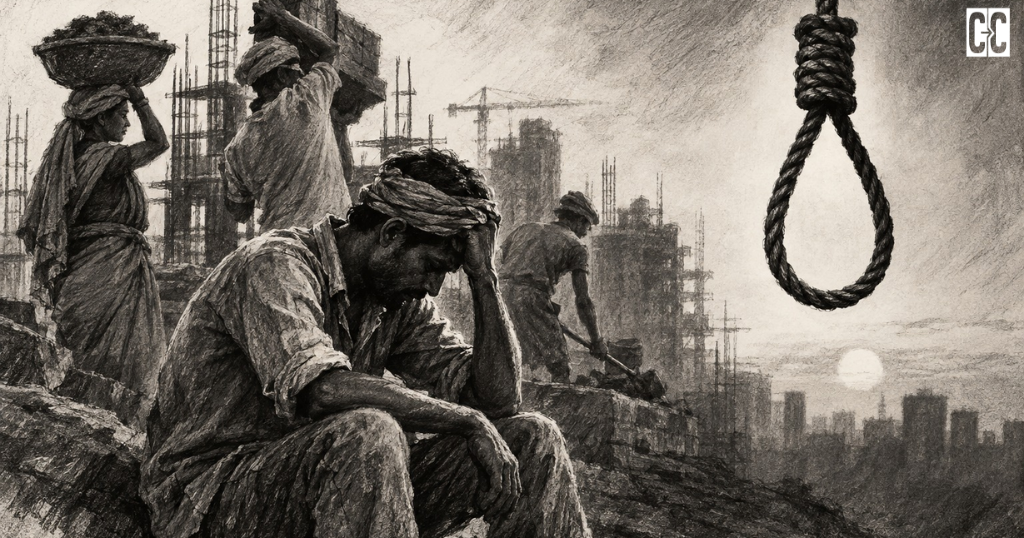
The reasons for this lag are in the labour market. About 90% of the workforce is informal – that means there is no employer-provided pathway for them to enrol in contributory insurance schemes, the ILO’s India office states. Economist Santosh Mehrotra puts it at 91% of a workforce of 520 million people, and says that even the Code on Social Security, 2020 (which attempts to provide a universal framework for the organized and unorganized sectors) doesn’t quite get us there.
Efforts like the e-Shram portal, rolled out in 2021 to register informal workers and provide portable benefits. The Karnataka gig-worker welfare bill of 2025 are important steps to fill the void. How those registrations turn into actually claimable entitlements is more complicated.
The Spot Where It Bites the Most
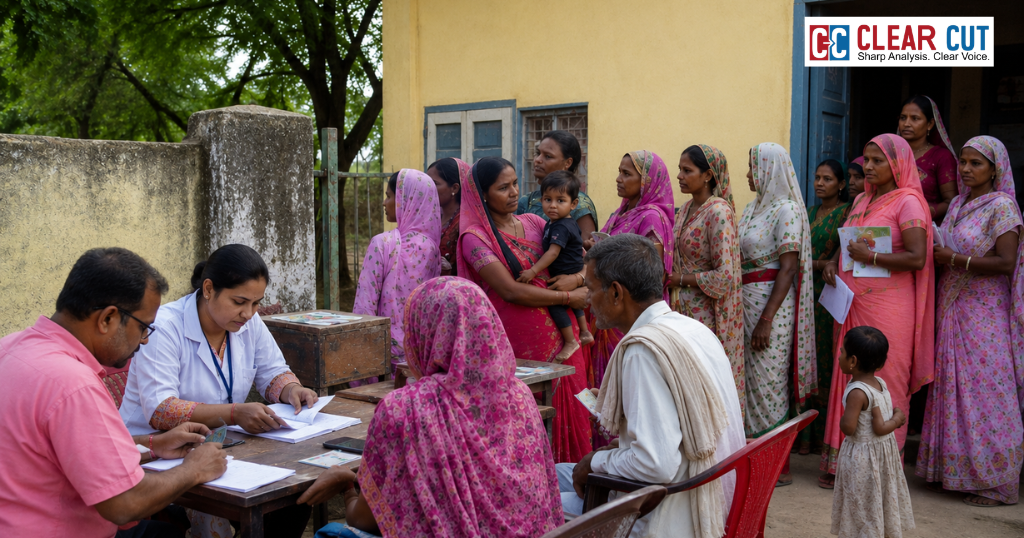
The pension scheme brings the gap to the concrete and visible: The Centre’s non-contributory old-age pension has remained constant at 200/month since 2007, while widow and disability pensions remain at 300/month since 2012 – not only have these not been revised, but they have not even been indexed for inflation since. Research published in July 2026 by the Centre for the Study of the Indian Economy, Azim Premji University, says the 2001 Census data set the beneficiary ceiling for the scheme and only covers 3.09 crore people, when the India Aging Report 2023 said nearly 14.9 crore are old adults, with 18.7 percent of them saying they have zero income. The states’ additional amounts bring the actual coverage to just 8.95 crore. Another relatively recent exclusion identified in the same study is existing pensioners being kicked out due to Aadhaar-linked identification errors. As Amartya Sen and Jean Drze have repeatedly demonstrated, social security entails “the use of social means to prevent deprivation and vulnerability,” going far beyond compensating for income losses.
A Different Blueprint: The Single Registry in Brazil
Brazil encountered a similar issue from an almost identical starting position: nearly 50 percent of the workforce in Latin America operates in the informal sector (OECD). Instead of maintaining separate databases for different schemes, Brazil developed the Cadastro nico (unique registry), which registers workers along with their formal jobs and household characteristics. This system prevents beneficiaries from falling through the cracks when they switch between formal and informal work.
That registry serves as the foundation for Bolsa Família, Brazil’s conditional cash transfer program, which directs about 73 percent of payments to the poorest quintile of households.
In the meantime, the number of families increased from approximately 4.5 million in 2004 to almost 20.8 million in 2024. But the foundational structures on which these systems operate in India, such as the e-Shram (unorganized workers database), PM-JAY (health insurance scheme), PDS (public distribution system), and the NSAP (national social assistance program), continue to exist in silos. A Coverage Rate can continue to grow even when benefit amounts decline in value, lists of entitled individuals aren’t updated, and new digital controls quietly purge those previously enrolled. The Rajasthan Minimum Guaranteed Income Act, 2023 – a first-in-the-country law mandating an inflation-indexed pension as an entitlement, not a benefit – illustrates a path the country could be heading toward for near-future reform. Until updated recipient numbers, updated benefit amounts, and compatible data systems are matched with the publicised percentage, the claim that India’s welfare net has expanded significantly enough is only partially true.
Clear Cut Health Desk
New Delhi, UPDATED: July 10, 2026 09:00 IST
Written By: Yatharth Pathak