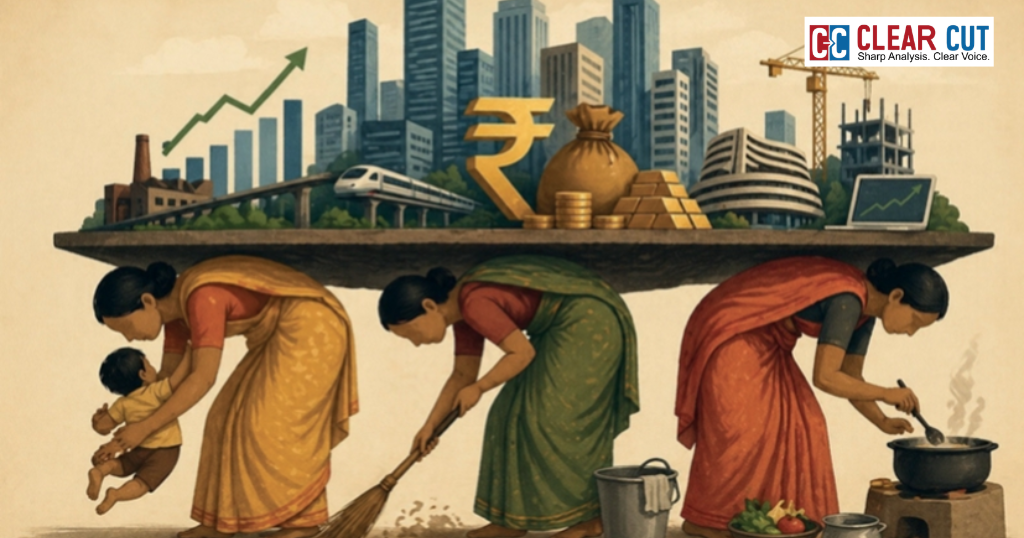
- Unpaid care work remains one of India’s biggest hidden gender challenges, with women spending significantly more time on household and caregiving responsibilities than men.
- This unequal burden limits women’s education, career growth, and workforce participation, highlighting the need to recognize care work as essential labour.
- Achieving gender equality requires shared household responsibilities, supportive policies, and a shift in social norms so that care work is valued and distributed more fairly.
In the story of India’s rise, one form of labour remains largely unseen: unpaid care work. As Indian women advance in education, careers, and public life, they continue to be assigned primary responsibility for day-to-day cooking, cleaning, the care of the elderly, the young, and the disabled, and for household coordination. That concealed labour is today the defining issue for women and men, in India and beyond. UNDP Report – decade-stagnation-new-undp-data-shows-gender-biases-remain-entrenched?
Why is it a Problem?
In 2019, because the labour isn’t shared, Indian men reported spending 2.8 hours a day on domestic and care work, and women reported 7.2 hours.
Globally, according to the UNDP, women devote 2.6 more hours to this work than men each day, whether or not they are employed. The price of all those hours isn’t just that people will be tired – it’s that those hours will be paid for at the expense of their education, job trajectory, career earnings, life earnings, or power status. “Care is not sentimental labour,” a UNDP report released said. “It is the infrastructure that allows people to show up at jobs, in classrooms, and in public life.” UNDP Report
Why is this trend significant
Gender conversations in India have, in recent years, indicated evolving perspectives on gender, though gradually. ORF India’s analysis of the matter pointed out that while gender roles in the country had evolved over the course of the 21st century, many within the household, however, continued to be traditionally defined. It could manifest as aspirations of career and personal development interwoven with domestic obligations. ORF – Gender Attitudes in India
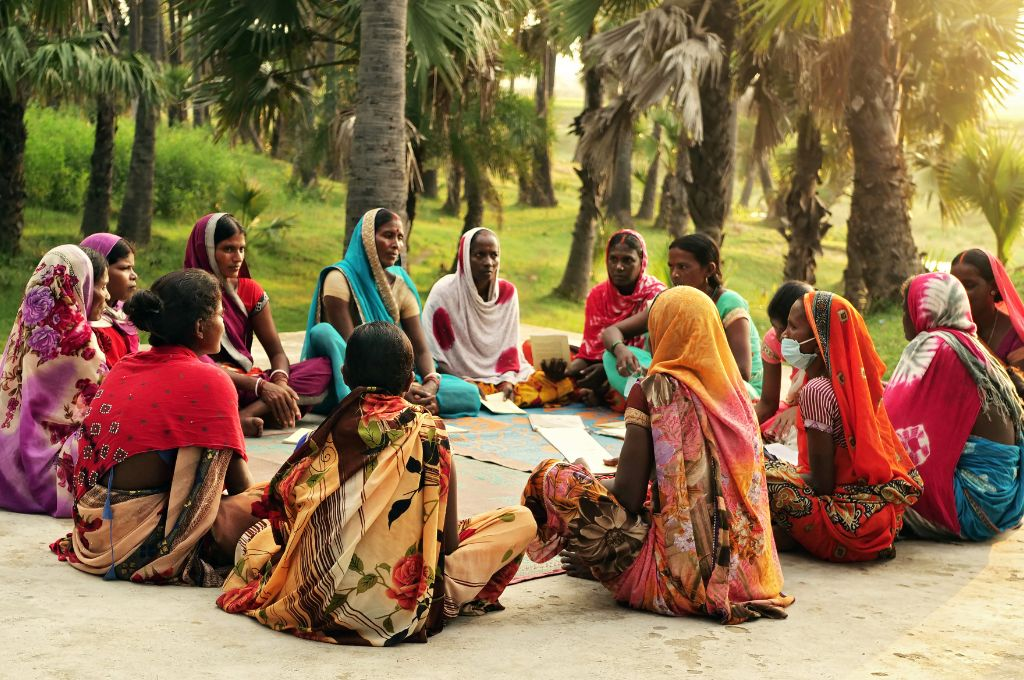
Researchers often refer to the result as a care gap, in which women are encouraged to thrive in the paid economy while remaining burdened with unpaid household duties, leading to issues with women’s participation and continuity in the workforce. It is a challenge, especially highlighted among urban and middle-income families. In terms of the economy, too, UNDP India mentioned.
What do others say about change?
The UNDP in India says perhaps the most powerful point of all, “care systems can’t outrun social norms.” For service-delivery-based changes to succeed, they cannot ignore the norms around who in the household is expected to care. In short, they can’t solve or care for children and welfare in the country without men pitching in on the side of caring.
In more general terms, Lakshmi M. Puri explains why: “India cannot have an Atmanirbhar Bharat without Atmanirbhar girls and women.” The former is “essential for achieving the latter; for human beings cannot survive as a species at the cost of losing one-half of the world’s human and their capacity of creativity and work and passion,” and the latter is “essential not for her own welfare alone.” Or back to a very old point from Arundhati Roy, “A political struggle that does not have women at the heart of it, above it, below it and within it, is no struggle at all.” Today, this quotation is perfectly appropriate for the debate about care because equality is not a slogan; it has to mean equality in the lifetime of an ordinary citizen. Via Business Standard
A Change from Home
There is some hope. Flexible working and more generous childcare and parental leave will reduce some of the burdens for mothers, more and more fathers are taking a greater share of the housework, but what we most need to change is what goes on in our houses. Currently, care still rests on the shoulders of women, assumed as a female responsibility.
Which is why gender equality in 2026 isn’t just about getting equal education or opportunities at work; it’s also about time, labour, and fairness within homes. For inclusive growth, India needs to acknowledge that care work is labour and get more men to join in.
Clear Cut Gender Desk
New Delhi, UPDATED: July 09, 2026 09:00 IST
Written By: Clear Cut Team