
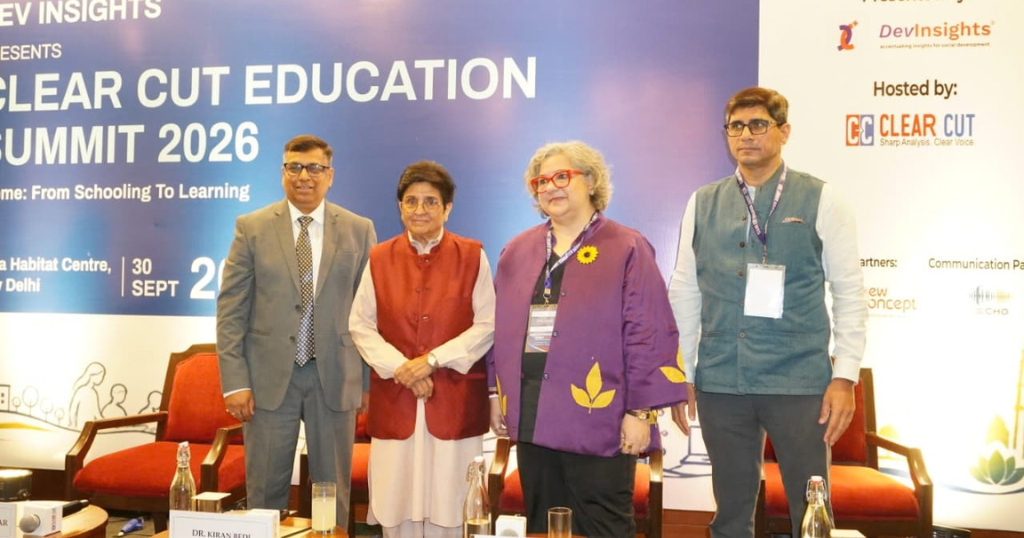
At the inaugural Clear-Cut Education Summit 2026 in New Delhi, education leaders, practitioners, researchers and innovators called for a wider understanding of learning one that goes beyond enrolment, examinations and foundational skills to include thinking, inclusion, character, technology, evidence and the realities children face outside school.
New Delhi, October 1, 2026: Getting children into school is no longer enough. The larger challenge is to ensure that they learn, think, question, and develop the skills and values needed to navigate a rapidly changing world. That message ran through the inaugural Clear-Cut Education Summit 2026, held at the India Habitat Centre in New Delhi on September 30.
Built around the theme “From Schooling to Learning,” the Summit brought together voices from government, education, civil society, research, CSR and philanthropy. The discussions ranged from foundational learning and inclusion to artificial intelligence, financing, and scaling successful education models.
The central question was simple: What does meaningful learning really mean? Opening the Summit, Paresh Kumar, Managing Editor of Clear-Cut Magazine and CEO of DevInsights, argued that learning cannot be understood only through what happens inside a classroom. A child’s family, access to school, teachers, and the wider environment all influence a child’s ability to learn. The challenge, he said, is not new. What is needed is a willingness to ask harder questions and translate conversations into action.
Kiran Bedi: Bring real lives into education
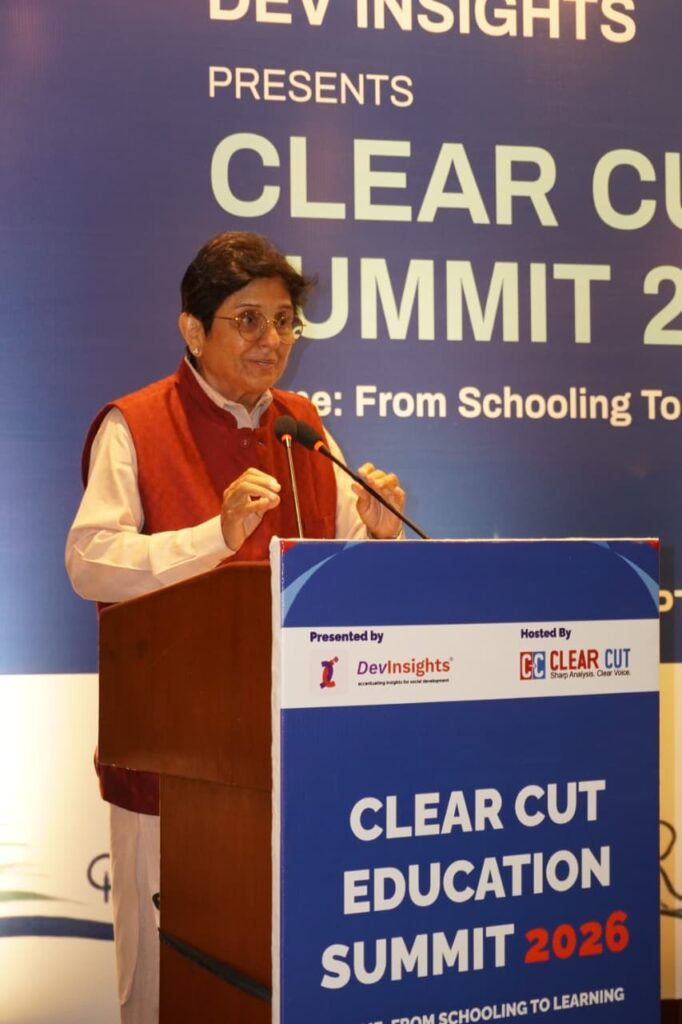
Chief Guest Dr Kiran Bedi placed character building at the heart of education. She called for greater use of films, documentaries, biographies, autobiographies and visual storytelling in schools. Children, she argued, should encounter real stories of courage, resilience, responsibility and leadership. “For me, education should use three forms of learning material – one, films and documentaries; two, biographies and autobiographies; three, Amar Chitra Katha and visual storytelling – see life, read life and know the story,” Bedi said. Bedi subsequently described her approach as a model of watching, reading and reflecting, with documentaries and stories of people of character becoming part of learning. Her argument widened the discussion beyond academic achievement. Education, she suggested, must also help shape character, citizenship and responsibility.
Senior journalist and author Kaveree Bamzai brought another dimension to the opening conversation: listening to young people. “We owe them our time, and we need to listen to them – they need our ears and empathy and not our neglect,” she said. She also questioned why existing school spaces could not give children a stronger voice. Even school assemblies, she suggested, could become spaces where children speak, and adults listen.
Dr Rishikesh Patankar drew attention to the connection between education, skills and employment. He stressed the need to prepare young Indians for an evolving world of work and called for stronger skills development. The panel then asked a fundamental question: what should count as learning? Foundational literacy and numeracy remain essential. But speakers argued that education cannot stop there.
Dr Dhir Jhingran, Founder and Executive Director of the Language and Learning Foundation, asked whether schools could build on the distinctly human strengths of “curiosity, creativity,” as well as other higher-order abilities. The panel argued for greater attention to reasoning, questioning, application, and critical thinking, particularly in the early years. It also challenged the tendency to measure learning only through the child.
S. Raghavan argued that the entire learning ecosystem needs to be examined. Teachers, schools, and systems also need to learn and adapt. Assessments should therefore help understand a child’s experience rather than merely compare the child against a grade-level benchmark.
Chaitanya Kumar Prasad stressed the need to move from information delivery to meaningful engagement. In a world of information overload, he argued, communication around education needs to be accessible, multilingual, and two-way.
Start where the Child Is
Evidence from the ground brought the debate closer to the everyday realities of children.
The Summit’s “Reality Check” session highlighted how poverty, migration, inadequate civic services and difficult family circumstances can shape a child’s ability to learn. One message stood out: start where the child actually is, not where the curriculum assumes the child should be. The discussion emphasised the importance of first understanding what a child can do. Teaching can then build from that level.
It also highlighted the role of families. Parents should not be seen as being outside the education system. Mothers, in particular, can become important partners in children’s learning. Assessment, the speakers argued, should also serve a practical purpose. It should help teachers understand children better and change how they teach.
Inclusion means more than getting a child into school
Another recurring concern was that access alone does not guarantee inclusion. A child may be enrolled in school and still struggle to participate or learn. The panel on equity and inclusion examined physical, intellectual, and social barriers. It also drew attention to children whose disabilities may not be immediately visible. “Accommodations are not provided when disability is invisible,” said disability rights advocate Nipun Malhotra.
The discussion, moderated by Parvati Chandran, brought together Arjun Sanyal, Merry Barua and Malhotra. It called for changes not only in classrooms but also in attitudes, regulations, and the wider education system. The broader message was that different children face different barriers. Inclusion cannot, therefore, be delivered through a single standard intervention.
AI can assist teachers. It cannot replace them
Artificial intelligence inevitably entered the conversation. But the discussion did not frame technology as a substitute for teachers. “The teacher is the universe through which the student sees society, and that cannot be replaced,” said Nuriya Ansari, CEO of Bharti Airtel Foundation. The panel examined how AI could support assessment, reduce some of the burden on teachers and enable more personalised learning. But speakers also raised concerns about unequal access and the risk that technology could widen existing gaps.
Saurabh Singh of Mantra4Change argued that technology must begin with the problem, rather than the product. Solutions also need to be designed with scale in mind and in partnership with the government. Children, he added, should be “co-designers” of learning rather than passive consumers of content. Technology can support learning. It cannot reproduce the human relationships and collective experience that a classroom provides.
Why good pilots do not always scale
A related question followed: India has no shortage of promising education programmes. Why do so many struggle to grow beyond pilots? The “What Scales?” session pointed to government ownership as one of the critical conditions for scale. Pilots can demonstrate what works. But wider adoption requires government participation, institutional capacity and adaptation to local conditions.
The discussion also cautioned against simply copying a successful model from one geography to another. Infrastructure differs. Resources differ. Teachers and communities differ. Successful scaling, therefore, requires attention to the entire school ecosystem. Civil society can test ideas, build community engagement and demonstrate models. The government can provide the mandate and resources needed to take them wider.
More money alone will not solve the problem
The final policy discussion turned to financing. Government remains the principal funder of education. CSR and philanthropy can play important roles, but speakers cautioned against seeing them as substitutes for public systems. “CSR funding can only be catalytic; it can never solve the problem,” said Dr Pratibha Narayanan.
Dr Antony Nellissery argued that sustainability must be considered from the beginning of a programme rather than when funding is about to end.
Ratna Vishwanathan called for a systems perspective. “Unless there is a system focus to look at the big picture, we will be wasting money and time of stakeholders,” she said. The discussion shifted the question from how much is being spent to what the money is being spent on. Teacher capacity, foundational learning, data, behaviour change and stronger systems emerged as important priorities.
From conversation to action
The day closed with a keynote by author and educator Shiv Khera under the theme “From Learning to Doing: Preparing Young India for the Real World,” followed by the Clear-Cut Education Awards. Across the day, there was no suggestion that India’s education challenge has a single solution.
Instead, the discussions repeatedly returned to the connections among the child, teacher, family, school, government, and the wider social environment. Learning cannot be reduced to attendance. Nor can it be reduced to completing a textbook or passing an examination. It must include the ability to understand, think, question, and apply. It must make room for children who learn differently. Technology must serve that purpose rather than define it.
Funding must strengthen systems rather than chase trends. And evidence must help educators see what is actually happening on the ground. That may ultimately be the harder part of moving from schooling to learning. Getting children into classrooms was one challenge. Ensuring that every classroom becomes a place where every child can genuinely learn is the next step.
Clear Cut Education Desk
New Delhi, UPDATED: October 01, 2026 18:30 IST
Written by: Clear cut Admin Desk