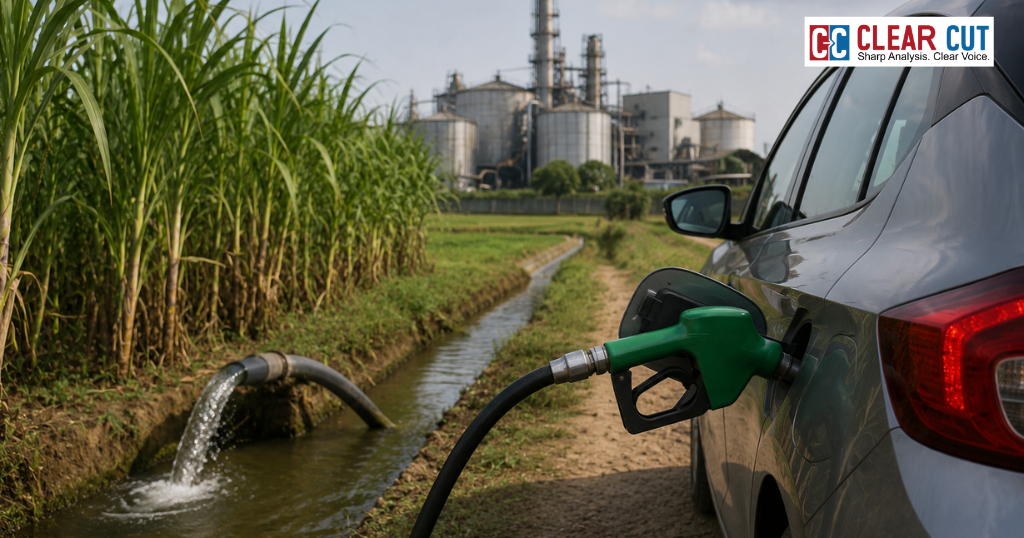
Even as the government battles back on E20 petrol from mileage complaints, the real struggle for the biofuel is on fields and water beds in India and elsewhere.
New Delhi, July 10, the Indian Ministry of Petroleum and Natural Gas admitted for the first time that its new E20 fuel (petrol blended with 20 percent ethanol) may affect the mileage of certain vehicles to the extent of three to five percent, in an unusually direct statement issued in a Q&A paper to counter mounting social media allegations of a 30 percent loss. At the same time, it added that it continues to be a cleaner, higher-quality, and more efficient fuel, with a higher-octane content that enables higher combustion rates and roughly a 40 percent reduction in lifecycle carbon emissions.
What the ministry omitted was to disclose the per-litre cost at the pump, since E20 is not cheaper than normal petrol at all, as ethanol prices are kept high enough to ensure farmers keep producing and selling the fuel to OMCs. The move to mandate a nationwide usage of E20 fuel, which has had unusually fast rollout, from a small pilot of five percent in 2003 to 10 percent blend from June 2022 – almost five months ahead of its deadline, India achieving 20 per cent blend in a full rollout by 2025 – five years ahead of schedule to the 2030 target in the National Policy on Biofuels – has benefited it in terms of savings in foreign exchange of Rs 1.97 lakh crore and reduction of 316 lakh tonne in crude oil imports and Rs 1.66 lakh crore transferred to farmers from 2014-15 as stated by the ministry figures.
The reasoning for supporting farmers is also central to an expanding social argument. The 2023-24 drought mandated the government to curb the diversion of sugarcane for ethanol production, driving the program toward grain inputs: Maize and rice now provide about 65% of India’s ethanol (an almost zero share a decade earlier), with nearly 29% of the nation’s total maize crop being marked for fuel in 2024-25. The FCI is said to be selling excess rice to distilleries for about ₹23 per kilogram compared with an acquisition cost of nearly ₹41 – a difference that Ashok Gulati, agricultural economist at ICRIER, calls “the most irrational policy that the government has”, and one that “hides its real cost using power and fertiliser subsidies”. Then comes the water, with NITI Aayog placing rice-based ethanol consumption at more than 10,000 litres of water per litre of fuel – more than three times that of sugarcane – further stressing the country’s over-exploited or critical aquifers in Punjab, Haryana, Maharashtra, and Karnataka. Officials from the all-India distiller’s association defend the shift: Bharti Balaji of the association notes that “the maize farmer, he had no guaranteed buyer, and now spreading it out to 12-13 states reduces its vulnerability”, even though energy economics and finance researchers argue that “in a country like India where people do not get enough food, to use food grains for energy production cannot be considered ideal”.
Lessons from Elsewhere
But India is not the only nation balancing these factors. Brazil’s Proalcool program, implemented following the 1975 oil shock, created the world’s most sophisticated sugarcane economy – Brazil uses an estimated 27% sugarcane ethanol in fuel. Today, nearly 90% of new cars in Brazil are flex-fuel enabled. At their height, the cane industry and the plants converting cane to sugar fuel accounted for close to four million jobs that paid wages 80% above the average and supported schools and clinics.
Instead, the United States opted for corn-based fuel production, a dilemma similar to what we face today; in 2026, advocacy groups informed U.S. Legislators that a large portion of the benefits of additional ethanol subsidies would accrue to absentee property owners in the Corn Belt rather than family farmers, while even the U.S.
The Environmental Protection Agency’s scientific panel questioned the net greenhouse gas benefits of corn-based fuel once the land-use change impact is calculated.
Still Finding Balance
Across 40,000 km of field trials, the“field evidence for this did not throw up any significant impact” on mileage, according to B Ashok, a former chairman of Indian Oil Corporation. At the same time, Maruti Suzuki and Hero MotoCorp, which together sell millions of vehicles annually, said there have been no reported damages attributable to E20 despite crores of vehicles being serviced. But, a tighter race, analysts contend, is brewing less below the hood than across land and water: who gets richer when the mixing target is achieved. Brazil and the US show that ethanol can boost incomes. Still, it’s vital to choose the right feedstock, matching crops to soil and water capacity rather than to a mandate – a fact the fledgling Indian effort for 2nd generation ethanol from crop residue is learning on the job.
Clear Cut Climate Desk
New Delhi, UPDATED: July 11, 2026 13:30 IST
Written By: Yatharth Pathak