

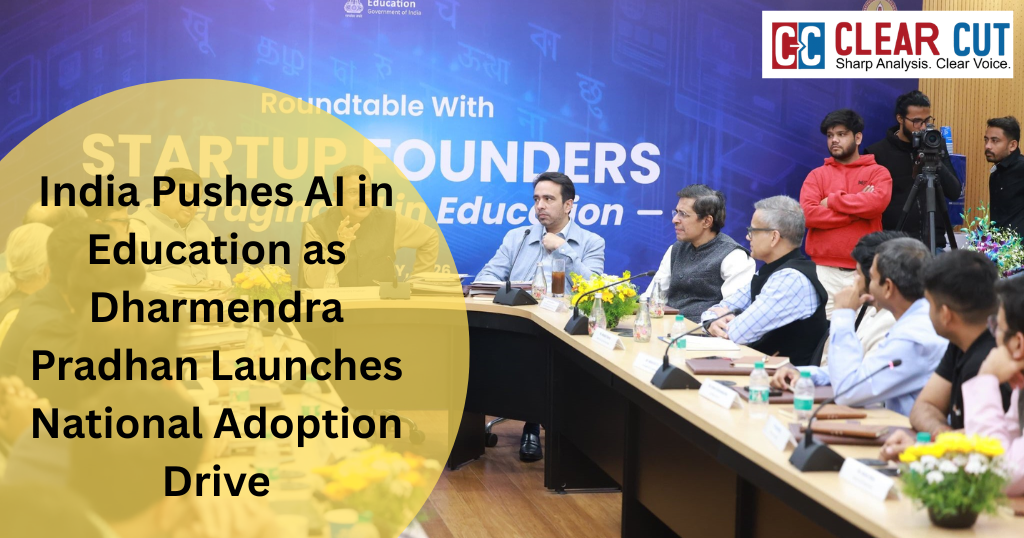
On February 12, 2026, Dharmendra Pradhan launched India’s national AI adoption drive in education at the Bharat Bodhan AI Conclave 2026, introducing the Bharat EduAI Stack to modernise classrooms, labs, and research. Aligned with the NEP 2020, the initiative promotes AI-powered learning, teacher support, early AI education, research expansion, and ethical global cooperation, aiming to make India a leader in inclusive digital education.
India has launched a major campaign to embed artificial intelligence (AI) across its education system. On February 12, 2026, Union Education Minister Dharmendra Pradhan inaugurated the Bharat Bodhan AI Conclave 2026. The event signals a broad government push to modernise learning, from early schooling to research institutes.
The conclave also marked the launch of the Bharat EduAI Stack, an open, interoperable digital framework that will support AI tools and solutions in classrooms, labs, and online learning platforms.
National Vision, Local Impact
Pradhan told reporters that India must prepare students for a future where digital skills are essential. “AI should empower teachers and students equally. It should not replace teachers, but aid them,” he said at the conclave.
The approach aligns with the National Education Policy (NEP) 2020, which calls for technology-enabled learning to bridge gaps in access and quality. The NEP envisions AI-powered inclusive classrooms, capable of supporting diverse learners across languages and regions.
A government document notes that the NEP’s emphasis on AI includes adaptive learning tools, personalised feedback systems, and AI-assisted assessment modules for students.

Startups, Roundtables and Real Solutions
Ahead of the conclave, Pradhan chaired a roundtable at IIT Delhi with founders of 10 Indian AI edtech startups. Participating firms included Vedantu, ConveGenius, SpeakX and Fermi AI.
Pradhan said these homegrown companies are examples of “AI innovation born in India”. He urged them to focus on solutions that address the needs of rural schools, regional languages, and underserved students.
Minister of State for Education Sukanta Majumdar added that the government will support scalable solutions that improve learning outcomes at every level.

AI From Classrooms to Research Labs
Government plans extend beyond software for schools. According to official statements, AI concepts will be taught from Class 3 onwards, not just as a separate subject but as a tool for innovation and problem-solving.
Pradhan said integrating AI early helps develop computational thinking and creativity in young learners. “Our goal is to prepare students for tomorrow’s digital economy,” he stated.
At higher education levels, AI will also become core to research, especially in fields like data science, robotics and automation. Institutions will receive guidance to set up AI research clusters and labs.
Towards a Global AI Dialogue
The conclave feeds into a larger global agenda. The government is hosting the India AI Impact Summit 2026 from February 16–20 in New Delhi, drawing participants from over 100 countries.
This summit will focus on responsible and ethical AI, global cooperation, and real-world impact across sectors including education, health and agriculture.
International dialogues on AI also stress ethical, people-centred approaches. A recent United Nations statement called for AI that promotes inclusivity and sustainability for all communities.
Educators Sound Off
The School Leaders’ Summit held earlier this month highlighted that schools must equip students with skills, not just facts. Leaders said AI can help personalise learning and reduce disparities between urban and rural institutions.
Meanwhile, in Uttar Pradesh, government bodies are allocating tens of crores of rupees to establish AI labs and centres of excellence in technical institutes.
Challenges Ahead
Experts recognise obstacles remain. A high-level dialogue hosted by Reliance Foundation and Central Square Foundation pointed out that pilot AI tools often fail to scale widely. Speakers called for consistent policy, robust teacher training, and localised content in many languages.
Despite these challenges, Indian policymakers stress that AI can be a leveler, reducing education inequality and making high-quality learning accessible to all.
Clear Cut Education Desk
New Delhi, UPDATED: Feb 13, 2026 01:00 IST
Written By: Ayushman Meena