


- India’s tiger population increased from 2,967 in 2018 to 3,682 in 2022, marking a major conservation success, but regional declines show that national figures can hide local challenges.
- India now needs a landscape-based approach that connects tiger conservation with local communities, wildlife corridors, and sustainable forest management.
- Ecotourism, bioeconomy and better compensation systems could support livelihoods, but human-tiger conflict and unequal benefit-sharing remain major challenges.
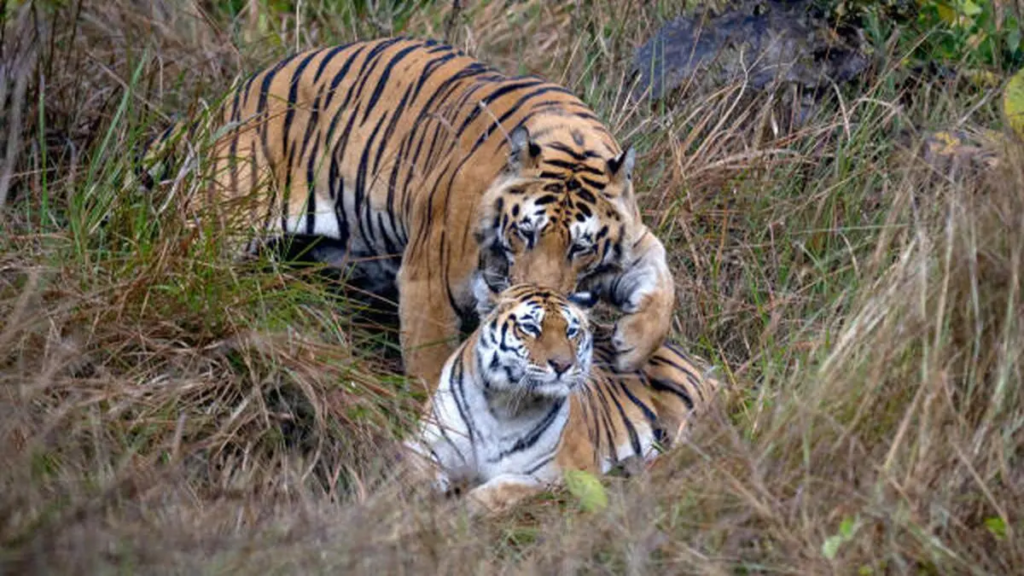
The country has recorded an increase in the population of its tigers from 2,967 in 2018 to 3,682 in 2022 – a recovery rate of about 6% per annum, as recorded in the NTCA-WII Status of Tigers in India-2022. But that is just one side of the picture. As Union Environment Minister Bhupender Yadav launches an international workshop in New Delhi on “Tiger Landscapes: Conservation, Bioeconomy and Ecotourism,” organized by the International Big Cat Alliance, the Asian Development Bank and the National Tiger Conservation Authority, he does not see tigers as a species that needs counting, but an indicator of “natural capital” in whose forest, grasslands, and rivers, millions of people thrive. A more pertinent question that the workshop will have to address: can India create landscapes where wildlife conservation and economic sustenance complement, rather than detract from, each other?

From Tiger Reserves to Tiger Landscapes
Until now, Indian conservation efforts focused on strictly protected zones. However, the 2022 tiger population estimation project, led by Qureshi, Jhala and colleagues, considered India to consist of five landscapes – Shivalik Hills and Gangetic Plains, Central India, North-Eastern Hills and Brahmaputra floodplains, Western Ghats and the Sundarbans – due to the fact that tigers travel beyond their reserves and have a common gene pool with neighbouring populations. The results varied: there was a strong increase in the number of tigers in Central India and in the Shivalik landscape, while the Western Ghats demonstrated localized decrease in tiger numbers, which proves that a single optimistic figure for the whole country may hide fragile situation in a specific region. Only 5% of India is occupied by protected zones, but at least 5 million people live in them, while 147 million rely on them for their livelihood. Consequently, landscape thinking becomes an ecological need imposed by the reality of tiger movement through humanised landscapes.
Conservation and the People Who Live Around Tigers
Communities existing within the habitats of tigers are difficult to classify into victims or villains, considering the available literature. The method of relocation, initiated since the 1970s as a strategy to decrease the footprint of human habitation in core areas, has been inconclusive. In the case of Similipal Tiger & Biosphere Reserve, there has been an increase of 8% in the absolute household income level in the case of relocated families, which is more prominent among poorer households. On the other hand, studies regarding conservation-displacement have shown that there is a possibility of losing the cultural identity of the community members along with the common-property regime and food security, which can further exacerbate poverty for those marginalised households. In the case of Buxa Tiger Reserve, the decision to relocate has been taken due to economic reasons rather than ideological considerations. This implies that the community is neither an impediment nor the guardian of conservation efforts.
Can Ecotourism and the Bioeconomy Deliver?
Tourism money does come to some households, but not all. In the area around the Kanha Tiger Reserve, for example, only 6% of households made any money from ecotourism, at an average of $600 a year, which is additional money, not a livelihood. The ecosystem services related to tourism in the area around Ranthambhore were estimated at $129 million, but a systematic literature review of the impacts of ecotourism from 2000 to 2013 noted that as many failures as successes were reported, due to lack of monitoring and failure to match policy to practice. Bioeconomy, the sustainable extraction of resin, honey, medicinal plants and other non-timber forest products, or NTFPs, is a complementary path to pursue. Resin and mace accounted for most of the extracted products in Periyar Tiger Reserve, while honey and cardamom had the highest value per kg. Authors of scientific articles warn that such extraction cannot overtake nature’s ability to regenerate indefinitely and thus depends on constant monitoring.
The Difficult Trade-offs
However, Human-tiger conflict still stands out as the primary source of tension in this landscape-based approach. In Bandhavgarh, 88.5% of conflict incidents were found to be due to livestock, with cattle, bulls, and calves forming the main victims; at Tadoba-Andhari, 78% of 132 attacks of carnivores on humans from 2005 to 2011 were attributable specifically to tiger attacks, more than half of which turned fatal. In national-level studies, human losses have been shown to be greater in value than either crop or livestock loss in the true cost of conflict in India, and compensation amounts paid out have been found to be insufficient wherever independently evaluated. In the Rajaji-Corbett Corridor, losses due to conflict have lowered income by up to 11.6% in some places – a stark reminder of how critical a corridor is not only for genetic connectivity but is at the same time a place where daily coexistence tensions arise.
What Should India Do Next?
There is more evidence in favor of participatory and monitored methods than one-off programs and slogans of coexistence: Benefit sharing arrangements that will ensure that tourism profits go to households around reserves instead of falling into hands of few entrepreneurs; Enterprises run by communities with proper market connections for NTFPs, which will be based on ecological monitoring; Evaluation of compensation programs through independent auditing; and Continued conservation of wildlife corridors based on landscape-level population data. These are the areas where the evidence supports such initiatives, but success is not assured and will depend on governance capacities of the locals, coordination between forest departments and rural development agencies, as well as community participation.
Conclusion
The tale of the tigers of India is a good story to tell, and the re-establishment of a significant predator population in India is indeed a true policy success story. However, the re-establishment of the tiger is not all there is to say about the matter. The more difficult and unanswered question is whether the forest that supports the re-emergence of the predator also enables dignified livelihoods for those that inhabit its edges in terms of actual income, compensation received, and shared decision-making.
Clear Cut Climate, Livelihood Desk
New Delhi, UPDATED: September 04, 2026 10:00 IST
Written By: Dr. Jyoti Aggarwal
Designation: Senior Research Associate at Devinsights