
As the country’s demographic centre of gravity shifts toward the young, surplus north, the movement of workers is becoming the quiet engine of the next three decades, and the question is whether India will finally choose to look at it.
The Invisible Majority
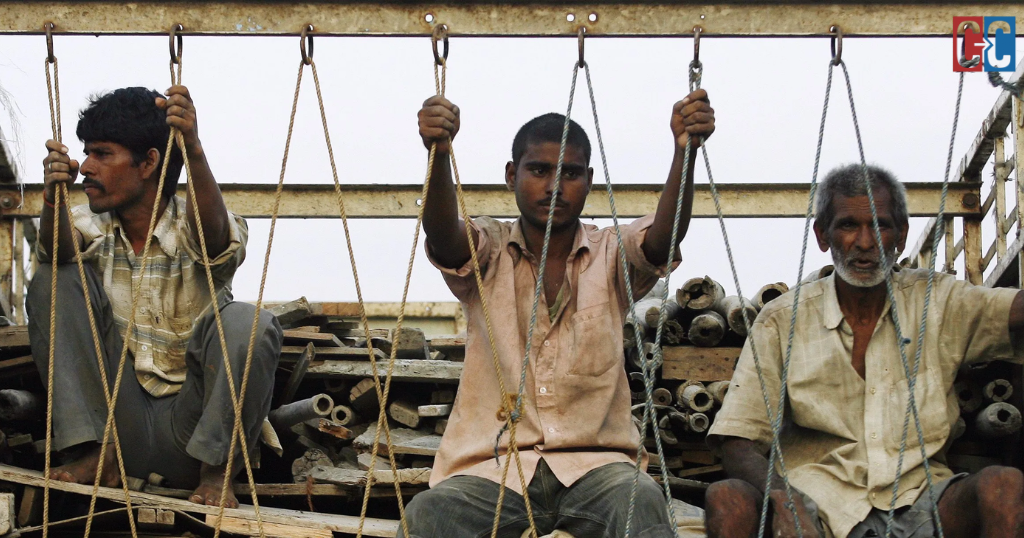
Walk through any Indian metro at dawn and the city that assembles itself belongs to people the data makes invisible. The mason laying brick in a Gurugram high-rise grew up in a village in Bihar. The woman in the apartment kitchen came from a remote corner of eastern Uttar Pradesh or West Bengal and is recorded by the state, if at all, as having moved for marriage. The security guard, the delivery rider, the man mixing cement, person cleaning airport or railway station: they keep the city standing, send a large share of their wages home, and in most official registers do not actually live where they work.
For decades India has told itself a reassuring story, that Indians do not move very much. The census appeared to confirm it. The truth is closer to the opposite. India’s internal migration is not a trickle but one of the largest movements of human beings anywhere on earth, and it is about to become the single most important force shaping the country’s economy, demography, and culture and the shape of its cities. The force has been quiet only because the country has chosen not to measure it seriously.
What the numbers Miss
The most influential account of this gap is a World Bank study by Gaurav Nayyar and Kyoung Yang Kim (2018), India’s Internal Labor Migration Paradox: The Statistical and the Real. Official census figures suggested migration for work was low and static: in the five years before the 2001 Census, fewer than 3 percent of Indians had changed state, the lowest in a sample of about eighty countries. Yet the India Human Development Survey, which follows the same households over time, reversed the picture. Labour migrants had risen from roughly 16 million in 2004-05 to 60 million by 2011-12. More striking still, circular or seasonal migrants, who leave home for months of work and return, exceeded 200 million that year, more than ten times the 15 million the national sample survey had captured. This is not a rounding error. It is the difference between a country that believes its people stay rooted and one whose economy is held together by constant motion. A separate metric, built from railway passenger traffic, put annual interstate work migration near 9 million, far above what successive censuses implied. The deeper problem, the authors stress, is that the instruments are old and crude. When they wrote, census migration data were public only up to 2001, and the last dedicated migration survey dated to 2007-08 (Nayyar & Kim, 2018). Even the most-quoted current figure, that more than 600 million Indians, roughly 42 percent of a population nearing 1.43 billion, have migrated within the country’s borders (The India Forum, 2025), is extrapolated from the 2011 Census, which counted about 454 million internal migrants, some 37 percent of the population then. With the 2021 Census long delayed, no firmer number exists. What a country cannot count, it cannot plan for and cannot protect.
The People Behind the Flow
Behind the numbers is a recognisable person. He is a young man of around thirty with roughly 8-10 years of schooling, from a village in Uttar Pradesh or Bihar. Those two states alone account for close to 60 percent of all Indians who cross a state line. He most likely travels alone, as nearly three-quarters of circular migrants do, and is away for an average of about seven and a half months. He is often recruited through a contractor onto a construction site, which is by some distance the single largest occupation for short-term migrants. Rural-to-urban movement dominates the flow, and about one in five migrants head to a metro city (Nayyar & Kim, 2018).
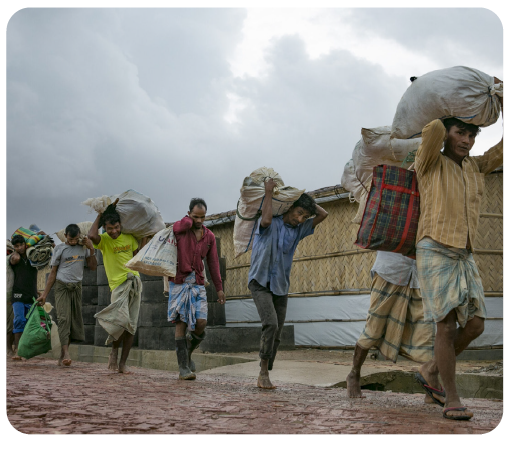
Through remittances, this migratory movement delivers poverty reduction at a scale no welfare scheme can match. In Bihar, money sent home by migrants climbed from under 12 percent of the state’s domestic product in 2004-05 to nearly 36 percent by 2011-12 (Nayyar & Kim, 2018). Migrant households, on average, consumed more than households that stayed behind. For India’s poorest regions, migration is not a social problem to be managed but a private transfer system that quietly underwrites household survival.
The official story is also gendered in a way that hides as much as it shows. Because the census records only a single principal reason for moving, the millions of women who migrate for marriage and then enter the workforce are filed under marriage, and their labour is rendered statistically invisible. Nayyar and Kim (2018) are explicit that their own data understate women’s economic movement for precisely this reason. The result is a national accounting system that systematically undercounts both the seasonal poor and working women, the two groups on whom the urban economy depends significantly.
The Next Three Decades Will See More Migration, Not Less
If the past four decades of migration were driven by the search for higher wages, the next three decades will be driven by “something more structural demography itself”. New projections to 2051 map an India pulling apart at different speeds (Rajan & Retnakumar, 2025). The population will keep growing, from about 1.4 billion in 2021 to roughly 1.6 billion by 2051, but the growth is slowing sharply and unevenly spread, with fertility down from two children per woman to 1.67. The working-age share peaks at 65.8 percent in 2031 and then declines, so the celebrated demographic dividend may begin to close soon. Meanwhile the share of Indians elderly (60+) doubles, from under 10 to more than 20 percent, and the median age climbs from 29 to 40 years (Rajan & Retnakumar, 2025).
The migration story here is a regional one. The southern states, having completed their fertility transition, are projected to start shrinking after 2041, their share of the national total falling from 20 to 17 percent. The centre of demographic gravity moves north: the central belt of Uttar Pradesh, Bihar, Madhya Pradesh and Chhattisgarh sees its share climb from 34.6 to 38.8 percent and its working-age population swell toward 65 percent. Within the north, this bloc will hold more than half of the India’s population, “becoming in effect, the reservoir” of labour force for the rest of India (Rajan & Retnakumar, 2025).
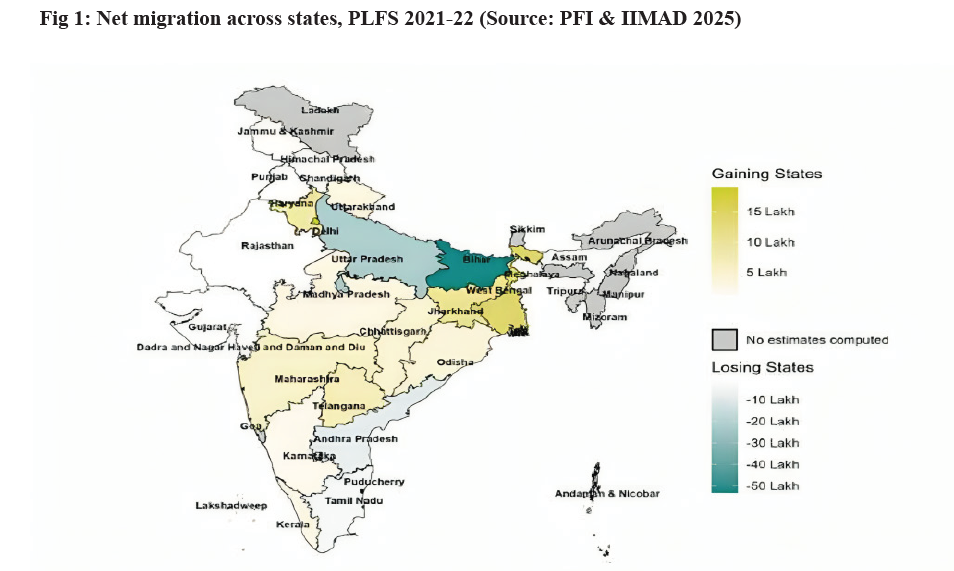
The state-level picture sharpens the point. The most recent labour force survey accounts India’s migration rate at 28.9 percent (NSO, 2022). Uttar Pradesh, Bihar and Madhya Pradesh remain the great sending states, while Maharashtra, Karnataka, TamilNadu, Gujarat, Punjab and Delhi are the destinations, with in-migration rising fastest in Kerala and Tamil Nadu. This marks a shift from short, neighbour-state moves to long-distance corridors from the northern plains to the southern peninsula, a new geography of labour supply and demand. Bihar alone is projected to grow from about 104 million in 2011 to 170 million by 2051, overtaking Maharashtra for second place, even as the south depopulates from around 2036 (Rajan & Retnakumar, 2025).
The implication of this demographic dynamic is impossible to miss. Workers will move from poor, young, surplus states to richer, ageing, labour-deficit ones: the prosperous south and west will need workers at exactly the moment they run short of their own, while the north and centre hold a surplus of young people just as local jobs fail to keep pace. Migration is the mechanism that will carry India’s last reserves of youth to where the economy needs them.
The Citification of a Nation
That redistribution of internal migrants will land in cities. By the 2050s, for the first time in its history, more than half of India’s population is projected to live in urban areas, with the rural share dropping below half. The urban share climbs from 31 percent in 2011 to around 40 percent by 2031 and just past half by 2051, while the urban population more than doubles, from 377 million to 828 million, a trajectory broadly in line with the United Nations’ estimate of roughly 53 percent by 2050. However, the growth is uneven. A dozen states, among them Tamil Nadu, Kerala, Maharashtra, Gujarat, Karnataka, Telangana and Delhi, are projected to be majority-urban, with Delhi, Kerala, Tamil Nadu and Telangana more than two-thirds urban. Many of these states are ageing fastest and will lean hardest on workers from elsewhere
(Rajan & Retnakumar, 2025). The concentration is already extreme: the five largest districts account for roughly 18 percent of national employment, a share that has barely shifted even as
the cities at the top of that list have changed (Fernandes & Sharma, 2012).
However, cities are often not designed for the people building them. The workers end up in informal settlements and carry no portable entitlements with them. And these workers are only the first wave. As the population ages with low fertility, a second wave is taking shape. The care workers, domestic staff and health aides who will be needed as one in five Indians passes sixty are a new and rapidly growing stream of urban labour. The urban landscape of 2050 will be shaped less by master plans than by these two flows of people, the young who come to work and the old who need to be cared for, neither of whom the planning system is currently built to absorb.
The Architecture of Exclusion
Migration is, first of all, one of the most effective anti-poverty forces the country has. And yet here lies the uncomfortable core of the story. India’s migrants are economically indispensable and institutionally excluded, and the exclusion is structural rather than accidental. Nayyar & Kim (2018) trace the machinery in detail. Much of the social safety net, together with preferential access to higher education and public-sector jobs, has historically been tied to a person’s home state and did not travel with them.
A worker who moved risked forfeiting those entitlements at the moment of greatest precarity. The penalty has fallen hardest on the poorest. The same study finds that the people with the least to lose are the most likely to move to another state. Those who depend most on the support tied to their home state are the least likely to move for good, even though they are the ones most often forced into desperate, short-term moves for work. A recent essay in The India Forum called this exclusion by design (The India Forum, 2025).
Migrant workers and their families are usually counted at origin and rendered invisible at destination: they vote where they came from rather than where they live and work, which strips them of political leverage in the very cities they sustain. Reforms exist, and the One Nation One Ration Card scheme has begun to make food entitlements portable, but the broader framework of rights still attaches to where a person is from rather than where they are contributing economically.
The same story is written larger
India’s internal migration has a near-perfect mirror abroad. The country has the world’s largest diaspora, more than 18 million people (United Nations, 2024), and is the world’s largest recipient of remittances, taking in around USD 135 billion in 2024-25 and remaining the only nation ever to cross the 100 billion mark (Ministry of Finance, 2026). The Gulf labour corridor reproduces the internal pattern almost exactly.
Roughly 1.7 million workers were cleared for emigration between 2021 and 2025, the largest shares bound for Saudi Arabia, the United Arab Emirates and Kuwait (Indian Council of World Affairs, 2026), most on temporary contracts, predominantly male, separated from their families, their wages flowing home (Banerjee et al., 2002). In several Gulf states migrants make up two-thirds to three-quarters of the entire population (IOM, 2026). The precarity of a Bihari worker on a Gurugram construction site and an Indian worker on a Dubai one is recognisably the same precarity, simply playing out across a national border instead of a state one.
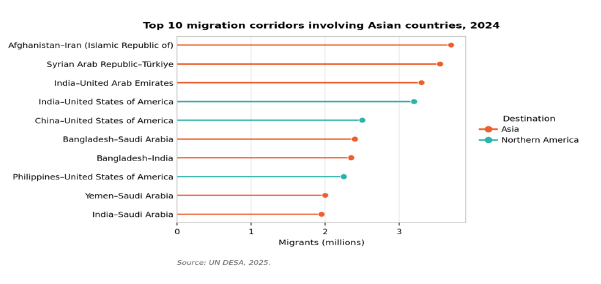
The composition is shifting, however. The OECD now identifies India as its single largest source of migrants and notes a 75 percent jump in health and care visas issued to Indians (OECD, 2025), a movement of nurses and doctors rather than only labourers. Women, who numbered 2.6 million among Indian migrants in 1990, now exceed 6.6 million and make up more than a third of the total (United Nations, 2024). India is also, increasingly, a destination: it hosts more than 240,000 refugees, mostly from Myanmar and Afghanistan (UNHCR, 2024). In 2025 it consolidated its fragmented colonial-era statutes into a single Immigration and Foreigners Act (Government of India, 2025). The IOM’s World Migration Report 2026 situates all of this inside an Asian region that is now the origin of two in every five of the world’s international migrants. India, in other words, mirrors global migration within its own boundaries.
Making the invisible visible
If migration is the force quietly reshaping India, the quiet is largely self-imposed. The 2021
Census was delayed, and the last dedicated migration survey is from 2007-08. The most consequential movement of people in the country has been governed in the dark. That may finally be changing: the government has announced a yearlong National Migration Survey
beginning in July 2026 (Ministry of Statistics and Programme Implementation, 2026), the first
exercise of its kind in nearly two decades.
But counting is only the first step. A survey can make migrants visible; it cannot, on its own,
make them matter. The harder task is institutional: to detach entitlements, social protection and
political voice from a person’s place of origin, so that rights travel with the worker rather than staying behind. It means building cities that can absorb not one stream of migrants but two, the young who come to work and the growing ranks of care workers an ageing society will lean on. And it reaches beyond the country’s borders, to the millions who carry Indian labour into the Gulf under the same precarious terms. It matters because the stakes are no longer abstract. The demographic dividend begins to lose its momentum around 2031. Whether India captures the last of it will depend on whether young workers in Bihar and Uttar Pradesh can move to where the work is, arrive in cities that will house and protect them, and carry their rights
along with them when they go. Get that wrong, and a generational surplus of labour sits idle while ageing states go short. Get it right, and migration becomes the quiet infrastructure of a richer and more balanced country. The force was there the whole time. The only real question is whether India will at last choose to see it.
About the Author: Dr. Sushanta Kumar Banerjee is a public health expert with over three decades of experience spanning research, policy, and programme implementation. He holds a PhD in Demography and a master’s degree in Economics, bringing a strong analytical lens to complex development challenges. He recently retired as Chief Technical Officer at Ipas Development Foundation. Dr. Banerjee has authored multiple research papers in peer-reviewed international journals and UN publications, and has contributed economic analyses to the Economic and Political Weekly (EPW). He is also a contributing author to Clear Cut.
Clear Cut Livelihood Desk
New Delhi, UPDATED: August 12, 2026: 09:00 IST
Written By: Dr. Sushanta Kumar Banerjee