
Tribal rehabilitation for India’s first river linking project has been answered with a ten-year-old survey in Parliament. Reports suggest and it is known that the actual figures and associated human rights violations are much higher with protests, a High Court judgment and even numbers from project authority itself indicating this disparity.
The Union Ministry of Tribal Affairs stated in the Lok Sabha on August 5 that Phase I of the Ken-Betwa Link Project will uproot 1,913 Project Affected Families, of whom 648 will be tribal families. The ministry’s own submission links this figure to the 2016 proposal by the National Water Development Agency- a decade-old estimate that the implementing authority for the project, as well as the tribal families in protest on the ground, feel is an underestimate.
Answering questions in Parliament, Minister of State for Tribal Affairs Durgadas Uikey said land acquisition and rehabilitation for India’s maiden river-interlinking project was the “responsibility of the state governments (Madhya Pradesh and Uttar Pradesh) and the ministry has only a monitoring role.” It stated, “However, to comply with the provision of the forest clearances which were provided in 2021 and 2023, it was subjected to the condition that while seeking final approval by the respective State Government for forest diversion, adequate compliance with the provisions of the Forest Rights Act, 2006 was ensured,” and that as per section 4(5) of FRA, no “other person is evicted unless his right is determined “. “While State Governments are responsible for the implementation of the provisions of the Forest Rights Act, 2006 and the data related to the compliance of FRA is not maintained at central level.”
The project itself is vast. Budgeted at ₹44,605 crore, the Ken-Betwa link promises irrigation for 10.62 lakh hectares and drinking water for 62 lakh people, largely in Uttar Pradesh’s Bundelkhand districts. But the Daudhan dam that anchors it, rising inside the Panna Tiger Reserve in Madhya Pradesh, will submerge or acquire land across roughly two dozen villages — displacing over 6,600 families by the project authority’s own more recent estimate, more than three times the government’s Lok Sabha figure. Most belong to the Gond and Kol tribal communities, who are not counted among the project’s intended beneficiaries.
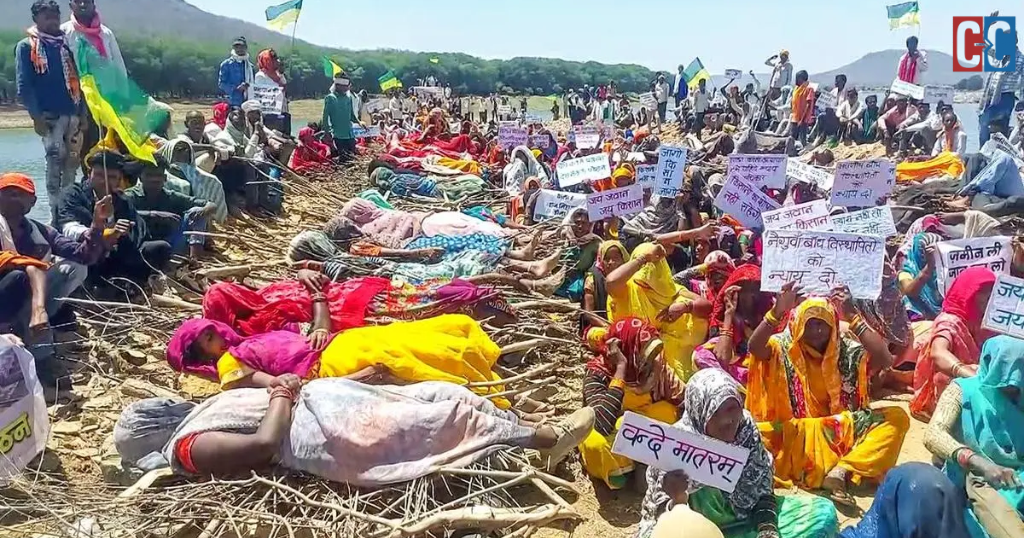
And it’s this very disconnect between official counts and ground reality that’s been the focus of families in Chhatarpur and Panna for much of the year. In April, tribal women held a “Chita Andolan” by lying down on dummy funeral pyres to protest alleged forced evictions. In July, after government officials called off an 18-day hunger strike by movement leader Amit Bhatnagar, a new verification of unpaid families was ordered – perhaps the biggest tacit admission yet that the official lists can’t catch up.
But in this case, the allegation of injustice actually holds up under the law. In 2024, the Madhya Pradesh High Court, dealing with the same displacement in orchards and the Wildlife Sanctuary issue in Kamlesh Prajapati v. State of Madhya Pradesh, observed that consent under threat is not voluntary. No eviction shall be done without adequate application of the Forest Rights Act, which, according to the oppositionists, the Ken Betwa link has been the opposite of.
The process of obtaining environmental and forest clearances has been severely distorted, said Himanshu Thakkar, coordinator of the South Asia Network on Dams, Rivers and People. Thakkar has been monitoring the project since it got clearance in 2011. He is also one of the independent respondents regarding the hydrological data for the Ken-Betwa interlinking project; he has questioned whether the claim that the Ken river basin has more water to give to the Betwa has been authenticated by any credible agency before the displaced communities were assured they had to make way.
Ken-Betwa isn’t an isolated incident. According to Ministry of Tribal Affairs data from March 2026, there were nearly 47,900 community forest rights claims rejected nationwide, and separate ministry data notes that there are almost 700,000 individual and community claims pending – this is evidence that a law intended to amend “historic injustice” against forest-dwellers cannot overcome the bureaucracy it was passed to help reform, say researchers.
This pattern is not just in India. In a historic global review, the World Commission on Dams concluded that an estimated 40 to 80 million people were forcibly displaced across the world to build dams; that women and tribal communities paid the highest prices, usually without any reward, conditions many critics suggest are being repeated by Ken-Betwa.
For now, the fresh verification ordered in Chhatarpur and Panna is underway. Whether it closes the gap between Parliament’s 2016 figures and the families still waiting to be counted will determine whether India’s first river-linking project rehabilitates its displaced — or revises its paperwork.
Clear Cut Livelihood, Research, Climate Desk
New Delhi, UPDATED: August 11, 2026: 06:00 IST
Written By: Yatharth Pathak