

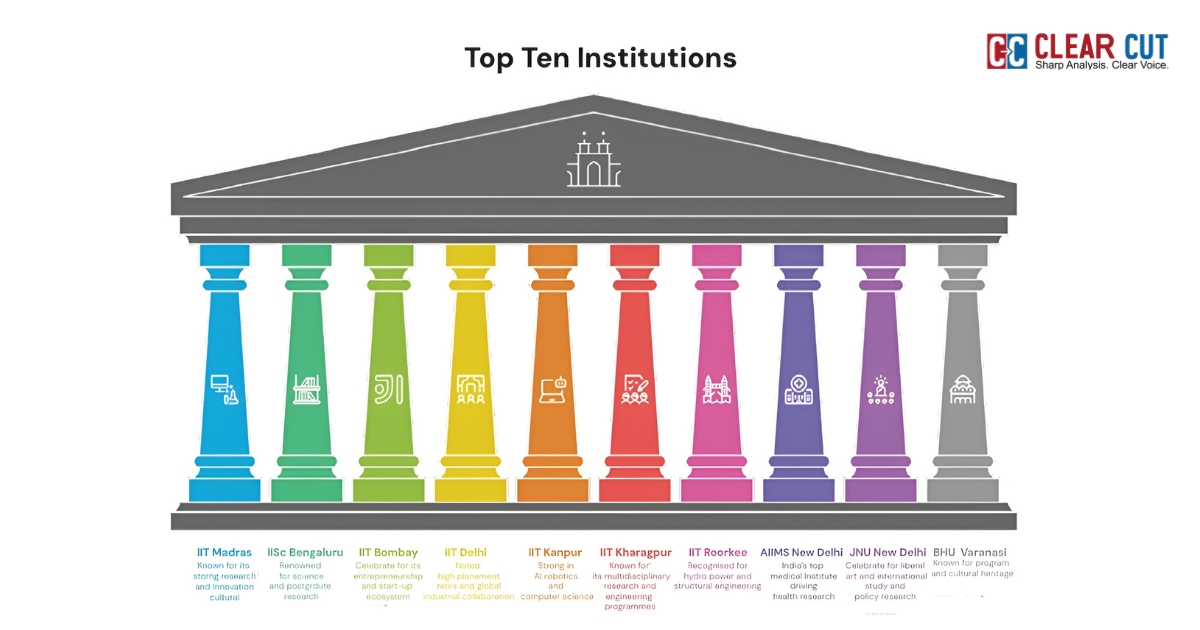
The launch of National Institutional Ranking Framework (NIRF) 2025 for the fourth time in a row, by the Ministry of Education brought higher education back into focus in our country. But while this latest release of rankings, particularly in the “Overall” category, serves to enlighten students and their families, it also raises questions for those promoting a national conversation about research, funding, and equity. What is the Basis & Criteria of “Overall” Ranking? The NIRF “Overall” ranking amalgamates various aspects of institutional performance.
To generate these rankings, the institutions are evaluated with respect to five major criteria:
• Teaching, Learning & Resources (TLR) – infrastructure, faculty/student ratio, lab facilities, library resources.
• Research & Professional Practice (RPC) – quantity and quality of research papers published, number of patents filed, collaborations with industry, etc.
weightings and these are normalized (to a 100 point scale). The weighted average then determines an institute’s ranking as the final score.
Trends and changes for 2025
The rankings recorded in 2025 show that the IITs and IISc continue to be powerhouses, comprising seven of the ten highest-scoring institutions. Their positions appear strongly justified and are on the backs of a decades-long commitment from the government and utility of built research infrastructure into educational leadership. The ranking metrics highlight the growing relevance of medical sciences (in the form of AIIMS), liberal arts (with JNU), and multidisciplinary education (BHU), with all three institutions in the top 10.Interestingly, private institutions, such as Manipal Academy of Higher Education (MAHE) and some of the others, have seen a huge increase relative to their own institutional peers that reflect possibilities for private investments in advancing the landscape of higher education.
Future Pathways
While NIRF is well-respected, there are detractors. The pervasive emphasis on research output and perception tends to privilege the old-school, established university that also has a long, storied history. Upstart universities that might be exemplary in terms of student support, student and faculty inclusivity, and the quality of teaching, cannot move up the ranks as quickly. Moreover, as issues such as mental health, safety in hostels and apartments, and general well-being do not have any representative measures in the current rankings.
have any representative measures in the current rankings. have any representative measures in the current rankings. These would represent a more concerted effort toward aligning India’s ranking system closer to global ranking systems, such as the QS World University Rankings or Times Higher Education (THE).
The NIRW 2025 Top 10 list reflects the pride of existing academic behemoths in India, yet remains a pathway for the whole system’s next destination. For students: rankings are the barometer of futures, but still one of many tools to inform their future direction. For policymakers: an opportunity to expand the reach of excellence beyond IITs and AIIMS; so that, India’s many millions of students are assured the opportunity for quality; on their terms; and at their site of study.
Note: Views expressed are personal and do not reflect the official position or policy of the Clear Cut Magazine.
Clear Cut Education Desk
New Delhi, UPDATED: Jan 09, 2025 01:00 IST
Written By: Clear Cut Team