
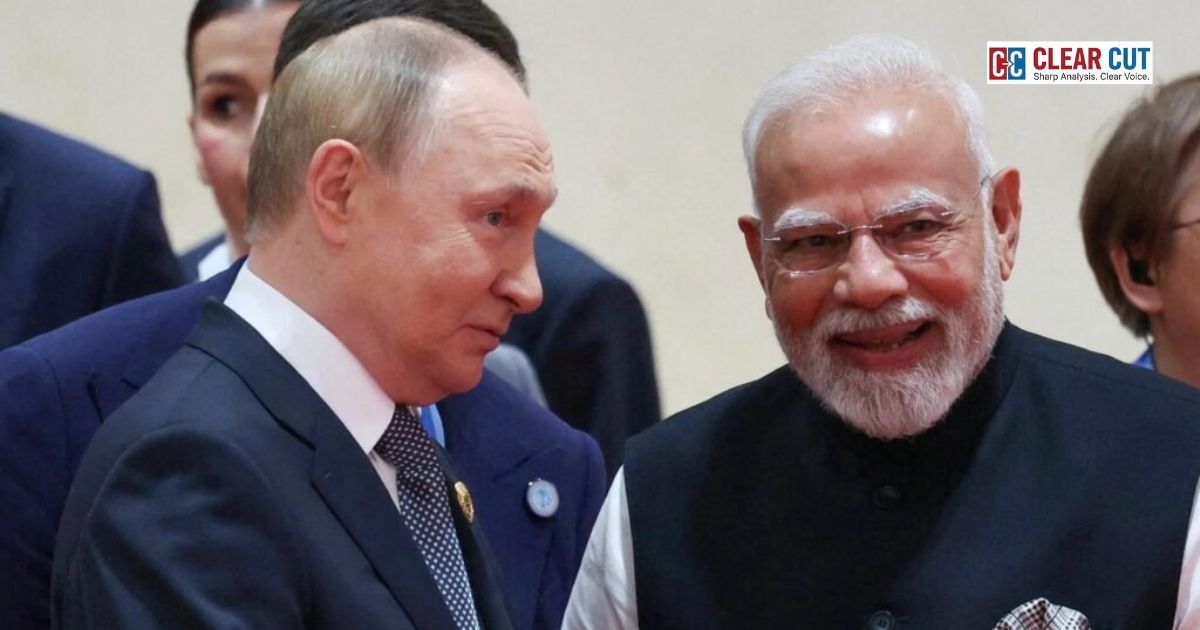
When two old friends meet after a long time, the conversation is never about just one thing. Something similar is unfolded as Russian President Vladimir Putin visited India on 4 and 5 December 2025. It was his first in four years, but the relationship between the two countries goes back more than seven decades. This visit is small in calendar size, yet it carries a quiet weight for both nations.
A Meeting Shaped by Today’s Challenges
The Russia-Ukraine conflict has resulted in heavy Western sanctions imposed on Russia, while many countries have reduced the number of trades with Moscow. Guided by the belief in strategic independence, India managed to preserve a working relationship with Russia in those times. New Delhi bought oil when it was needed, and continued defence cooperation where it was essential. This visit gives both sides an opportunity to stabilise their partnership when the world is unsettled. The unveiling of a “Programme for Economic Cooperation until 2030,” a comprehensive framework intended to diversify and stabilise bilateral trade, served as the visit’s focal point. The focus on increasing Indian exports by removing Russia’s regulatory restrictions and non-tariff trade barriers shows a mutual understanding of the structural imbalance in bilateral trade flows. The trade volumes have increased to approximately USD 64-65 billion in recent years. This is because India’s significant imports of discounted Russian crude oil, exports from India have remained disproportionately low. The program aims to establish more equitable economic ties by specifically aiming for USD 100 billion in trade by 2030.
Defence-in-depth means keeping old systems running
Beyond trade, the visit demonstrated a cautious but evident shift in military-technical cooperation and defence. Much of the defence equipment and spares for India come from Russia. Fighter jets, submarines, missile systems, and helicopters built over decades depend upon regular maintenance and timely supplies. Even if India is diversifying now, the current inventory remains large. This have historically been the most resilient pillars of India-Russian relations. The wording used in the joint statement indicates a move away from the traditional supplier-buyer model. It moves towards in-depth cooperative research, co-development and co-production. Even though it refrained from listing particular defence transactions. This is in line with India’s larger goal of achieving strategic autonomy through domestic defence production as part of the Make in India initiative. Beyond maintenance, the commitment to produce spare parts, aggregates and components of Russian-origin systems domestically has implications. It lessens India’s reliance on future Russian supplies. It is uncertain due to sanctions and supply chain disruptions. It also enables India to export jointly produced systems to “mutually friendly” nations.
Trade and Payments: Finding Workable Solutions
Payment is one of the biggest practical problems in India-Russia trade today. Sanctions blocked many banking routes, so even when both countries want to trade, money cannot move smoothly. The officials have been discussing rupee-rouble payments or settlement through neutral currencies like the UAE dirham. Technical challenges have become political concerns. This is evident in the joint statement’s emphasis on lowering tariff and non-tariff barriers, resolving logistical bottlenecks and guaranteeing more seamless payment processes. The conversation on insurance, reinsurance and the compatibility of national payment systems shows an understanding that the fundamental barrier to the expansion of Indian exports is still financial friction. It is further made worse since Russian banks were shut off from the SWIFT network. A partial but functional solution has been produced by the promotion of rupee-rouble settlement structures, including the usage of special Vostro accounts. The talks point out that while Russia might continue to be a significant supplier of energy. It will not significantly integrate into India’s export markets in the absence of a stronger and more contemporary local currency settlement system. The results of the summit demonstrate a desire to reverse this trend.
Civil Nuclear Cooperation and Technology Partnerships
Already, India and Russia cooperate on nuclear energy at the Kudankulam site in Tamil Nadu.
Additionally, this recalibration is occurring within a broader structural framework. According to SIPRI, Russia’s proportion in India’s defence imports has decreased dramatically over the last ten years, from 76% in 2009-13 to 36% in 2019-23. This decrease is a result of India’s increasing reliance on Western defence suppliers as well as its expanding needs for cutting-edge technologies like artificial intelligence, space-based surveillance, unmanned systems, and cyber capabilities areas where the US and its allies provide more advanced and competitive platforms. However, the summit confirmed Russia’s continued importance as a strategic partner, especially in the areas of nuclear energy, air defence, and naval systems. The extent of current interdependence is highlighted by talks about the S-400 system’s impending deliveries and possible future co-production of the S-500.
Geopolitically, the visit took place at a time when India is trying to strike a careful balance between its close connections to Moscow and its quickly growing alliance with Washington. Foreign Secretary Vikram Misri’s states that economic cooperation is like the “driving impulse” of this visit. It tries to separate contentious areas like India’s defence diversification and Russia’s closeness to China from the larger strategic partnership. Furthermore, India’s intention to ground the alliance in geoeconomic processes is less susceptible to great-power politics. It is evident in the summit’s emphasis on connecting corridors, investor protection agreements, and free-trade talks with the Eurasian Economic Union.
A Visit Rooted in Continuity, Not Drama
It’s not a visit of loud excitement. It is one born out of necessity. The two countries are trying to find their feet in a rapidly changing world and trying to protect their vital interests. India wants steady energy, predictable defence support and room to maintain its independent foreign policy. Russia wants a reliable partner at a time when many doors have closed. Even a small set of agreements can make a quiet but long-lasting difference. Affordable oil, stable payments and steady defence supplies may not feel dramatic to the public. Although, they can influence inflation, national security and economic stability.
Analysts noted that Putin’s visit also took place against the symbolic backdrop of “split-screen diplomacy”. With India concurrently handling tensions with the US over punitive tariffs related to its purchases of Russian oil. The complex, multipolar environment in which India functions is exemplified by this juxtaposition. Sectoral interests rather than ideological affiliations increasingly influence strategic decisions, and partnerships are no longer binary. India’s ongoing commitment to multi-alignment is thus demonstrated by the reaffirmation of the “special and privileged strategic partnership” with Russia.
In summary, the December summit represents both adaptability and continuity in India-Russian ties. With a long-term plan to diversify trade, update payment systems and lessen structural weaknesses, the economic cooperation has emerged as the stabilising force. In line with India’s larger goals for independence, defence connections are shifting from transactional buying to cooperative manufacturing. The visit demonstrates that the cooperation still has strategic relevance for both parties, despite ongoing difficulties, especially Russia’s growing ties with China and the limitations of Western sanctions. India’s strategy is based on pragmatic multi-alignment. It aims to maintain historical connections while adjusting them to new geopolitical, technological, and economic realities.
Clear Cut Livelihood Desk
New Delhi, UPDATED: Dec 08, 2025 04:55 IST
Written By: Janmojaya Barik