

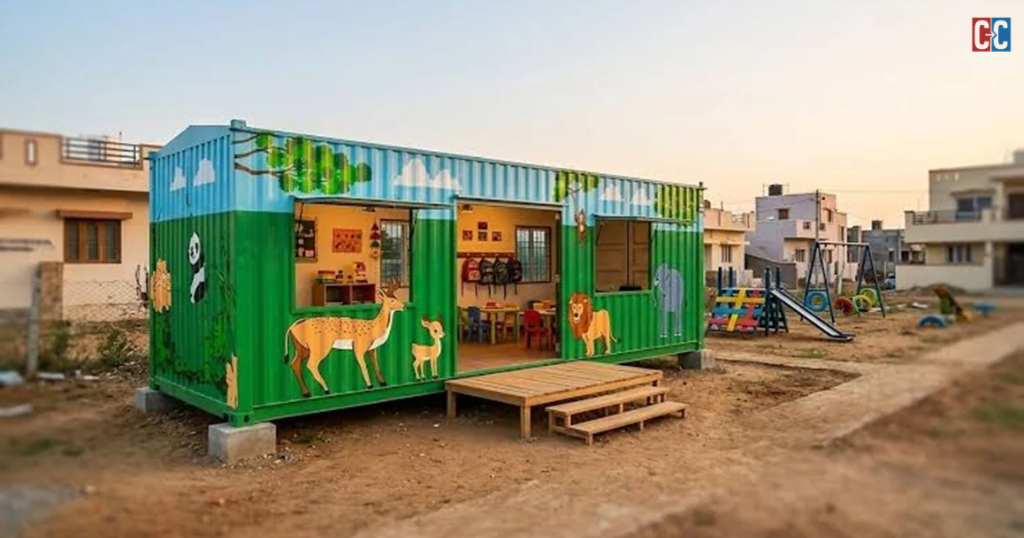
The Unboxed School in Bengaluru is a portable shipping-container classroom designed to provide education to children of migrant construction workers. Expected to open by the end of 2026, the project aims to improve access to learning while raising questions about affordability, teaching arrangements and continuity of education for families who move frequently.
The structure is finished. The interiors and the solar installation are not. The Unboxed School, a shipping-container classroom for children of migrant construction workers in Bengaluru, is expected to open by the end of 2026, according to reports published over the past week.
It is the project of Divit Garg, a Class 12 student at Inventure Academy. The container, a standard 40-by-8-foot unit, sits on a concrete platform of about 420 square feet at a residential project on Sarjapur-Attibele Road, where a Bengaluru real-estate developer has funded the work. Reports describe space for 20 to 25 children, a small washroom, and a storage area that can double as a classroom for children needing specialised support. To manage heat inside the metal shell, the design uses heat-reflective paint and passive turbine vents that need no electricity. If families move, the container can be trucked to another site at an estimated cost of ₹30,000.
Two cost figures
Reports differ on what the project costs. The Press Network of India gives an estimate of under ₹10 lakh. The Marathi and Kannada editions of Asianet News report ₹5 lakh. The sources do not say which items each figure includes, such as the platform, fit-out, solar panels or teachers. Until a budget is published, cost per child cannot be calculated or compared with other models.
The problem it addresses
The need is documented. A study from the Institute for Social and Economic Change (ISEC) in Bengaluru drew on interviews with 656 informal migrant workers who had brought children to the city. It found marked differences in children’s educational outcomes across construction, garment and domestic work. Parents’ education was a significant factor. Language barriers limited access to effective learning environments and made it harder for children to fit into local schools. Awareness of government schemes varied, and some families did not know about resources meant for their children. The Right to Education Act, 2009 covers children aged 6 to 14, including those of migrant workers, according to a Citizen Matters explainer, so the entitlement exists. The barrier is access in practice.
A container at the work site removes one obstacle, distance, and keeps young children supervised while parents work. It does not by itself address the others the ISEC study identified. A classroom inside a residential project in Sarjapur may help children whose parents stay for the duration of that project. A family that moves across the city, or back to another state, leaves the classroom behind unless another container is waiting. The reports do not say who will teach, which language or curriculum will be used, or how children will be linked to a government school’s records.
Earlier attempts
Portable schooling for construction-worker children in Bengaluru is not new. The SELCO Foundation has documented a portable bridge school built for a migrant community, using locally sourced materials and designed for thermal comfort. The foundation reports that the child-friendly design raised the number of children attending. That is an organisational claim and was not independently verified in the sources examined. Against such earlier models, a container offers durability and a standard, transportable form. Its advantage over cheaper tent structures has not been tested in any comparison identified in the sources.
The funding arrangement is notable. Developers control the sites where migrant families live, which is where a replicable school would have to be hosted. Garg hopes other developers, NGOs and public agencies will copy the model. That raises a question the project has not yet answered publicly: what keeps a classroom running after a building project finishes and the site is handed over?
The first test will be modest. Do enrolled children attend consistently through the first term, and what happens to those who leave? A short public record of enrolment, attendance, staffing and per-child cost would let others judge whether a container classroom costing between ₹5 lakh and ₹10 lakh is a model worth copying, or a solution that works at a single site.
Clear Cut Education, Child Protection Desk
New Delhi, UPDATED: November 18, 2026 23:00 IST
Written By: Tanmay J. Urs