

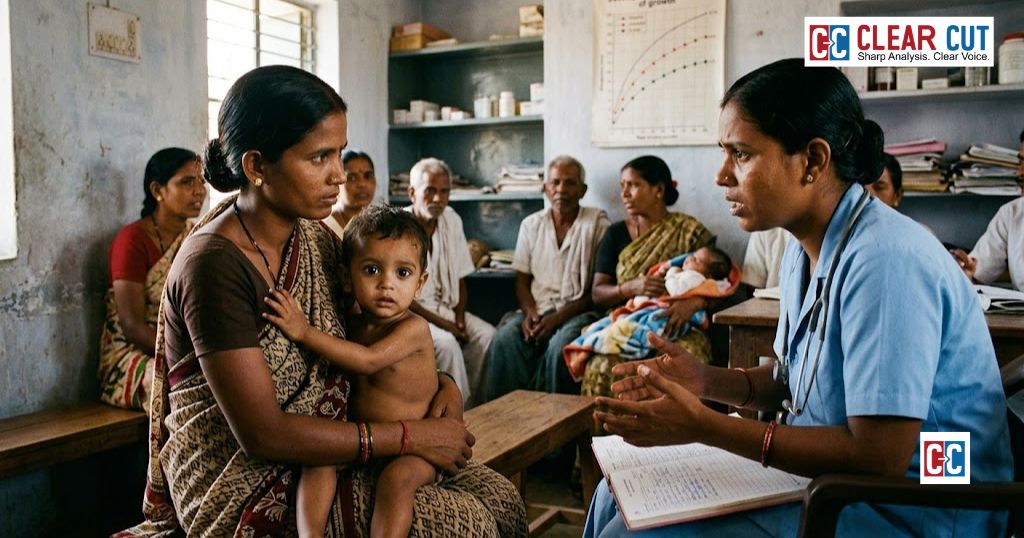
- Despite decades of initiatives like ICDS and POSHAN Abhiyaan, malnutrition remains a major challenge in India because it is driven by factors beyond food, including poor healthcare, sanitation, maternal education, and poverty.
- The article highlights the need for stronger last-mile service delivery, better coordination across sectors, community participation, and targeted interventions to ensure every child receives adequate nutrition and care.
India has been fighting malnutrition for decades. Since the launch of the Integrated Child Development Services (ICDS) in 1975 and, more recently, the ambitious POSHAN Abhiyaan, the country has built one of the world’s largest systems for addressing childhood nutrition.
Yet malnutrition continues to affect millions of children.
This raises a difficult but important question: if India has programmes, policies and institutions dedicated to tackling malnutrition, why does the problem persist?
The answer is that malnutrition is rarely caused by a lack of food alone. It is connected to the conditions in which people live—the availability of healthcare, access to clean water and sanitation, household income, maternal education, childcare practices and the ability of public systems to reach the people who need them most.
To understand India’s nutrition challenge, therefore, we must look beyond the existence of schemes and examine how effectively they work on the ground.
When the System Does Not Reach the Last Mile
The Integrated Child Development Services, launched in 1975, reaches approximately 1.4 million Anganwadi Centres across the country. These centres are expected to provide supplementary nutrition, monitor children’s growth, offer preschool education and facilitate health referrals for children below six years of age, as well as pregnant and lactating women.
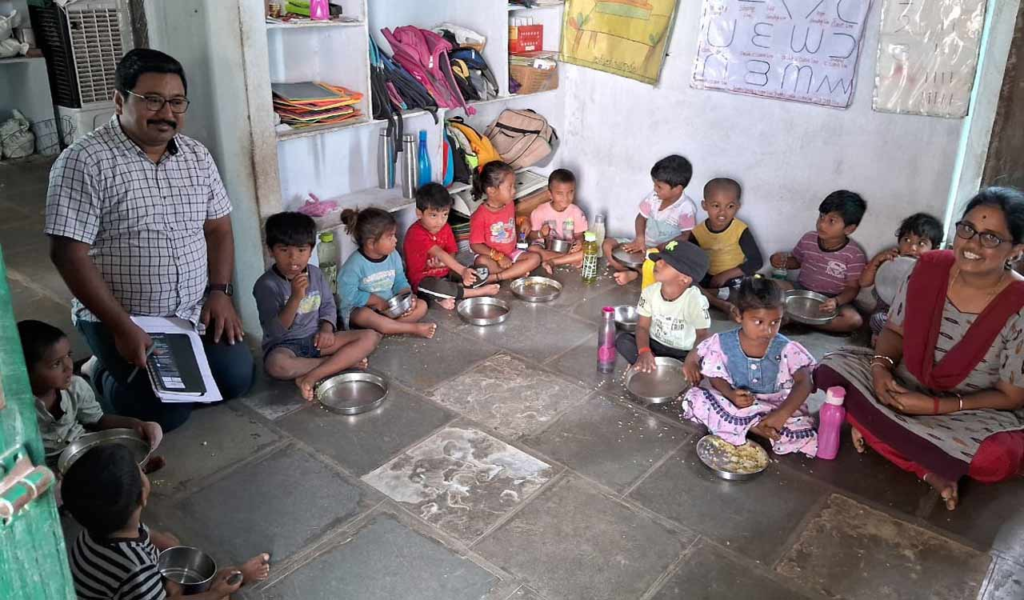
On paper, this is a powerful system.
But for many families, particularly in high-burden states and remote tribal and forest regions, the reality can be very different.
Anganwadi centres may be understaffed. Basic infrastructure may be missing. Some of the most vulnerable communities live in areas that are difficult to reach. Supplies of take-home rations may not always move smoothly through the system, while vacancies among Anganwadi workers and helpers can place enormous pressure on the frontline workers who are already responsible for serving large populations.
The result is a familiar gap between what a programme promises and what a family actually receives.
For a mother living in a remote village, a nutrition programme is only as effective as the person, service or supply that reaches her doorstep.
One Country, Many Nutrition Realities
India does not have one nutrition story.
The dietary practices of a tribal community in a forested region may be very different from those of a family in an urban settlement. Childcare practices, access to healthcare, water availability, sanitation facilities and ideas about food can vary widely from one community to another.
Yet nutrition programmes are often designed with a standardised approach.
An intervention that works well in a nutritionally better-performing state may not work in the same way in a high-burden tribal region. The problem is not necessarily that the intervention is ineffective. It may simply not fit the realities of the people it is intended to serve.
A one-size-fits-all approach can improve average outcomes while still leaving the most disadvantaged children behind.
If India wants to address the worst forms of malnutrition, programmes must be designed around local realities rather than assuming that the same solution will work everywhere.
Malnutrition Does Not Belong to One Ministry
A child’s nutritional status is shaped by much more than what they eat.
It is influenced by whether their family has enough food, whether the child can access healthcare, whether the household has safe water and sanitation, whether the mother has received an education, whether the family has a stable income and what social norms shape childcare practices.
This makes malnutrition a multisectoral challenge.
However, the response to it has often remained fragmented. Nutrition efforts have largely been centred around the Ministry of Women and Child Development, without sufficient convergence with health, education, drinking water and sanitation, and food and public distribution systems.
Mechanisms for coordination have been created under initiatives such as POSHAN Abhiyaan. But coordination on paper does not always translate into coordinated action on the ground.
For a child, hunger, illness, unsafe water and poor sanitation do not arrive as separate departmental problems. They often occur together.
The response must therefore be equally connected.
A Child Cannot Absorb Nutrients from Food if the Environment Keeps Making Them Sick
The relationship between sanitation and nutrition is one of the clearest examples of why malnutrition cannot be addressed through food alone.
Research using data from NFHS-1 to NFHS-5 has shown a strong relationship between open defecation, lack of access to safe water, wasting and stunting.
Repeated exposure to pathogens through the faecal-oral route can cause Environmental Enteric Dysfunction, a condition involving persistent inflammation of the intestine. Over time, this can impair the body’s ability to absorb nutrients—even when a child is consuming enough calories.
This means that a child may be eating adequately and still remain malnourished because the environment around them continues to expose them to infection.
India has made significant progress in expanding toilet infrastructure through the Swachh Bharat Abhiyan. But infrastructure alone cannot solve the problem.
A toilet that is built but not consistently used cannot deliver its full health benefits.
The lesson is simple: sanitation infrastructure and behavioural change must move together.
The Mother’s Education Can Shape a Child’s Nutrition
Among the many factors that influence child nutrition, maternal education repeatedly emerges as one of the strongest.
Analyses of NFHS data show a consistent relationship between maternal education, household wealth and better nutritional outcomes for children.
An educated mother is more likely to have access to information about breastfeeding, complementary feeding, healthcare and nutrition. But the relationship is deeper than information alone. Education can influence confidence, decision-making power, health-seeking behaviour and the ability to navigate public services.
This is why investing in girls’ education is also an investment in the nutritional health of future generations.
The benefits may not always be immediately visible, but they can shape the lives of children born years later.
The Accountability Gap
India’s nutrition challenge is also a question of priorities and accountability.
Nutrition has historically received less financial attention than the scale of the problem demands. Allocations for programmes such as POSHAN Abhiyaan and ICDS have seen changes over the years, while state-level allocations may fall short of planned outlays or remain under-utilised.
But money is only one part of the problem.
There is also a question of ownership.
When many departments are involved in improving nutrition but no single institution is clearly responsible for the overall outcome, accountability can become blurred. Progress can be claimed by several agencies, while failure can become difficult to attribute.
The Poshan Tracker is an important step towards using technology to monitor nutrition-related services and outcomes. But collecting information is not the same as solving a problem.
Data must lead to action.
If the system identifies that a child is not receiving services, that information should trigger a response. Monitoring should not simply tell us where the problem is; it should help ensure that something is done about it.
Information Alone Does Not Change Behaviour
This is where Social and Behaviour Change Communication, or SBCC, becomes important.
SBCC is not simply about telling people what they should do. It is about helping individuals and communities adopt healthier behaviours and sustain them over time.
A mother may know that exclusive breastfeeding is recommended. She may know that a child needs a diverse diet. But knowledge alone does not guarantee that she has the time, resources, support or freedom to follow those practices.
Behaviour is shaped by circumstances.
That is why effective SBCC must go beyond messages and posters. It must create spaces for dialogue, support and problem-solving while also addressing the social and structural barriers that make healthy choices difficult.
The First 1,000 Days Cannot Be Replaced
The first 1,000 days—from conception to a child’s second birthday—represent one of the most important windows for nutrition.
During this period, the foundations of brain development, immunity and physical growth are being established.
The interventions are well known: adequate maternal nutrition during pregnancy, antenatal care, exclusive breastfeeding for the first six months, timely complementary feeding and a diverse diet.
But the challenge is not simply to make people aware of these practices.
NFHS-6 shows mixed trends in exclusive breastfeeding and dietary diversity, reminding us that awareness does not automatically translate into action.
The question is not only whether a mother has heard the right message.
The question is whether she has the support and resources to act on it.
Sometimes, the Most Effective Intervention Is a Conversation at Home
Evidence from POSHAN Abhiyaan suggests that home visits by Anganwadi workers can be one of the most effective ways to support mothers.
A home visit allows a frontline worker to understand the specific circumstances of a family.
Perhaps the child is not eating because of illness. Perhaps the mother lacks support. Perhaps the family cannot afford a diverse diet. Perhaps cultural beliefs influence feeding practices.
A general message delivered to a large group cannot always address these realities.
A conversation at home can.
Personal interaction can build trust, allow counselling to be tailored to individual needs and help women take greater ownership of nutrition-related decisions.
For many families, this relationship with a frontline worker may be more valuable than a message delivered through a poster, television advertisement or mobile phone.
Communities Can Become Part of the Solution
Self-Help Groups have also emerged as important platforms for nutrition-related behaviour change.
The experience of Bihar’s Jeevika programme demonstrated how SHGs can be used to promote discussions around food, nutrition and health.
When women learn from one another, information can become more relatable and practical.
A woman may be more likely to adopt a new practice after hearing how another woman in her community managed a similar challenge.
Peer learning can also create support systems that help sustain behaviour change.
Evidence from other countries, including Bangladesh and Vietnam, similarly points to the potential of SHG-led interventions to influence nutrition-related social norms.
However, challenges remain. Groups must be sustained, cultural barriers must be addressed and successful interventions must be scaled without losing their effectiveness.
People Learn Better When They Participate
Nutrition communication is often designed as a one-way process: someone speaks, and people listen.
But evidence suggests that interactive engagement works better.
Small-group discussions, problem-solving exercises, demonstrations, interactive counselling and role-playing can be more effective than simply delivering lectures.
This is because behaviour change depends on more than knowledge.
People also need motivation, confidence, support and the ability to apply what they have learned.
These qualities are more likely to develop when people participate in the process rather than simply receive information.
One Message Is Not Enough
Different people receive and respond to information in different ways.
This is why SBCC is often more effective when multiple communication channels are used together. Home visits, community meetings, radio, mobile messages and other forms of engagement can reinforce one another.
But communication cannot compensate for the absence of basic services.
A mother cannot be encouraged to provide a diverse diet if nutritious food is unavailable or unaffordable. A family cannot be told to prevent infections if clean water is inaccessible. A community cannot be expected to improve child health without access to healthcare.
Behaviour change requires an enabling environment.
Technology Can Help, But It Cannot Replace Human Connection
Mobile health interventions, audio messages, SMS and digital monitoring tools can help reach people, particularly in areas where frontline worker coverage is limited.
They can deliver specific nutrition messages, remind people about supplements and encourage the use of health services.
But the experience of platforms such as the Poshan Tracker also offers a critical lesson.
Technology can support human interaction.
It cannot replace it.
A mobile message cannot always understand why a child is not eating. An app cannot necessarily identify the social pressures affecting a mother’s decisions. A digital reminder cannot replace the trust built through regular engagement with a frontline worker.
Technology can strengthen the system, but people remain at its centre.
The Road Ahead: From Broad Schemes to Last-Mile Solutions
India’s next phase of nutrition action must focus on what happens at the last mile.
Food, water, sanitation, healthcare and caregiving all influence stunting, wasting and anaemia. These issues cannot be addressed in isolation.
District-level planning must therefore bring together officials and institutions across departments and create genuine collective ownership of nutrition outcomes.
The goal must be to move beyond convergence in policy documents and create convergence in the lives of families.
India also needs more targeted and precise programming.
Every district does not face the same nutrition problem. The causes of malnutrition in one region may be very different from those in another.
Some communities may face food insecurity. Others may struggle with poor sanitation, limited healthcare access, poverty or deeply rooted social norms.
Understanding these differences is essential.
The children facing the greatest disadvantage cannot be helped by averages alone.
Conclusion: The Fight Against Malnutrition Must Reach the Child
India’s malnutrition challenge is not simply a story about food. It is a story about the conditions in which children are born, raised and cared for.
It is about whether a mother has access to education and healthcare. Whether a family has safe water and sanitation. Whether nutritious food is available and affordable. Whether an Anganwadi worker has the resources to do her job. Whether different departments work together. And whether the system responds when the data shows that a child is being left behind.
The evidence is clear: awareness alone is not enough. Programmes alone are not enough. Technology alone is not enough.
Real progress will require nutrition programmes that are locally responsive, adequately supported and backed by strong community engagement. It will require better convergence between departments, greater accountability for outcomes and a stronger focus on the first 1,000 days of a child’s life.
Most importantly, it will require listening to the realities of the families these programmes are designed to serve.
India has built the architecture to fight malnutrition. The challenge now is to make that architecture work where it matters most—at the last mile, in the last village and, ultimately, in the life of every child who needs it.
Because the success of India’s nutrition journey will not be measured only by the number of programmes it launches or the data it collects.
It will be measured by whether a child is healthier, whether a mother is better supported and whether no child is left behind simply because the system failed to reach them.
Clear Cut Health Desk
New Delhi, UPDATED: July 17, 2026 09:00 IST
Written By: Muskan Pal
Designation: Communication Manager at Devinsights