


A new UNFPA survey of over 108,000 young adults finds that economic insecurity, not a change of heart, is driving the world’s fertility decline — a pattern India shares with countries as far along the demographic curve as South Korea.
Two-thirds of the world’s people now live in countries where the total fertility rate, which demographers often use to indicate the level at which a population replaces itself from one generation to the next, has dropped to below 2.1 births per woman. It is not just an issue affecting a handful of rich countries, but rather a phenomenon now seen in many middle-income nations and in countries with what were only recently high birth rates. This number is the core of Lives, Choices and Futures, a UNFPA report based on the largest demographic survey of its kind, the 2025–2026 Demographic Futures Survey.
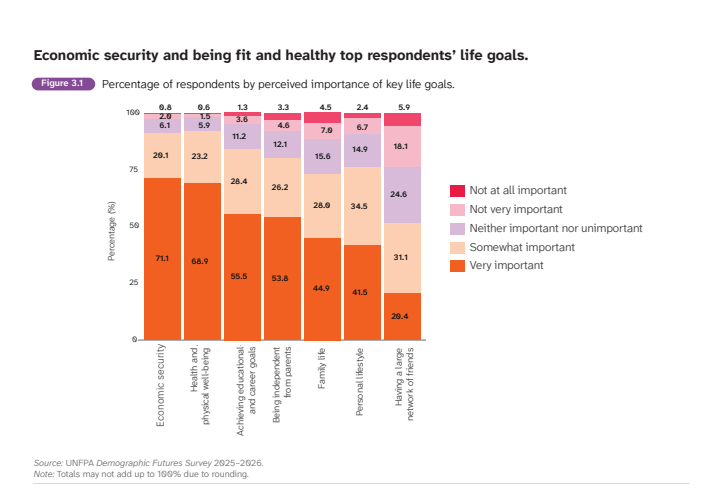
Conducted using data from 108,926 adults aged 18 to 39 in 73 countries and territories with internet access, the survey challenges the widely accepted view that demographic decline leads to giving up on family.
In fact, over two-thirds of the young adults surveyed still want to marry or live with a partner, and a majority cite a two-child family as their ideal, in five of the seven UN regional groupings. The change, according to the survey findings, has not been a desire among children but rather a willingness among young people to believe they can afford them. The overwhelming majority of participants – 81 percent – regard financial security as a precondition of entering a relationship, and 88 percent feel it necessary before having children. For the two-thirds who identify economic or housing insecurity as a factor limiting their fertility, the price of a dream deferred is paid disproportionately by women: Nearly a third 29 percent surveyed say they would disapprove of a mother of a young child (younger than 3) taking full-time employment, as compared with only one fifth (20 percent) who feel similarly of a father taking a similar job.
UNFPA executive director Diene Keita describes this report in her foreword as “a story of hope.” It is also a story about unfulfilled expectations due to circumstances.
In the case of India, that’s more precise than usual. A Sample Registration System report released by the Indian government this past year estimated its total fertility rate at just about 1.9 to 2.0, falling below the 2.1 number for replacement. The sixth National Family Health Survey indicated similar trends.
In a recent survey of 1,722 Indians, women aged 18 to 39 said an ideal family has 2.1 children, while those aged 35 to 39 had an average of 1.0 child. Males wished for an ideal 2.2 children, and averaged 1.1. Indians ages 18-34 are mostly hopeful about their future, with 83% believing they’ll have a better future than their parents did. But, almost half are concerned with inequality and economic insecurity. “Young people across India are telling us they remain hopeful about their futures,” said Andrea Wojnar, UNFPA Representative in India, adding that now “we have to see if that hope is met with opportunities.” For development economist Dipa Sinha, who analyses India’s social policy, “more opportunities for girls’ education, for access to contraception and for their empowerment in decision-making, in addition to a rise in the cost of bringing up children,” explain the decline in birth rates.
The goal of India’s 2000 National Population Policy to reach a total fertility rate of 2.1 will be achieved through India’s federal framework on family planning. But it is not able to offer the needed facilities for Indian parents who want a larger family, but are having trouble bearing one. Therefore, Indian states have individually developed solutions to the growing problems.
For example, in Andhra Pradesh, any Indian parents who bear a third child can be given Rs 30,000. In Karnataka, Goa, and Telangana, but, money has been put into facilities for Indian parents who wish to use fertility treatment to increase their family.
A strategy South Korea has pursued at a far larger scale and over a longer period: Seoul has invested in baby bonuses, fertility treatment subsidies, and longer parental leaves to raise the fertility rate that has fallen to about 0.7 children per woman, spending more than $200 billion over sixteen years with minimal positive returns.
In most cases, an economic analysis suggests that most children born under South Korea’s localised baby-bonus programs would likely have been born anyway. As Heather Barr of Human Rights watch notes: “As women are increasingly educated and join the workforce, they simultaneously continue to face very deep levels of gender inequality at work and in the home.” UNFPA’s own recommendations reinforce this same argument: the report encourages countries to shift from focusing on fertility reduction as the management goal, and to rather invest in the prerequisites of a stable family- that is, inexpensive housing, availability of affordable childcare, parental leave policies, which are equitable across genders, and security of employment- rather than focusing on incentives, so that young people can start the families they already claim to desire. For India, a country on the verge of a demographic change similar to South Korea’s, yet decades away from its extremity, this evidence serves less as a cautionary note than as an opportunity to choose a different approach one where society nurtures conditions for families before cash bonuses become the government’s only resort.
Clear Cut Health Desk
New Delhi, UPDATED: July 14, 2026 17:35 IST
Written By: Yatharth Pathak