
- India has approved its first-ever dengue vaccine, Qdenga, for people aged 4–60 years, marking a major milestone in dengue prevention. The two-dose vaccine is currently available only through the private market and complements existing vector control measures.
- While Qdenga has demonstrated strong safety and efficacy globally, its protection varies across dengue serotypes and declines over time. Concerns over affordability and its exclusion from the Universal Immunisation Programme (UIP) remain key challenges for equitable access.
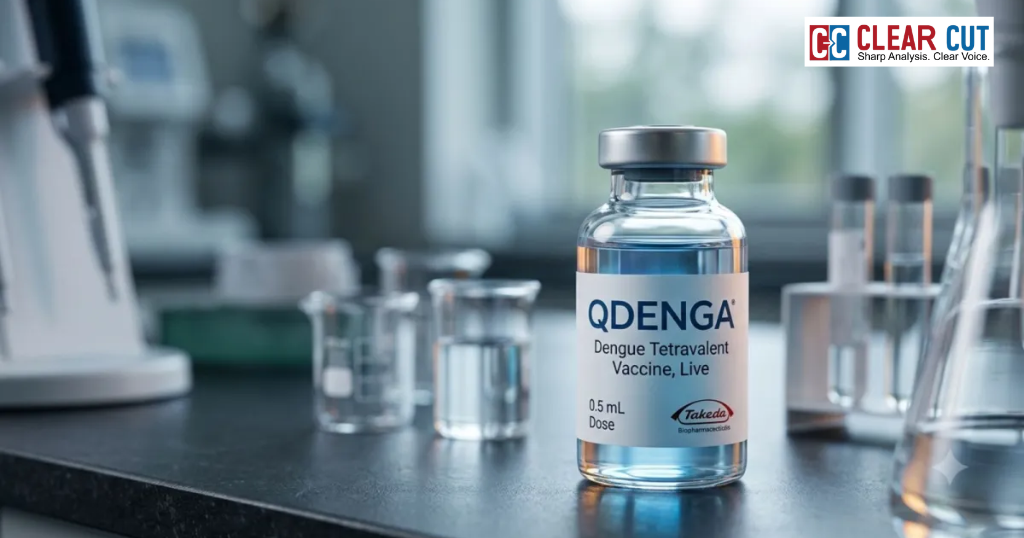
India is set to receive its first-ever dengue vaccine after the Central Drugs Standard Control Organisation (CDSCO) granted marketing authorisation for Qdenga, a tetravalent dengue vaccine developed by Japanese biopharmaceutical giant Takeda and manufactured at its facility in Germany. The vaccine received the marketing authorisation on 21 July 2026, as confirmed by India’s Ministry of Health and Family Welfare, for people aged between 4 and 60 years. It will be given in two hypodermic doses, three months apart. Qdenga has a strong clinical development profile, with a specific Phase III safety and immunogenicity study conducted specifically in the Indian population, built on a global study program that enrolled patients in eight countries, including Thailand, Sri Lanka, and Brazil.
This isn’t new to the world, though. It’s already approved in 42 countries, including the EU, the UK, and Indonesia; it has the WHO prequalification, and has been given to more than 24 million people around the world with a safety record considered favourable by regulatory agencies. But what’s new is that India – a country with one of the world’s heaviest dengue burdens – now has a dengue vaccine available at all. “This approval represents a significant step towards improving dengue prevention in India,” Mahender Nayak, Takeda’s Head of Intercontinental Markets, said in a statement.
Data from government surveillance offers insight into the scale of the issue the vaccine aims to address. In India, annual dengue cases ranged from 193,245 to 289,235 from 2021-2024, with the highest number of deaths during this period, reaching 485 in 2023, according to National Centre for Vector Borne Diseases Control figures. By 2025, the caseload declined to 121,824. Still, the load was never uniformly shared – during 2023-2024, put together, the state of Kerala was responsible for nearly one-third of the nation’s dengue deaths while having less than one-tenth of the country’s cases – a difference more in tune with each state’s capacity for diagnosis and care rather than simply insect populations.
Globally, the dengue crisis peaked this year: In 2024, according to the World Health Organization logged over 14.6 million cases and more than 11,000 deaths occurred across its six regions, a level attributed to warming temperatures, unpredictable rainfall, and disorganised urbanisation, all contributing to an increased breeding habitat for the Aedes mosquito.
Free Immunisations Developed over Four Decades
Qdenga comes at a time when the Indian system has had almost five decades to create and maintain a routine immunisation architecture. This first took shape as the Expanded Programme of Immunisation began in 1978, using four vaccines; it was renamed the Universal Immunisation Program (UIP) in 1985, and new vaccine antigens have been introduced almost every decade. Since 1992-93, when the first National Family Health Survey (NFHS-1) recorded 35% coverage, the rate of child immunization reached 76.4% in the latest one (NFHS-5; 2019-21).
| Year | Vaccine / Initiative | Milestone |
| 1978 | BCG, OPV, DPT, Typhoid-paratyphoid | Expanded Programme of Immunisation (EPI) launched, largely in urban centres |
| 1983 | Tetanus Toxoid | Added for pregnant women, to prevent maternal and neonatal tetanus |
| 1985 | Measles | EPI renamed Universal Immunisation Programme (UIP); six diseases covered nationally |
| 2002 – 2003 | Hepatitis B | Piloted in 33 districts and 14 cities |
| 2006 | Japanese Encephalitis | Introduced in high-endemic districts |
| 2011 | Hepatitis B (national) + Hib | Hepatitis B scaled nationwide; Hib piloted in Kerala and Tamil Nadu |
| 2014 | Pentavalent (DPT-HepB-Hib) | Extended nationwide; Mission Indradhanush launched to boost coverage |
| 2015 | Inactivated Polio Vaccine (IPV) | Added under the global polio endgame strategy |
| 2016 | Rotavirus vaccine | Piloted in select states, later expanded nationwide |
| 2017 | Measles-Rubella; Pneumococcal Conjugate (PCV) | MR replaces measles-only dose; PCV introduced in phases |
| 2021 | PCV10 (Indigenous) | First made in India pneumococcal vaccine licensed |
| 2026 | Dengue (Qdenga) | First dengue vaccine approved; private market only, ages 4-60 |
Table: Major additions to India’s routine immunisation schedule, 1978–2026. Sources: National Health Mission; Indian Journal of Medical Research.
“The 2014 rollout of Mission Indradhanush to accelerate the reach to under-performing districts resulted in a 27% increase in the rate of fully-immunized children in the targeted districts and an estimated saving of about 1,413 child deaths in 2024, says the analysis on cost-effectiveness,” stated the government source.
The Vaccine with True Concerns
Qdenga’s shield does not provide uniform protection against the four dengue serotypes. The vaccine is based on a live-attenuated DENV-2 virus, and so there is robust protection against this serotype, regardless of previous dengue infection. Protection against the other three serotypes is dependent on prior infection.
Qdenga’s shield does not provide uniform protection against the four dengue serotypes. The vaccine is based on a live-attenuated DENV-2 virus, and so there is robust protection against this serotype, regardless of previous dengue infection. Protection against the other three serotypes is dependent on prior infection.
For dengue-naive children below the age of six, there are concerns that there may be an increased risk of severe illness following a later DENV-3 or DENV-4 infection. This is the same issue that undermined Sanofi’s Dengvaxia in the Philippines, where a campaign that failed to make this distinction contributed to hospitalizations and long-term public mistrust. The CDSCO’s Subject Expert Committee placed a safety and efficacy study within six months of launch as a post-marketing condition for its March recommendation.
Who Gets to Be Protected First
And this is where the narrative moves from science to access. Unlike all other vaccines listed in the table above, Qdenga has not been incorporated into the UIP and will therefore not be available free of cost in government centres for now. Industry analysts place the full two-dose treatment price in the private market at between 6,000 and 12,000 – clearly unaffordable for daily-wage and informal workers who form a large chunk of India’s urban population. But that’s exactly where dengue is most concentrated, because those neighbourhoods are usually crowded and poorly drained.
There are two reasons this may change eventually: Hyderabad-based Biological E has teamed up with Takeda to manufacture it in India, and Panacea Biotec is testing its own vaccine in collaboration with ICMR and is in the midst of its phase III trial.
But don’t expect prices to shift any time soon.
How India’s Approval Compares
India becomes the second dengue-endemic country after Indonesia to approve the vaccine. While Brazil is now offering the vaccine in its public immunisation system, as opposed to being just an option in the private sector, India’s approved range is more expansive. Unlike the WHO’s recommendation that the vaccine be targeted at those aged 6 to 16 in areas with heavy transmission, which tend to have higher case burden, India will offer Qdenga to a broader age group.
What Comes Next
According to the Health Ministry, Qdenga is to supplement – not substitute – the surveillance, case management, and vector control activities in the National Vector Borne Disease Control Programme: streets will still need to be sanitized and mosquito larvae controlled, year after year, whether vaccine or not. The more critical question, still unasked and unanswered publicly, is: will Qdenga or its successor ever make it to the free immunisation calendar, which covers most children in India? For the time being, only those who can afford to demand the vaccine will get it.
Clear Cut Health, Research Desk
New Delhi, UPDATED: July 21, 2026 17:35 IST
Written By: Yatharth Pathak