
- One Nation One Ration Card (ONORC) has transformed India’s Public Distribution System by enabling beneficiaries, especially migrant workers, to access subsidized food grains from any Fair Price Shop across the country using Aadhaar-based authentication.
- The scheme has significantly improved food security and welfare portability, but challenges such as biometric authentication failures, low awareness, connectivity issues, and administrative coordination continue to affect its full potential.
- ONORC serves as a model for a portable welfare system, highlighting the need for stronger institutional support, awareness, and expansion of portability to other social welfare schemes.
The Problem of Residence-Locked Entitlements
India’s welfare policies have been based on a simple yet incorrect premise that people stay where they’re born for decades. Most welfare schemes were designed around fixed residences, and not on a individual citizen. This model worked in a less mobile society, but is becoming increasingly at odds with today’s India, which sees millions of people moving annually for various reasons including employment, education, and improved opportunities.
One of the largest social protection programmes in India is the Public Distribution System (PDS) which best exemplifies this paradox. The National Food Security Act (NFSA), 2013, provides for distribution of subsidised food grains under ration cards to almost 80 crore beneficiaries. But until recently, a Bihar ration card was virtually not accepted in Gujarat, Delhi or Maharashtra. In a country, as India has more than 5.4 crore internal migrants, according to the 2011 Census, the seasonal labourers, construction workers, domestic workers and other non-regular workers who went from one bordering state to another, often found themselves without any access to food security the moment they moved across the state border.
The people who were the most vulnerable to economic insecurity were the least likely to be able to receive welfare services. In August 2019, the government launched the One Nation One Ration Card (ONORC) scheme to fix this structural flaw, and it has been one of the biggest initiatives in India to achieve portable welfare.
How ONORC Works: Making Food Security Portable!
ONORC is based on a straightforward, but powerful principle that welfare should go with the person, not the place. The scheme has 3 technological pillars. Firstly, the Aadhaar seeding makes the beneficiary’s biometric identity a unit of entitlement instead of the address, which is the default unit of entitlement. Secondly, the electronic Point of Sale (ePoS) devices at Fair Price Shops (FPS) are used to verify beneficiaries using their f ingerprint or iris scan. Thirdly, the Integrated Management of Public Distribution System (IM-PDS) has been designed as connecting state databases to a common national database.
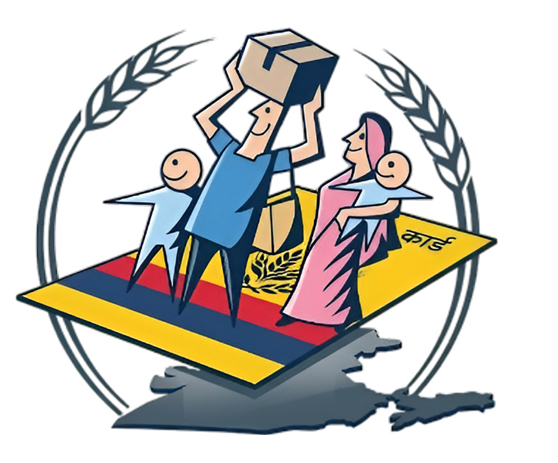
It’s easy to do. In India, a migrant worker can go to ePoS setup ration shop and can say a word to get the food grains as per his/her entitlements. The transaction is automatically captured and offset with their state of origin’s allocation. Partially portable is one of the most innovative features of ONORC. A migrant worker can pick up his/her portion of food grains at the destination whereas family members who stayed back at the village can go to the ration shop at the village to collect the remaining portion. Such f lexibility is important to meet the needs of migrant families in split households.
The government also launched the Mera Ration mobile application in 13 languages to make the application more accessible, giving beneficiaries the ability to f ind the nearest Fair Price Shops, see their transactions history and entitlements.
Rapid Expansion and Significant Achievements
The implementation of ONORC accelerated dramatically during the COVID-19 pandemic. With millions of migrant workers stuck far from home during lockdowns, the need to take a more comprehensive approach to the issue of welfare was clearly made evident. ONORC started in four pilot states, in August 2019, and spread to all 36 states & UTs by mid2022, Assam being the last state to join. Today, the programme is implemented with over 20 crores of ration cards and nearly 80 crores beneficiaries in more than f ive lakhs of Fair Price Shops.
Technological infrastructure of the scheme has also improved a lot. Almost 80 per cent of cards of the NFSA ration cards have been Aadhaar-linked and more than 97 per cent of Fair Price Shops are now having biometric ePoS. Ever since its inception, ONORC has been handling over 124 crore portability transactions, which translates to some 3 crore transactions per month on average. The effect is more than just in numbers. In the pandemic alone, over 24 crore portability transactions were made possible to get food security to those migrants who were stranded away from their home state. Research carried out by the states with a greater number of early adopters, like Andhra Pradesh, Karnataka, Rajasthan, Jharkhand and Uttar Pradesh, showed that beneficiaries welcomed the additional freedom of choice and greater responsibilities given to the ration dealers.
Note that non-migrant populations also have benefited from ONORC. However, earlier the beneficiaries had to rely on a particular dealer who often was a monopoly in a locality. The element of competition has arisen with portability, allowing people to select the ration shop with the better performance. Also, digitisation has helped to enhance transparency. Aadhaar authentication and e-keeping the records has minimized duplicate beneficiaries and ghost ration card in PDS leakages.
Why the Scheme Is Still Falling Short
Coverage is not ONORC’s problem, its biggest challenge is usage at the immense scale at which it operates. The scheme, which was designed for longdistance inter-state migrants, is still not being used to its full potential by them. Most of the portability transactions are intra-state, intra-district instead of inter-state, according to researchers. That many migrants still have difficulties accessing the system is a sign that there are still additional obstacles.
One of these is the use of technology. Manual labourers might face problems during biometric authentication as their f ingerprint might get damaged after years of working as manual labourer. Often rural ration shops have weak internet connectivity, which is detrimental to a system which is entirely dependent on real time verification.
The field study highlighted that despite the awareness of ONORC among the migrant workers at brick kilns, only 70 per cent of them had heard of ONORC, 50 per cent had tried to use portability and only 59 per cent had succeeded. This shows a significant awareness / access barrier. There is also some inconsistencies in awareness. Many migrants simply don’t understand that they have other states’ ration cards that they can use outside their home state, or that they can ask for an unfamiliar benefit of their local dealers.
Administrative incentives result in yet another issue. Immediate food grains distribution is the responsibility of destination states and reimbursement/reconciliation with source states may take a longer time. This sets a mild discouragement for the local dealers to enjoyably enter the market with the beneficiaries. There are also new compliance requirements that pose risks. The mandatory e-KYC verification processes of recent years may end up excluding those targeted by ONORC. Excluding a verification deadline can impact benefits and may be a disproportionate effect on mobile and under-documented households.
There has also been concerns due to privacy issues. Technological failures can lead to a loss of access and thus result in deprivation of a fundamental right, for access is greatly dependent on biometric authentication.
Beyond Food Security: Building a Portable Welfare State
The role of ONORC is so much more than distributing rations. It provides a design for rebooting the whole welfare structure in India. There are already several welfare schemes in operation in India, such as LPG subsidy and health insurance (Ayushman Bharat). Meanwhile the e-Shram portal is building a comprehensive database of workers not in the organised sector which could in the future help with portable pensions, maternity benefits and employment programmes. However, extending portability to other schemes will not be easy. For instance, MGNREGA provides jobs with gram panchayats and worksites in the area. To make employment portable, tools need to be reworked at the local level, not just simply the databases.
Likewise, verifying pension and disability schemes is a more complicated process than verifying food distribution. The risk is that, while food security portability is a successful experiment, it is challenging to do in other areas.
Making Portability Truly Work
The second step in ONORC should be institutional changes, not technological innovations. First, it should be clear that destination states will be compensated in a timely fashion, which would prevent the local dealers from having a vested interest in discouraging beneficiaries from coming from elsewhere. Second is that India desperately needs strong backup systems like one-time passwords, offline tokens or manual override registers to those with weak biometrics. Third, Local awareness creation should be done directly in the labour contractors, railway stations, bus stands and the village panchayats in the migrant population. If the intended beneficiaries are unaware of technology, then it is not going to work for them.
Last, a few more schemes should be incrementally extended to the portability principle. If ONORC is to mark the beginning of a wider process, it will be crucial to implement portable pensions or maternity benefits to determine if this is the case.
One Nation One Ration Card has achieved a big achievement. It’s removed a welfare benefit from a certain address and linked that to someone. This signifies a shift in the concept of welfare from living in a house to citizens focused welfare. The scheme is also a good reminder of one important point, however the solution to social exclusion is not technological. The need for interoperable databases is important, but not enough. Trust, awareness, administrative coordination and institutional flexibility are also vital.
It will not be software systems that will decide the fate of portable welfare of India in the future. It will be based on the ability of the state to establish institutions which acknowledge a simple fact of the twenty first century India – people move and their rights must move too. The concept of a reform of ration distribution may eventually be the basis of a truly mobile welfare state, which moves with citizens, wherever they go.
About the Author: Subhanshu Jaiswal is Assistant Manager – MLE at DevInsights, a research, monitoring, evaluation, and learning (RMEL) organization that generates evidence to support informed decisionmaking in the social development sector.
Clear Cut Research Desk
New Delhi, UPDATED: July 22, 2026 09:00 IST
Written By: Subhanshu Jaiswal
Designation: Assistant Manager – MLE at Devinsights