

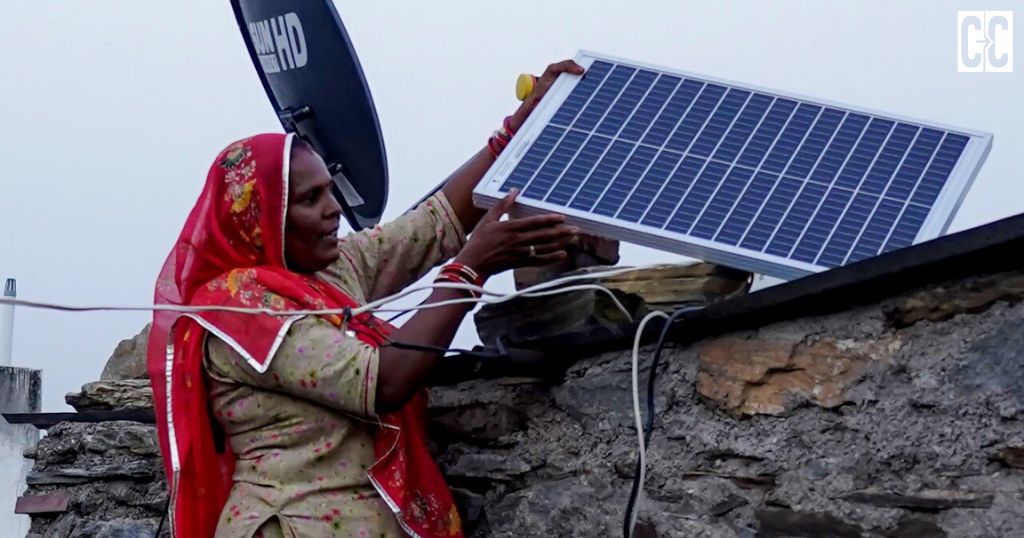
PM Surya Ghar has solarised 40 lakh homes. The government targets 1 crore by 2027. Each panel carries a 25-year lifespan. In roughly two decades, the clean energy that India is installing today will begin its journey toward becoming waste. The regulatory framework to manage that journey is still being written.
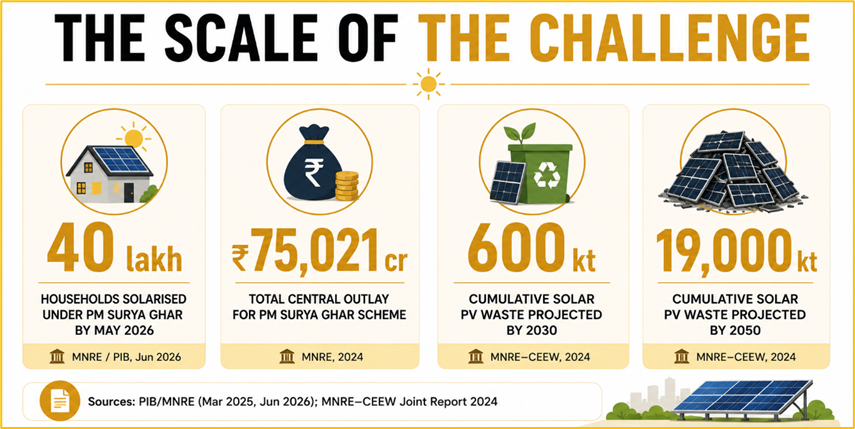
In February 2024, the Government of India launched PM Surya Ghar: Muft Bijli Yojana with an outlay of ₹75,021 crore, a target of one crore residential households, and the ambition of becoming the world’s largest domestic rooftop solar initiative. By March 2025, the scheme had crossed 10 lakh installations. By May 2026, the count was 40 lakh households, and the Ministry of New and Renewable Energy was targeting 75 lakh by December 2026, with monthly installations running at over three lakh a fortyfold increase from the 7,000 per month recorded before the scheme began.
The scale is remarkable and the intent is sound. India’s cumulative solar installed capacity crossed 110 gigawatts in 2025. The push toward renewable energy is accelerating, it is policy-backed, and it is achieving results.
But every solar panel that goes up today has a manufacturing date. And a roughly 25-year clock, after which it will need to come down.
The question of what happens when it does is one that India’s current policy framework has answered only in part. And that answer as documented in the government’s own rules, its regulator’s own draft guidelines, and its own commissioned research is a work in progress at the precise moment when the installations are happening fastest.
What Goes into a Solar Panel and Why It Matters at the End
A silicon-based solar panel is not a simple object. It is a laminated assembly of glass, semiconductor cells, metal conductors, polymer sheets, and an aluminium frame bonded together with adhesives designed to last decades. That durability, which makes the panel commercially viable, is precisely what makes it difficult to separate and process at end of life.
The Central Pollution Control Board’s draft guidelines of June 2025 flagged the specific hazardous substances that require controlled handling: lead, selenium, copper, silver, cadmium, arsenic, antimony, gallium, tellurium, and tin. These are not trace contaminants in a benign product. They are structural materials whose improper disposal into landfill or through informal dismantling poses documented risks to soil, groundwater, and the health of workers in the informal recycling sector.
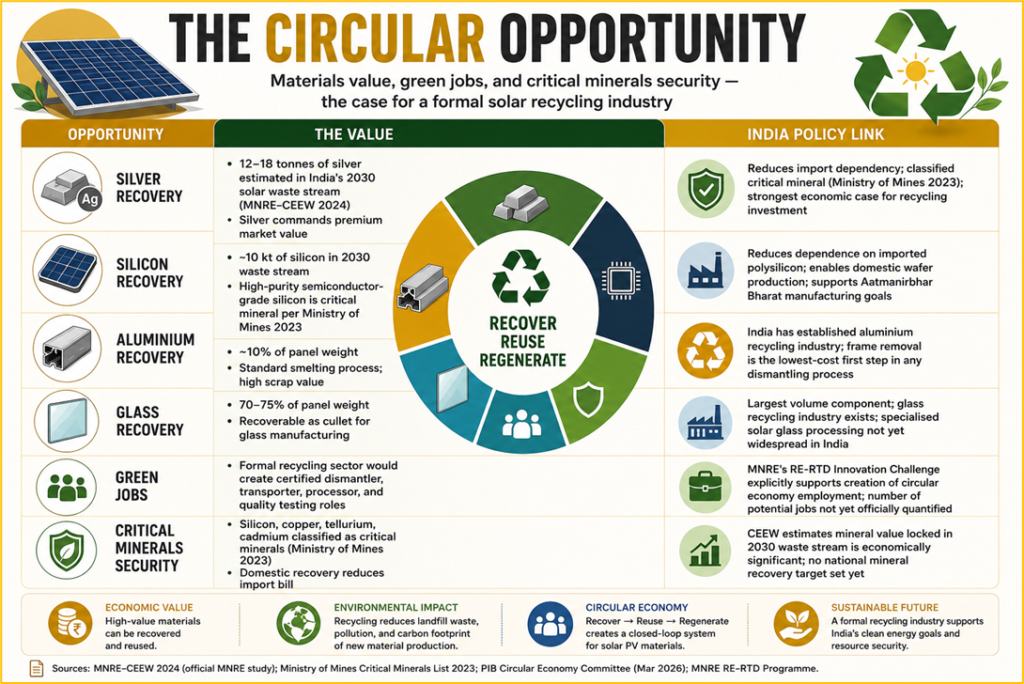
At the same time, these materials have significant recovery value. The Ministry of Mines classified silicon, copper, tellurium, and cadmium as critical minerals for India in 2023, meaning their recovery from domestic waste streams directly reduces India’s dependence on imported critical mineral supply chains a strategic as well as environmental consideration.
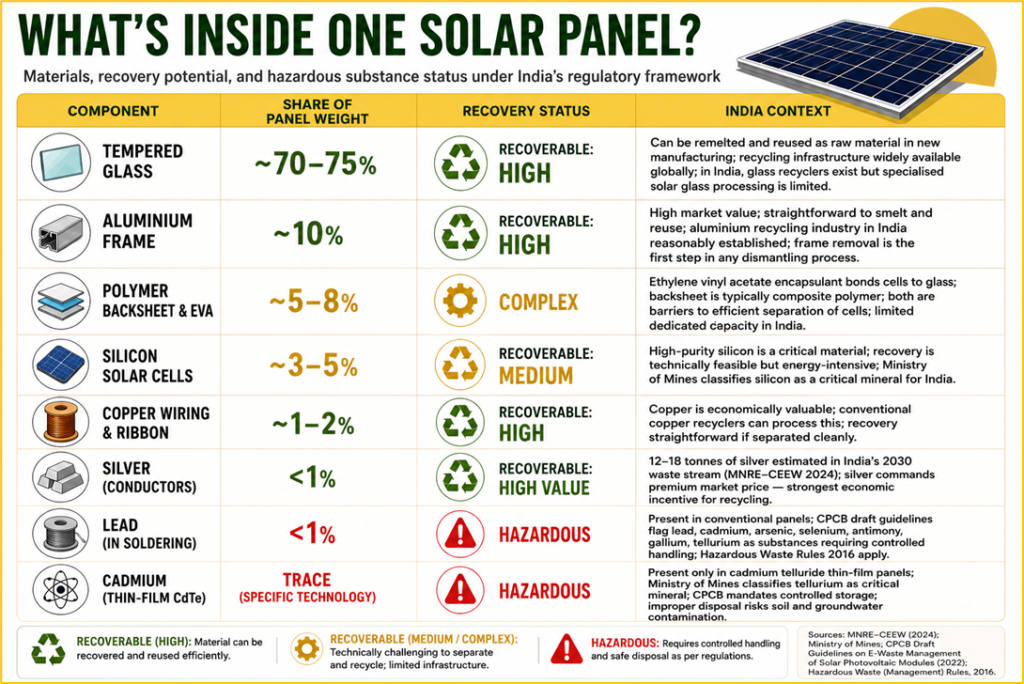
The composition of a panel determines both its value as a recycling feedstock and the complexity of the process required. Glass and aluminium roughly 80 per cent of panel weight combined are the easiest and most economically straightforward to recover. Silicon, silver, and copper are high value but require more sophisticated processing. The hazardous materials, though small in absolute weight, are the ones that the regulatory framework is most urgently needed to manage.
The Panel Lifecycle: From Rooftop to What, Exactly?
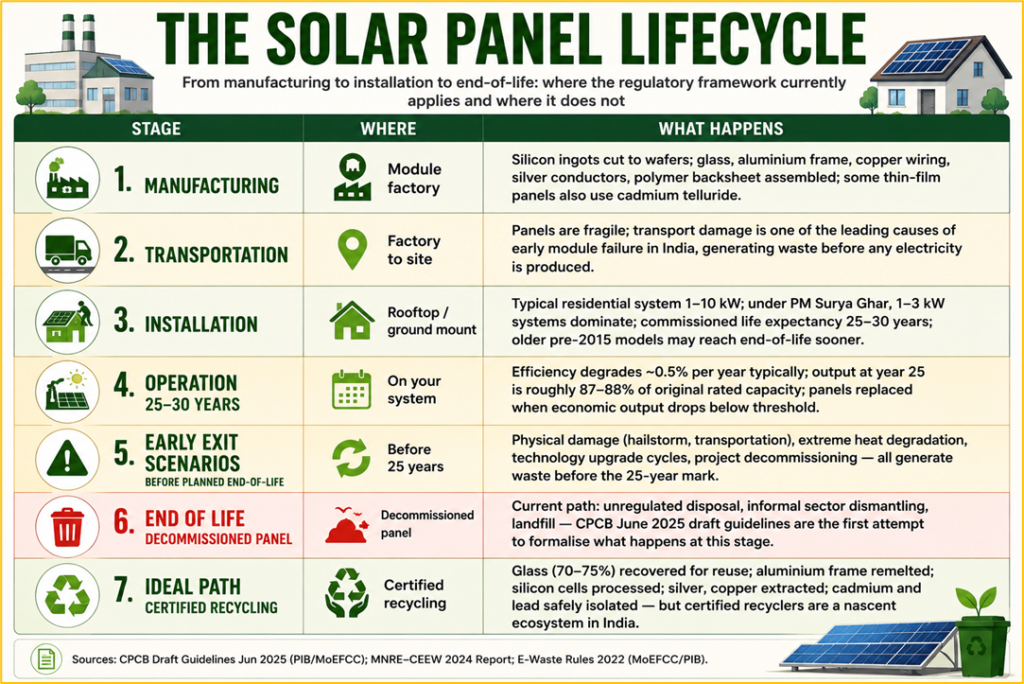
Solar panels sold under PM Surya Ghar today are warranted for 25 years. Some, particularly those manufactured before 2015 and installed under earlier MNRE programmes, may reach end-of-life sooner. Early retirement also occurs due to physical damage from hailstorms, transportation mishandling, extreme heat degradation, and technology upgrade cycles.
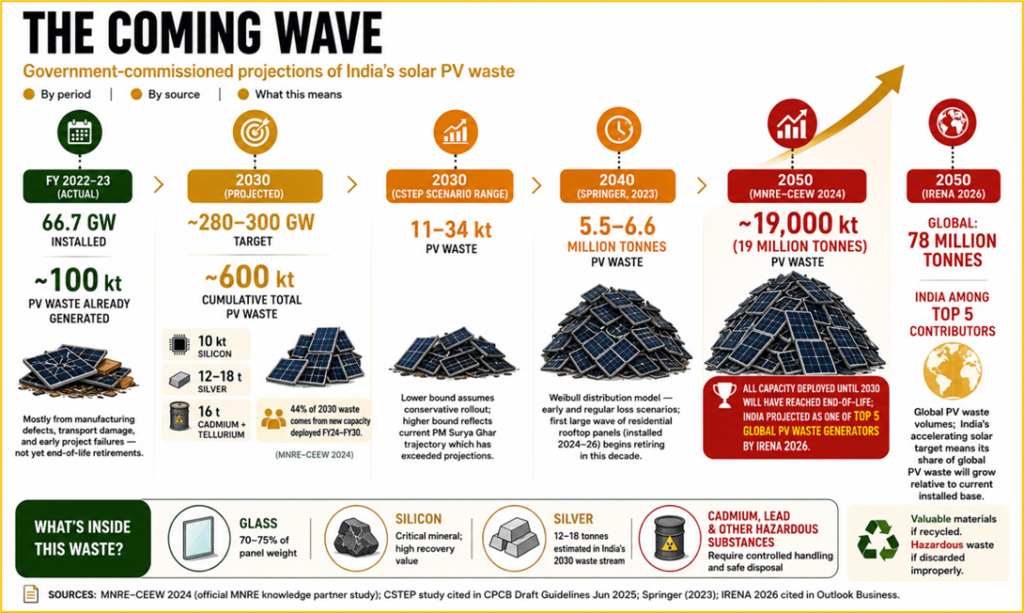
The MNRE and CEEW’s joint 2024 study produced with CEEW as the official knowledge partner for the NITI Aayog Circular Economy action plan for solar found that India’s 66.7 GW of installed capacity as of FY 2023 had already generated approximately 100 kilotonnes of waste, primarily from these pre-end-of-life sources.
The Coming Wave: What the Government’s Own Projections Say
The government’s official figures on projected solar waste are not speculative. They come from a study jointly produced by MNRE and CEEW, commissioned under the NITI Aayog’s circular economy action plan, with CEEW as MNRE’s designated knowledge partner.
The numbers are clear: India’s cumulative solar PV waste will reach approximately 600 kilotonnes by 2030 and 19,000 kilotonnes 19 million tonnes by 2050. Of the 2030 figure, 44 per cent will come from new capacity deployed between FY24 and FY30 meaning a significant share of the waste arriving in 2030 is being generated by installations happening right now, under PM Surya Ghar, this year.
The CSTEP study cited by the CPCB in its own June 2025 draft guidelines offers a different, higher projection: 4.5 million tonnes by 2050, based on a 64 GW baseline as of March 2023 a baseline that has since grown to over 110 GW.
A 2026 IRENA report cited by Outlook Business placed India among the top five projected global PV waste generators by 2050, with global PV waste expected to reach 78 million tonnes.
What the Regulations Currently Require and What They Don’t
India does have a regulatory framework for solar PV waste. The E-Waste (Management) Rules, 2022, notified by MoEFCC on 2 November 2022 and effective from 1 April 2023, included solar PV modules, panels, and cells in their ambit for the first time a significant step. Under Chapter V of the 2022 Rules, every manufacturer and producer of solar PV modules must register on the CPCB’s e-waste portal, store waste as per CPCB guidelines until FY 2034-35, file annual returns detailing quantities, and use only CPCB-authorised recyclers. There is a significant carve-out, however. The CPCB’s own FAQ on the 2022 Rules, issued in January 2024, confirms explicitly that solar PV waste is exempt from the EPR recycling targets that apply to all other 21 categories of electrical and electronic equipment. For every other category air conditioners, refrigerators, mobile phones, laptops, televisions producers are legally obligated to collect and recycle a defined percentage: 60 per cent in FY24–25, rising to 80 per cent from FY27–28. Solar PV producers face no such target.
POLICY VS. PRACTICE
What India’s regulatory framework currently mandates for solar PV waste – and where the gaps remain
| Policy / regulation | What it requires | The gap |
| E-Waste (Management) Rules, 2022 – Chapter V | MoEFCC, 2 Nov 2022; effective 1 Apr 2023. Solar PV modules/panels/cells included; producers must register on CPCB portal; mandatory storage till FY 2034-35; annual return filing; recyclers mandated for material recovery | Solar PV waste explicitly exempt from EPR recycling targets (unlike all other 21 EEE categories); no recycling quota imposed; no collection target; no take-back obligation timeline beyond storage |
| CPCB Draft Guidelines – Storage, Handling & Transport (Jun 2025) | India’s first dedicated solar waste framework; covers safe storage conditions, handling protocols, transport requirements, labelling, traceability database | Still in draft form as of Jun 2025; not yet notified as binding regulation; covers storage and transport only – no recycling standards, no recovery targets, no certified dismantler scheme yet |
| MNRE – RE-RTD Innovation Challenge | MNRE launched Innovation Challenge for Circularity in Renewable Energy Technologies – Solar PV under RE-RTD programme; supports R&D in recycling, second-life applications, circular design | R&D stage only; no commercial-scale certified recycling plants operational; no public list of CPCB-authorised solar-specific recyclers as of mid-2026 |
| NITI Aayog / MNRE – Circular Economy Committee | Committee on Circular Economy in Solar Panels constituted by MNRE; part of NITI Aayog’s 11-sector circular economy action plan; CEEW as knowledge partner | Action plan stage; no mandated implementation timelines publicly announced; PM Surya Ghar scheme already solarising 40 lakh homes with no mandatory end-of-life provision in subsidy framework |
| Hazardous and Other Wastes Rules, 2016 | Applies to panels containing lead, cadmium – classified as hazardous; controlled storage, transport and disposal required | State Pollution Control Boards responsible for enforcement; capacity varies significantly; informal dismantling sector largely outside compliance loop |
| PM Surya Ghar Scheme – warranty provision | REC guidelines (Nov 2024) mandate five-year post-installation maintenance and warranty period for scheme vendors | Warranty covers maintenance for 5 years; says nothing about end-of-life collection after 25 years; no EPR obligation built into subsidy terms; collection infrastructure not required of vendors |
Sources: PIB/MoEFCC (Nov 2022, 2023); CPCB Draft Guidelines (Jun 2025); MNRE–CEEW (2024); PIB Circular Economy (Mar 2026); CPCB FAQ (Jan 2024).
The June 2025 CPCB draft guidelines are the most specific document yet produced on solar waste management, addressing storage conditions, handling protocols, transportation requirements, and traceability. They are India’s first dedicated attempt to formalise what happens to a solar panel after it stops generating electricity. They are also, as of this writing, still in draft form not yet notified as binding regulation. And they cover storage and transport; they do not yet set recycling targets, define recovery standards, or establish a certified dismantler scheme.
The March 2026 PIB release on circular economy confirmed that committees have been constituted across 11 sectors including solar panels, and that MNRE has constituted a dedicated Committee on Circular Economy in Solar Panels. The CPCB’s EPR portal for e-waste is operational. The framework is building. What it is building toward a mandatory recycling quota, a producer take-back scheme, a network of certified collection centres has not yet been publicly announced with implementation timelines.
The Opportunity India Is Not Yet Capturing
None of this is an argument against solar energy. It is an argument for the second half of a clean energy transition: the part where the materials that make clean energy possible are not themselves treated as waste at end of life, but as inputs to the next generation of production.
The economic case for recycling India’s solar waste is made by the government’s own data. The 2030 waste stream alone is estimated to contain 10 kilotonnes of silicon, 12 to 18 tonnes of silver, and 16 tonnes of cadmium and tellurium all of them classified as critical minerals by the Ministry of Mines. Silver, at current market prices, is among the highest-value recoverable materials. The silicon recovered from end-of-life panels, if processed to semiconductor grade, directly reduces the import bill for a material that India’s domestic solar manufacturing programme central to Aatmanirbhar Bharat depends on.
The MNRE’s RE-RTD Innovation Challenge has identified this opportunity and is funding research into recycling, second-life applications, and circular design. The question is whether that research investment will be matched by the regulatory mandates the producer obligations, the collection targets, the certified facility network that turn research into industrial-scale practice.
The Subsidy and the Gap It Leaves
PM Surya Ghar’s design is, within its own terms, a well-constructed scheme. The subsidy up to ₹78,000 reaches the beneficiary directly via DBT. The five-year maintenance warranty is mandatory for registered vendors. Collateral-free loans through twelve public sector banks make financing accessible. Domestic manufacturing of modules and cells is mandated under Aatmanirbhar Bharat.
What the scheme does not contain is any provision for what happens to the panels it funds after their 25-year operational life. The vendor’s obligation ends at the five-year warranty. There is no EPR charge built into the subsidy to fund future collection. There is no requirement that the installer register the panel for eventual take-back. The 40 lakh households now participating in PM Surya Ghar have, in aggregate, no formal pathway for the end-of-life management of the equipment the scheme helped them install.
This is not a unique failure of Indian policy design. Germany and France created solar waste management frameworks years after their installation surges and are still working through the backlog of early installations. The difference is that India is still in the installation surge. The regulatory window to build end-of-life infrastructure alongside the installations, rather than after them, is open. Whether it remains open long enough to produce binding requirements before the waste volumes arrive is the policy question.
What a Complete Framework Would Look Like
The government has itself identified the components. MNRE’s Committee on Circular Economy in Solar Panels, the NITI Aayog action plan, the CPCB draft guidelines, the RE-RTD Innovation Challenge these are not unrelated efforts. They are the pieces of a framework that has been architected but not yet fully assembled into enforceable obligations.
A complete framework would require, at minimum: mandatory EPR recycling targets for solar PV producers, equivalent to those applied to every other e-waste category; a national network of authorised solar waste collection points, beginning in the states with the highest PM Surya Ghar penetration (Gujarat, Maharashtra, Uttar Pradesh); certified dismantler standards and a public registry of authorised solar recyclers; a material recovery schedule specifying minimum recovery rates for glass, aluminium, silicon, silver, and copper; and safe disposal protocols with enforcement for hazardous components containing lead, cadmium, and selenium.
Most of this is already within the existing legislative authority of MoEFCC under the E-Waste Rules 2022. The rules already classify solar PV as e-waste, require CPCB registration, and mandate CPCB-authorised recycling. What they do not yet do is set the recycling targets and the collection architecture that would give those requirements practical effect.
The Clock That Started in 2024
Every panel installed under PM Surya Ghar from 2024 onwards has a retirement date in the 2049–2054 range. That is distant enough to seem abstract. It is close enough that the infrastructure required to manage the retirement authorised recyclers, certified dismantlers, collection networks, processing plants needs to begin building now to be operational at scale when it is needed.
India does not have to navigate this without precedent. The E-Waste Rules 2022 are already a functioning model. The CPCB’s EPR portal works for twenty-one other product categories. The regulatory vocabulary EPR, authorised recycler, take-back obligation, annual return exists and is familiar to the industry. What is needed is for solar PV to be brought into the same framework as the television or the refrigerator: a product whose producer bears legal responsibility for its end of life, not just its first five years.
The PM Surya Ghar scheme is transforming India’s residential energy landscape and is doing so at a speed that would have seemed implausible five years ago. The question the scheme does not yet answer is the one that will define whether India’s solar transition is genuinely circular or simply a very large, very clean, and very temporary one-way trip from the factory to the rooftop to the landfill.
The 40 lakh households already solarised deserve an answer. The next 60 lakh deserve a framework that answers it before they install.
Clear Cut Climate Desk
New Delhi, UPDATED: August 01, 2026 09:00 IST
Written By: Shivangi Misra
Designation: Assistant Manager – MLE at Devinsights