- Rehana Khatun overcame disability and social scepticism to become a climate champion under the ECRICC project in coastal Odisha.
- She supports more than 200 beneficiaries through climate-resilient farming, livelihoods, government schemes, and climate education.
- Her journey highlights how disability inclusion and women’s leadership can strengthen community climate resilience.
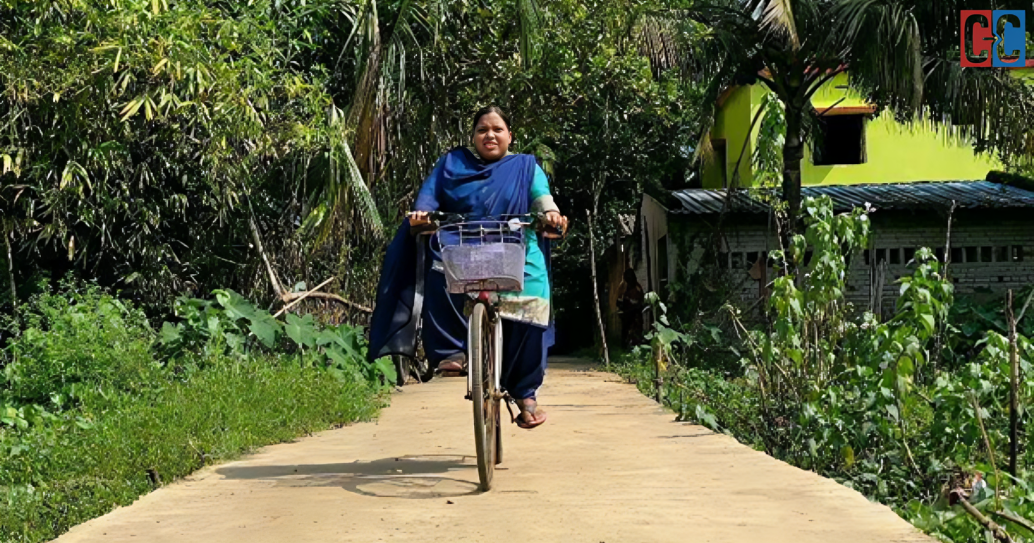
For years, Rehana Khatun’s world was the size of her family’s home in Kumbhirgadi, a small village in Odisha’s Balasore district. A spinal cord condition called myelitis, discovered in her school years, made doctors too nervous to operate. So, she stayed at home, filled her days with chores and a tailoring job, and waited for a future that never seemed to arrive. “The future felt like a long, flat road with no destination or purpose,” she says now. Today, at 25, she cycles those same village roads every day, an ID card swinging around her neck that reads, in effect, that she has become somebody entirely new.
A project looking for local leaders
This shift arrived in May 2023 through Enhancing Climate Resilience of India’s Coastal Communities (ECRICC), a collaboration among the Green Climate Fund, the Indian Ministry of Environment and Forests, the Odisha Government, and UNDP. The project required local ‘climate champions‘ who could take its efforts from house to house in coastal villages susceptible to cyclones. Rehana was selected by the Balasore Social Service Society, which coordinated operations on the ground, not despite her disability, say project staff, but on the merits of her demonstrated capabilities for the work.
Doubt, and what she did with it
No one voiced opposition when Rehana began, but scepticism was there nonetheless regarding the ability of a physically impaired young girl to get involved in field work and whether the villagers would trust her at all. “Doubts were raised, and then I just didn’t entertain them or reply,” she says. “When talks reached a standstill, I would simply re-emerge and give another explanation, and when even that didn’t work, I would bring in someone from the project team to lend a helping hand.” More than confidence, she needed patience.
What she actually teaches farmers
Today, Rehana is teaching villagers techniques to cultivate paddy using SRI methods, mud crabs, and ornamental fisheries (all chosen for their robustness in the vagaries of the weather in Odisha). She helps village families to start goatry and poultry units and links them to social welfare schemes in the government that they knew nothing of. She estimates that she has been directly responsible for the transformation in the lives of over 200 beneficiaries, while also reaching schoolchildren and youth with climate education in her locality.
Her family’s view of the change
Her father, S.K. Jamsed, a teacher, however, recalls the days leading up to ECRICC in a way very contrary to the picture that Rehana currently presents: “We provided our daughter with a normal childhood as we possibly could… But we did somehow feel that she was not content.
She never complained nor grumbled; however, something was still not well.” Haripriya Chand, the district coordination associate, who actually nominated her for the post, is even clearer: “Rehana proved that she is a fighter… Rehana was selected purely on merit and not on the basis of her situation.”
A new name and what it brought her
In Kumbhirgadi, she is no longer just Rehana. She is ‘ECRICC Didi,’ a title that carries real social weight in a region where a woman’s mobility once defined her worth. The pay that comes with the role has changed something more personal, too. “Earlier, for every small need of mine, I would be dependent on my family. Now, with the remuneration I receive, I am able to purchase things for them,” she says. “I am living in the hearts of people. I am living with dignity.”
The way forward
Climate programmes across India usually focus on achieving the target of having secured or tonnes of carbon dioxide equivalent averted. But Rehana Khatun offers a story that the final kilometre of climate resilience is served by a person, on a bicycle, delivering a pitch on which the recipient had initially balked – twice. Programmes such as ECRICC can move community-level disability inclusive hiring from “nice-to-have” into the realm of core design, a finding they only “discover” on completion rather than build into inception. Odisha’s coastline will continue to flood, but Rehana’s example demonstrates that how communities weather the challenges, and who they rely on for assistance, may not be who one anticipated.
Clear Cut Climate Desk
New Delhi, UPDATED: August 27, 2026 14:58 IST
Written By: Tanmay j URS