
A comparative look at UNICEF’s newly released 2026 HIV estimates, and what the same testing and treatment gaps look like in India and beyond
New UNICEF estimates, based on a total global HIV positive population of nearly 41 million, state that in 2025, there were 2.27 million children and adolescents (aged 0-19) living with HIV. In that same year, approximately 240,000 children and adolescents contracted the infection, and 74,000 died of AIDS. As a portion of the global total, they are not enormous. Still, the data shows they are continually slowest to get to diagnosis, medication, and care that have made the HIV infection treatable in most adults.
The gap widens sharply for children under 15. Of the 1.26 million children aged 0–14 living with HIV in 2025, only 65 percent knew their status, compared with 89 percent of adults. Just 55 percent were on antiretroviral treatment, compared with 79 percent of adults, and only 47 percent had a suppressed viral load — the point at which the virus stops damaging health and can no longer be transmitted. In practice, that gap meant roughly 255 children acquired HIV and 167 died of AIDS-related causes every single day of 2025
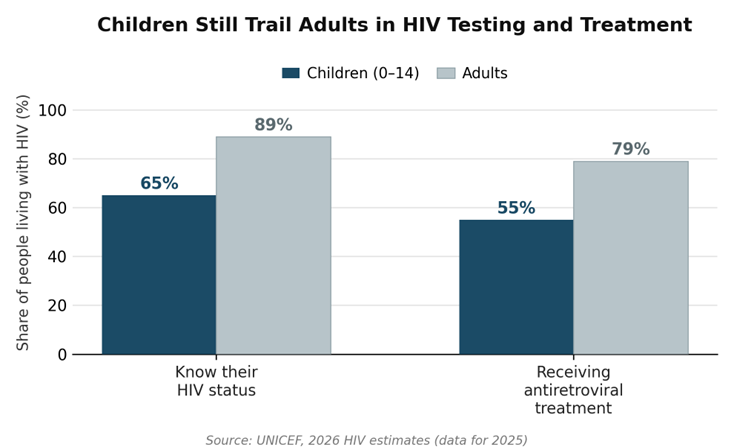
Children living with HIV are less likely than adults to know their status or be on treatment, 2025
UNICEF released the figures alongside the UNAIDS Special Report for AIDS 2026, presented at the International AIDS Conference in Rio de Janeiro in July, which warned that cuts to international financing, including reductions to major donors such as the United States’ PEPFAR programme, are disrupting HIV services built up over two decades. Anurita Bains, UNICEF’s Associate Director for HIV/AIDS, has said ending AIDS in children remains “in jeopardy without focused action,” warning that halving current programme coverage could push new child infections to 3 million and deaths to 1.8 million by 2040. Clinicians and advocates who gathered in Rio converged on a similar message: despite decades of scientific progress, children keep being the last to benefit from it.
India illustrates the same pattern from a very different starting point. The country counts an estimated 2.5 million people living with HIV, of whom children make up only about 2.5 percent of cases, or tens of thousands nationally. Union Health Minister J.P. Nadda told India’s own World AIDS Day event in December that new infections had fallen 49 percent and AIDS deaths 81 percent since 2010, with 88 percent of people living with HIV now on treatment. That national aggregate hides a familiar pediatric lag: the National AIDS Control Organisation set up a dedicated pediatric HIV programme, including seven specialist treatment centres, precisely because children’s treatment coverage trailed the adult rollout for years. As recently as 2013, NACO’s own figures showed barely 30 percent of children estimated to be living with HIV were on treatment, even as the adult programme scaled rapidly.
All around the world, that imbalance is most clear in sub-Saharan Africa, where some 86 percent of all children with HIV – or living with the disease – reside, and where adolescent girls continue to bear the brunt of new infections. But what the cities share, from Rio to New Delhi to Nairobi, is less a purely physiological question than one of structure. A child can’t pop into a clinic and get tested – it takes someone, either a caregiver seeing something wrong, or a mother going for prenatal testing, for us even to find out there’s a need.
And for decades, treatment itself was developed, then packaged, then dosed, for adults; child formulations often came last.
In the simplest terms, it’s an equity issue piled on top of a medical issue, since those most in need often are least able to speak up for themselves. UNICEF estimates provide four key priorities to plug the gap – ending mother-to-child transmission and the ‘triple elimination’ of HIV, syphilis, and hepatitis B; rapid diagnosis and child-friendly treatment; scaling up prevention for girls; and stronger data systems to monitor gaps in services when funding is restructured. If those priorities withstand a difficult funding climate, according to UNICEF, “it will determine whether the reduction of children’s AIDS-related deaths over two decades begins to continue or move backward.”
Clear Cut Health Desk
New Delhi, UPDATED: August 27, 2026 18:30 IST
Written By: Yatharth Pathak