

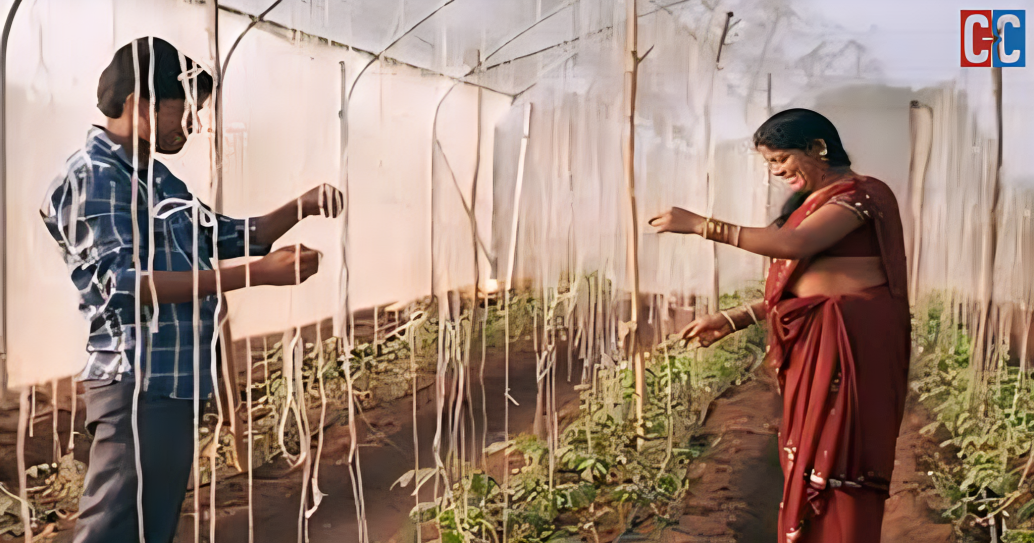
- Kheyti’s Greenhouse-in-a-Box helps India’s small farmers increase yields while using significantly less water and reducing farming costs.
- The model combines affordable greenhouses with loans, seeds, fertilisers, and market access to support farmers beyond just the technology.
- After winning the 2022 Earthshot Prize, Kheyti aims to reach one million farmers with its climate-resilient agriculture model.
Roughly 100 million families in India farm small plots and lose money doing it, on average, year after year. Kaushik Kappagantulu did not come to this problem through agriculture. He spent his first five years out of college helping school dropouts find jobs through vocational training, and noticed something troubling: nearly every trainee came from a farming family that was quietly giving up on farming. In 2015, he co-founded Kheyti with three others to try something unusual, shrinking the greenhouse, one of agriculture’s most expensive tools, down to a size and price a one-acre farmer could actually afford.
What’s actually inside the box
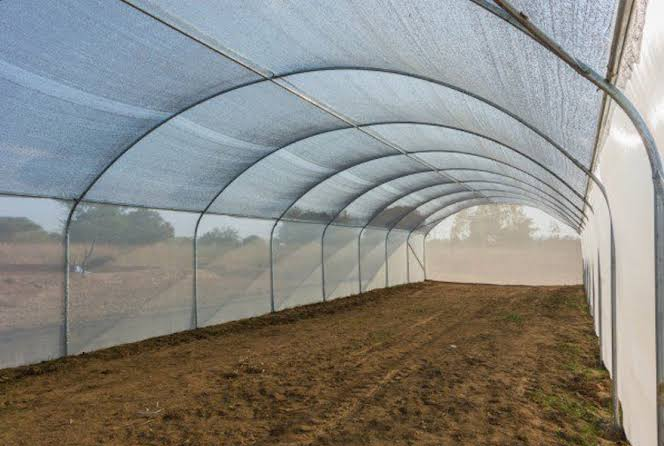
Kheyti’s Greenhouse-in-a-Box is a modular structure covered in insect netting and shading cloth, built with a drip irrigation system, and sold along with starter seeds and fertiliser. It costs roughly 90 percent less than a standard commercial greenhouse and uses up to 90 percent less water. Independent figures cited by the Earthshot Prize describe yields rising seven-fold compared to open-field farming, while water use drops by as much as 98 percent inside the structure.
More than a structure
Kaushik is clear that the greenhouse alone was never going to fix the underlying problem. Kheyti bundles it with loans arranged through partner banks, seed and fertiliser supply chains, and market linkages that help farmers actually sell what they grow at a fair price. “We work with banks to help farmers get loans, we work with import companies to get farmers seeds and nutrients, and we work with market companies to help farmers sell their produce,” he has explained. The greenhouse is the visible part; the surrounding services are what make it usable by a farmer with almost no working capital.
The Earthshot prize and what changed after
In 2022, Kheyti won the Earthshot Prize, founded by Britain’s Prince William, in the Protect and Restore Nature category, along with £1 million in prize money. At the time, roughly 1,000 farms had a Kheyti greenhouse. Kaushik has said the recognition mattered less for the money than for the doors it opened: new investors, NGOs, corporate partners, and government contacts followed, alongside a team that doubled in size.
The farmer who shaped the design
The Greenhouse-in-a-Box was not designed in a lab. Kaushik has traced the idea back to a 1.8-acre farm in Narayanpur village, where a farmer named Venkatesh and his wife Lakshmi were earning barely ₹30,000 a year despite owning land, because their borewells ran dry every summer. Venkatesh’s repeated, practical feedback pushed Kheyti’s team toward an even smaller, more affordable version of the greenhouse than they had originally built, a reminder that the product only works because it was shaped by the people who would actually have to use it.
The scale kheyti is chasing
The organisation’s stated goal is to reach one million farmers within a decade of its founding. That is a jump of three orders of magnitude from where it stood at the time of the Earthshot win, and it depends on Kheyti proving the model can be delivered and serviced at a distance, not just demonstrated on a handful of pilot farms near Hyderabad where the idea first took shape in 2017.
The way forward
A greenhouse that costs a tenth of the standard price is a genuine engineering achievement, but the real innovation in Kheyti’s model is refusing to sell a farmer a box and walk away. Loans, seeds, and market access are unglamorous, and they are also the reason most agri-tech pilots in India never survive contact with a real farmer’s cash flow. As Kheyti scales toward a million farms, the government’s own climate-resilient agriculture schemes should study this bundled approach closely, because subsidising a greenhouse without subsidising the farmer’s ability to sell what grows inside it solves only half the problem India’s smallholders actually face.
Clear Cut Climate Desk
New Delhi, UPDATED: August 28, 2026 06:30 IST
Written By: Tanmay J. Urs