
- Bajaj Foundation’s water conservation work in Wardha and Sikar has helped provide water security to 1.14 lakh families across 1,597 villages through river revival, groundwater recharge and rainwater harvesting.
- The initiative also focuses on community-led water management, with water user committees and maintenance systems designed to make rural water infrastructure sustainable.
Every year, before deciding where to focus its CSR water work, the Bajaj Foundation returns to two places: Wardha in Maharashtra and Sikar in Rajasthan. These are not chosen because they are convenient or strategically positioned. They are chosen because Wardha is where Jamnalal Bajaj, the Bajaj Group’s founding patriarch and a close associate of Mahatma Gandhi, lived and worked. And Sikar is where he was born. The Group’s founding philosophy has been interpreted, generation after generation, as a reason to begin at home. In 2026, that choice has produced water security for 1.14 lakh families across 1,597 villages, covering 3.61 lakh acres of land.

A river revived, and groundwater that returned.
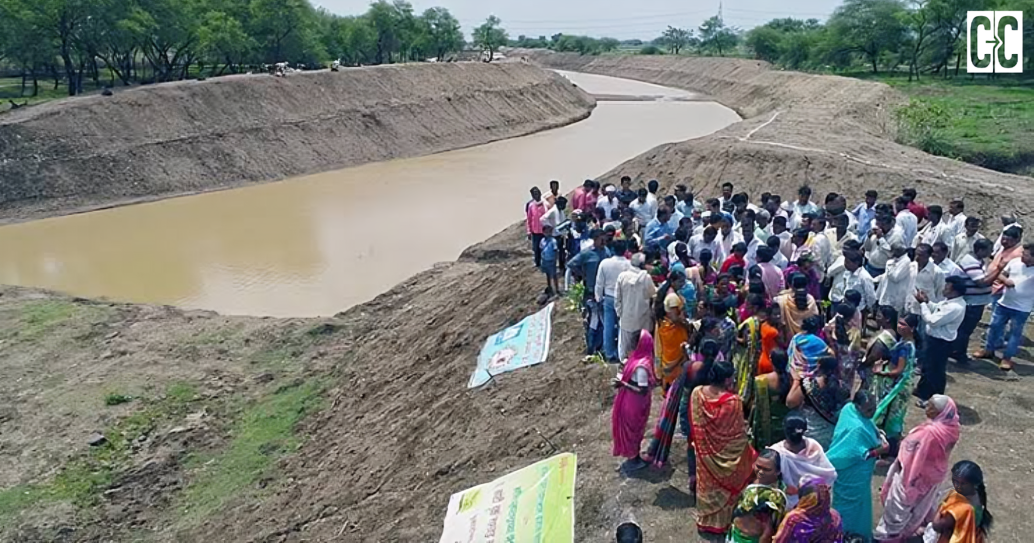
The Bajaj Foundation and the Jamnalal Kaniram Bajaj Trust’s water work rests on a set of integrated interventions: river revival, groundwater recharge through check dams and percolation tanks, and rooftop rainwater harvesting. No single intervention works in isolation when the underlying water table has been depleted over decades. The programme builds resilience into the water system itself by restoring surface water and recharging groundwater.
Permanent water at 4,537 doorsteps in Sikar
One of the most tangible outputs of the Bajaj Foundation water work in Sikar is a rooftop rainwater harvesting (RWH) structure for 4,537 families, which it describes as a “one-time investment and permanent solution to have pure and safe drinking water at the doorstep.” In the district, where women have historically travelled miles to fetch water often contaminated by the journey, these structures mean a big change in time use, health, and dignity. For a family that was previously dependent on a seasonal source or an unpredictable government allocation, life is now materially different and profoundly better. The Foundation describes water not as a resource but as the Foundation of every other development goal in rural India.
CSR is rooted in a specific ethical philosophy
The Bajaj Group’s CSR work is unusual in Indian business for being explicitly grounded in a named philosophical tradition: the trusteeship principle articulated by Jamnalal Bajaj and Mahatma Gandhi, which holds that business owners are custodians of wealth generated by society and therefore owe a portion of it back, not as charity but as an obligation. This framing has given Bajaj’s philanthropy a consistency across generations that purely financial CSR calculations rarely produce. At the UNICEF-organised consultation in Rajasthan in December 2025, where over ₹130 crore in CSR commitments were secured for water security across the state, the Jamnalal Kaniram Bajaj Trust was among the organisations sharing field insights from decades of direct implementation experience.
Community as custodian
What sets the Foundation apart from many corporate water CSR initiatives is community management. If they lack a community management plan, constructed infrastructure tends to deteriorate and become unusable after just a few monsoon cycles. The Foundation establishes water user committees, provides training in water management and maintenance, and sometimes links livelihoods to water conservation activities, so that the community has a commercial interest in maintaining its watersheds’ health. ‘If people can become its custodians,’ according to the Foundation’s communication on this project, ‘water is stronger than ever.’
Conclusion
The Bajaj Foundation’s water model carries a message that India’s Jal Jeevan Mission 2.0 should hear clearly: infrastructure installed without community ownership and maintenance systems does not hold. The Foundation’s multi-decade work in Wardha and Sikar shows that the path to water security in drought-prone districts runs through community governance of water resources, not just government supply chains. The Ministry of Jal Shakti’s performance certification for Har Ghar Jal should include mandatory formation of community water committees and at least 3 years of post-installation monitoring. Bajaj Foundation has built 1,597 villages that understand the difference between a connected tap and a water system that will last.
Clear Cut CSR Desk
New Delhi, UPDATED: September 18, 2026 13:00 IST
Written By: Tanmay J. Urs