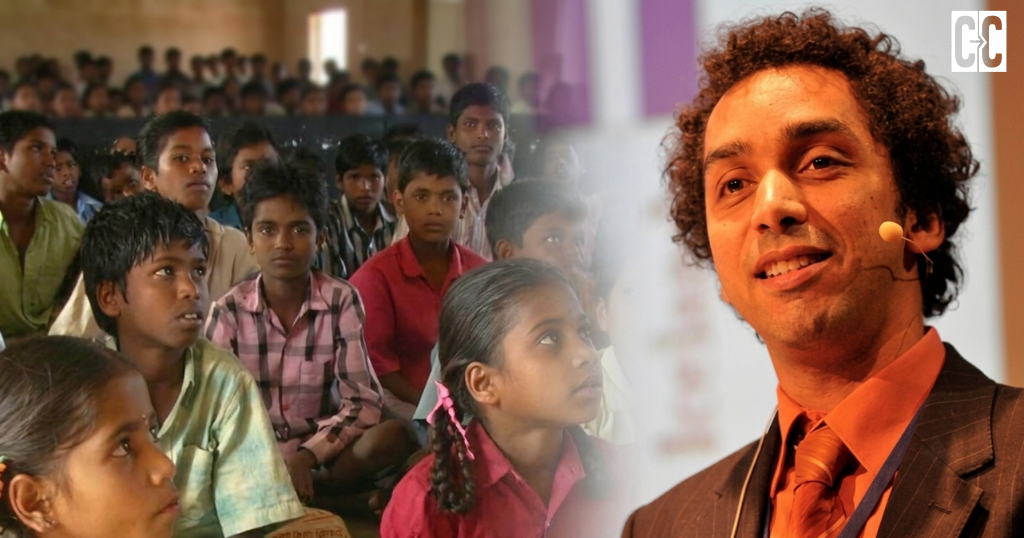


At the Clear-Cut Education Summit 2026, experts discussed how inequalities outside school affect children’s classroom experiences and learning outcomes. The panel called for more inclusive teaching, better assessment, meaningful communication and a broader, child-sensitive approach to learning.
NEW DELHI: Unequal conditions outside school shape children’s classroom experiences. At the Clear-Cut Education Summit 2026, speakers discussed how teaching, assessment and communication can respond more effectively to these differences.
The session, held on 30 September under the theme “Understanding the Learning Challenge,” was moderated by Subir Shukla, former Educational Quality Advisor to the Government of India. It brought together Dhir Jhingran, founder and executive director of the Language and Learning Foundation; Chaitanya Kumar Prasad, Head of Communication and Outreach at the Ministry of Education; and S. Raghavan, author and director at New Concept Information Systems.
For Jhingran, the gaps begin before a child reaches the school gate. “There are inequalities outside schools that become translated into inadequacies within schools,” he said. The panel traced these gaps to marginalisation, inadequate learning conditions, unequal access, low instructional time and classroom practices that do not encourage higher-order thinking.
National data show why this matter beyond the early years. India’s PARAKH Rashtriya Sarvekshan 2024found average mathematics scores of 60 percent in Class 3 and 37 percent in Class 9. The same survey also found that Class 6 mathematics averaged 46 percent against 57 percent for language, and that rural children who did better in Class 3 were outperformed by urban children across all subjects in Classes 6 and 9.

Learning, the panel argued, must go beyond foundational skills to include writing for different purposes, mathematical reasoning, questioning and critical thinking, especially in the early years. Jhingran asked whether schools can build on “The human advantage of curiosity, creativity, etc.”
The challenge is not India’s alone. A 2022 update by the World Bank and partners estimated that 70 percent of 10-year-olds in low- and middle-income countries could not understand a simple text.
Raghavan emphasised to the four pillars of learning, to know, to do, to live together and to be, set out in UNESCO’s 1996 Delors Report. “These four pillars of learning have stayed with me,” he said, a reminder that education is a lifelong and holistic process, not limited to children or classrooms. Measurement, he argued, is where the system falls short. “We are not measuring learning the right way. The entire ecosystem needs to be assessed.” That means looking at children’s experiences and also at how teachers, schools and systems function. PARAKH’s 2024 survey moved in that direction by pairing student assessments with teacher and school questionnaires and classroom observation.
Prasad brought the perspective of communication. Learners now draw on many sources of information, he said, which makes support and dialogue more important. “For me it is self-driven, backed by an institutional process, pushed forward by different elements of communication,”. “Education and communication should move from information delivery to meaningful engagement.” The panel stressed that communication must be accessible, localised, multilingual, evidence-based and two-way, and that trust and media literacy are essential in an age of information overload.
For children facing disadvantage, the panel called for contextualised approaches: inclusive classroom practices, better support for teachers, and assessment that captures individual learning journeys rather than only measuring children against grade-level expectations. “How we capture the complete experience of the child is crucial,” Raghavan said. “The entire system then learns with the objective of more child-sensitive teaching system.”
Taken together, the panel’s message was clear that the learning challenge is no longer only about getting children into classrooms. It is about whether the thinking, measurement and communication around them keep pace, and whether the system itself can learn. For the children most affected by inequalities outside school, that may be the difference between attending school and learning in it.
Clear Cut Education Desk
New Delhi, UPDATED: October 06, 2026 16:40 IST
Written By: Yatharth Pathak