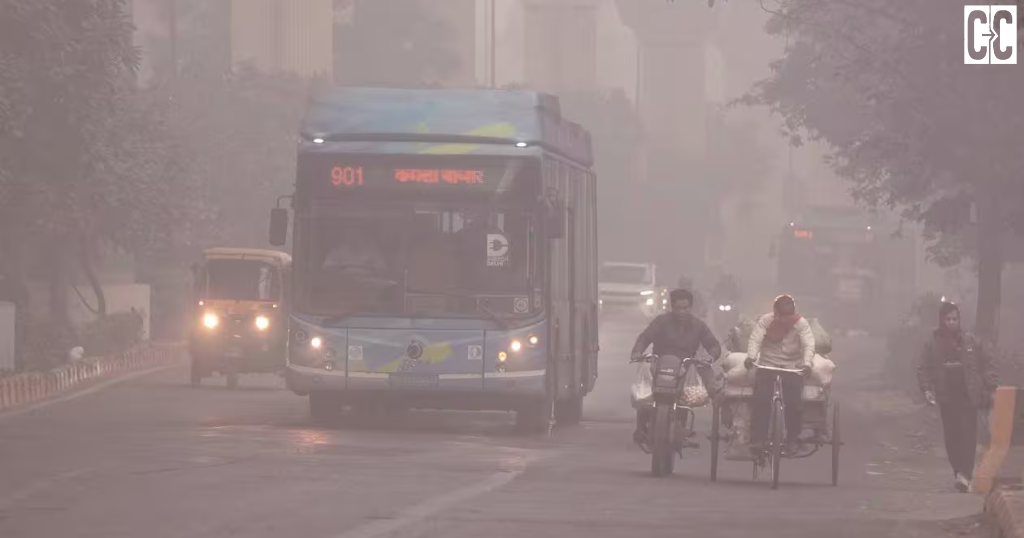
Delhi recorded its lowest September average AQI in five years at 102 in 2026, marking a Delhi AQI 5-year low, with fewer “Poor” to “Severe” air-quality days than in previous years. However, experts caution that the improvement may be linked to favourable monsoon conditions and fewer farm fires rather than a lasting trend. As winter approaches, vehicle emissions, stubble burning and unequal exposure to pollution among low-income communities remain major concerns for Delhi’s air quality and public health.
Delhi’s average Air Quality Index (AQI) for September 2026 stood at 102, the lowest for the month in five years, the Union Environment Ministry said on 30 September. It compares with 105 in both 2025 and 2024, 108 in 2023 and 104 in 2022. Between January and September, the capital logged 194 days with an AQI below 200, the highest in five years, and 79 “Poor” to “Severe” days, the lowest. Average PM2.5 stood at 69 µg/m³, unchanged from 2025.
The Numbers Look Good. The Experts Are Cautious
An AQI of 102, which falls in the “Moderate” category, suggests the city has improved but is still not in the best shape. The drop could be linked to fewer farm fires, with Punjab and Haryana witnessing 54 during September 15 – 29, compared with 102 in 2025 and 289 in 2023. But Manoj Kumar, an analyst at the Centre for Research on Energy and Clean Air (CREA), said the monsoon season could have played a part, and this shouldn’t be taken as a trend. The Centre for Science and Environment (CSE) also warned that it was better to be cautious, saying its analysis showed that December 2025 was more intense than October and November, which are typically the prime seasons for farm fires.
Anumita Roychowdhury from CSE said, “Most of the wintertime pollution does not necessarily drop when the fire goes out.” Her colleague Shambhavi Shukla pointed out that vehicles contribute nearly 50 percent of Delhi’s local emissions.
The health bill is not shared equally.
The stakes are measured in lives. A 2024 report in Lancet Planetary Health, based on an analysis of data from 10 Indian cities from 2008-19, indicates that an estimated 12,000 deaths a year in Delhi – 11.5 percent of the total – can be linked to PM2.5 levels exceeding the World Health Organisation’s daily limit. Exposure also seems to fall with income. A New York Times investigation tracked two Delhi children for a day, with research designed in collaboration with UC Berkeley pollution scientist Joshua Apte; the child from a low-income family was exposed to roughly four times as much pollution as the one from a wealthy family.
A UMass Amherst survey of 582 Delhi households found affluent homes almost universally have air conditioners and purifiers, whereas underprivileged workers labour outdoors, often without leave, and lose income when heat and pollution turn hazardous.
Policy has been slow to catch up. Rajesh Upadhyaya of the National Alliance for Labour Rights told The Wire that occupational safety laws were designed for organised factory workers and never factored in external hazards such as air pollution.
What to watch next
October sees air quality deteriorate to “Poor” or “Very Poor” and remain there until January. How will the efforts this winter protect the vulnerable? The ministry has committed to giving the Commission for Air Quality Management, the national authority, the power to expand its work.
A dedicated study from UMass passionately demands class-conscious policies, strong public transport, and healthcare. But CREA urges agencies to reach out to farmers and persuade them to consider alternatives to stubble burning. While a five-year low in September is encouraging, the coming months will be truly testing.
Clear Cut Climate Desk
New Delhi, UPDATED: October 07, 2026 10:06 IST
Written By: Yatharth Pathak