

The Tour de Thar, India’s first-of-its-kind international-level endurance cycling event, will start in the desert town of Bikaner in Rajasthan on 23 November 2025. Organised under the campaign CycleForZeroHunger by Vedanta Limited in collaboration with the Cycling Federation of India (CFI) and supported by government agencies, the race-from Norangdesar to Deshnok via the Amritsar-Jamnagar Expressway-spans the golden sands of the Thar Desert, offering three race formats: 100 km, 200 km and 300 km team relay. More than 2,500 cyclists from India and abroad will take part. This is not just a sporting spectacle-its social design and development impact are equally significant.
A Race with a Social Mission
The Tour de Thar is built on a cause. For each kilometre cycled, Vedanta has pledged to donate nutritious “Poshan Packs” to children in its rural child-care initiative, Nand Ghar. Nand Ghar has operations across 10,000 centres in 15 states and supports early childhood education, nutrition, and women’s empowerment programs. As each pedal will translate into a meal for a child, the sport will be turned into a social benefit. The race will highlight childhood nutrition, rural empowerment, and the connection between movement and social change through the CycleForZeroHunger campaign.
Economic, Cultural, and Regional Impact
The event carries considerable economic and regional implications. The deserts of Rajasthan have largely been bereft of high-profile sports action and tourists during the off-season. Tour de Thar brings international athletes, support crews, and spectators into Bikaner, boosting hospitality, food service, transportation, and sales of items from local artisans. To the local businesses and tribal craft sectors, it translates into exposure and revenue. The race also includes cultural programmes that include folk-dance performances, craft exhibitions, and music, which help revive the local heritage and give small vendors access to markets.
From the development point of view, the event showcases how CSR can combine with sport and tourism to create value on many dimensions: rural children directly benefit by way of nutrition support; local enterprises indirectly benefit in the form of increased commerce; regional branding improves as Rajasthan is positioned as a destination for adventure and wellness tourism.
Health, Fitness and Social Inclusion
The Tour de Thar aligns with a national push toward fitness and active lifestyles, and the ties to the Fit India Movement through the Namo Fit India cycle clubs are explicit. Beyond the elite competitors, the event will call on amateur riders and regional enthusiasts, allowing for more inclusiveness. This could have a ripple effect of greater interest in cycling in semi-urban and rural areas, an improvement in local road infrastructure, and a wider awareness of health and mobility issues.
The event opens up fresh vistas for women, youth, and tribal communities. Women’s participation in endurance sports remains low; thus, this is an event that provides the needed visibility and challenge. Also, local tribal youth may find involvement not only as participants but also as support staff, guides, and logistics assistants, gaining employment, skills, and exposure.
Challenges and Long-Term Sustainability
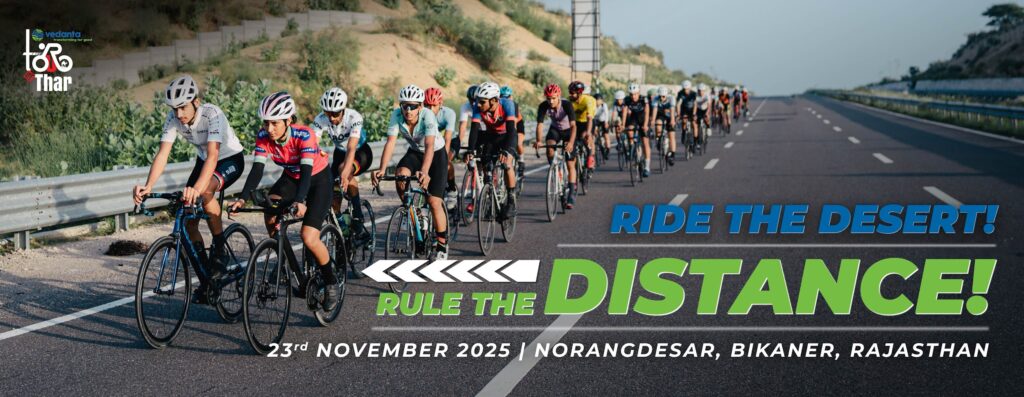
Photo Credit: Internet
While the Tour de Thar offers considerable positives, certain challenges remain. An endurance sport in a desert environment carries significant logistical demands: road safety, hydration, medical support, and climate risk from heat, dust, and sandstorms. The vital issue is ensuring security, fair competition, and participants’ welfare. In terms of social impact, one might question whether the linkage with nutrition benefits translates into sustained improvement in metrics on child health or remains symbolic.
Another challenge is how to keep local benefits after the event. Will hospitality spending dissipate after the race is over? Will local artisans get follow-on orders, or is this a once-off entry into the market? If development benefits are to be sustainable, follow-up mechanisms must be instituted-partnerships between chambers of commerce, tourism boards and the racing organizers, for instance.
The event needs to have an embedded CSR model that has to measure deeper outcomes, such as improved nutritional outcomes for children, enhanced employment for local communities, and increased sports participation over time. It is then that the event can be something more than a mere spectacle.
Conclusion
The Tour de Thar is an example of how sport, business, and social development can come together. Every cyclist’s journey into the sands of the Thar Desert becomes more than a test of endurance; it’s a vehicle for children’s nutrition, women’s empowerment, and regional growth. With each kilometre connected to a child’s meal, the event redefines what a race can mean. In Rajasthan, where rural disadvantage co-exists with craft heritage and tourism potential, the race offers hope: hope that a spectacle becomes a springboard for sustainable change; that local artisans gain exposure beyond state fairs; that rural children’s lives benefit from corporate-linked fitness events; and that sport becomes an engine of inclusive development. If organisers deliver on their promise-of links between the race and tangible social gains-then Tour de Thar may do more than blaze tracks; it may blaze a trail for how large-scale sport can power rural revitalisation.
Clear Cut Event Desk
New Delhi, UPDATED: Nov 15, 2025 03:24 IST
Written By: Janmojaya Barik