
Children living near India’s landfills face severe health risks from toxic waste, polluted water, and poor sanitation, leading to stunting, disease, and developmental harm. The article argues that this is not merely an infrastructure failure but a serious child rights and environmental justice crisis demanding urgent policy action.
She plays where the city throws its waste
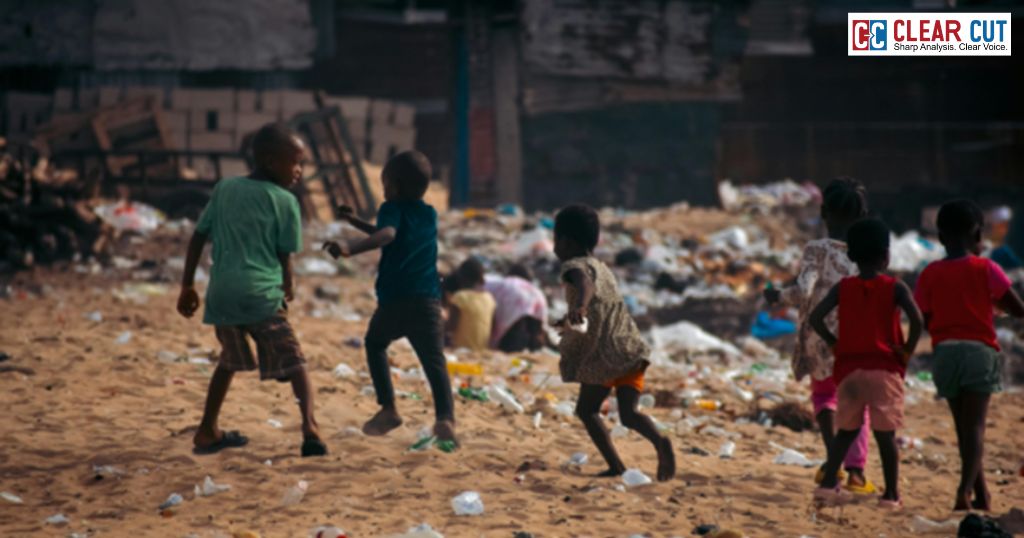
One of India’s most notorious open dump sites was found in a resettlement colony near the Ghazipur landfill in East Delhi. It caught fire spectacularly in 2024 and has happened multiple times before. There lives a 7-year-old girl named Sana, she plays in the late afternoon on a patch of ground that is a park space. In practice, it is an overflow zone for the dump: leachate runs through it after heavy rain, the soil is dark and wet, and the air on still days carries a smell that the adults have stopped noticing. Sana’s mother has noticed something else. Her daughter has not grown the way she expected as she is thin, prone to diarrhoea, and has missed school repeatedly in the past year with stomach ailments. The family has lived here since 2019, and they cannot afford to live anywhere else.
Sana is not a case study. She is a pattern. She is the pattern of what happens when a child’s right to a clean environment is treated as aspirational rather than constitutional, when the geography of waste disposal aligns, year after year, with the geography of poverty.
The scale of the crisis
A 2025 study published in the journal Preventive Medicine, cited by Mongabay India in August 2025, found that approximately 26% of deaths among children under 5 globally is due to environmental risks, with rising prevalence of cancers, asthma, and developmental disorders linked to toxic chemical exposure. In India specifically, children face a compounding crisis.
The State of India’s Environment 2025 report found that the country generates over 150,000 tonnes of municipal solid waste daily, with more than half remaining untreated or landing in open landfills. 37.7 million Indians are affected by waterborne diseases annually. 1.5 million children are estimated to die from diarrhoea alone each year, according to the UNICEF-FAO Water in India report.
India ranks 107th on the Global Hunger Index 2022 out of 121 countries, with the highest child wasting rate globally. A peer-reviewed study in JMIR Public Health (2024), tracking stunting data from NFHS surveys between 1998 and 2021, found stunting prevalence declining from 44.9% to 38.4%. But with persistent geographic clustering in states including Madhya Pradesh, Jharkhand, Odisha, Uttar Pradesh, and Bihar, precisely the states with the highest density of informal waste sites and lowest sanitation coverage.
What open waste does to a child’s body
The link between open defecation, poor sanitation, and child stunting is among the most thoroughly evidenced connections in public health research. A landmark study by Spears, Ghosh, and Cumming (2013), published in PLOS ONE, analysed data from 112 districts across India and found that a 10 percentage point increase in open defecation was associated with a 0.7 percentage point increase in both stunting and severe stunting, even after adjusting for socioeconomic status, maternal education, and calorie availability. Differences in open defecation could statistically account for 35 to 55% of the average difference in stunting between low-performing and high-performing districts.
The mechanism is not simply nutrition. It is environmental enteropathy: repeated sub-clinical gut infections from fecal contamination of water and soil damage the intestinal wall, reducing nutrient absorption even when calories are adequate. A child who drinks clean water from a contaminated source, plays on soil laced with leachate, and breathes air from a burning dump is being systematically denied her biological potential. No dietary intervention fully compensates for that environmental insult.
Children are more vulnerable to toxic exposure than adults, as the WHO has documented extensively. Their organs and immune systems are still developing. They breathe twice as quickly as adults and absorb more environmental pollutants relative to their body weight. India is the world’s third-largest e-waste generator, at approximately 3.8 million tonnes in 2024. Children living near informal e-waste recycling sites are exposed to lead, mercury, cadmium, and dioxins that produce adverse neurodevelopmental impacts at very low exposure levels. Lead exposure alone is associated with permanent cognitive impairment, reduced IQ, and behavioural disorders.
India’s Actions in 2025
In July 2025, the Ministry of Environment, Forest, and Climate Change notified India’s first-ever Environment Protection (Management of Contaminated Sites) Rules, 2025. This was a landmark legal intervention that established, a time-bound, enforceable mechanism for identifying, assessing, and remediating chemically contaminated sites. The Rules work under the Polluter Pays principle, require biannual district-level reporting on suspected contaminated sites, and align explicitly with SDG 3 (health), SDG 6 (clean water), and SDG 12 (responsible consumption). A 2010 government programme had found 103 contaminated sites in India; as of the Rules’ notification, only 7 had ongoing cleanup. The 2025 Rules create the legal framework that was missing. They do not yet guarantee the speed, funding, or enforcement that the crisis demands.
The accountability demand
Three actions are both legally grounded and morally non-negotiable. First, the CPCB must complete a comprehensive national inventory of all open dump sites, informal waste burning areas, and legacy contaminated sites within 18 months of the 2025 Rules’ notification, and publish this inventory in a publicly accessible, district-level database. Every site within 500 metres of a school, anganwadi, or residential settlement must be prioritised for immediate remediation.
Second, India must enact a Child Environmental Health Protection Act that recognises, explicitly and legally, every child’s right to a clean, safe physical environment as a justiciable constitutional right, consistent with the UN Convention on the Rights of the Child and India’s Article 21 jurisprudence on the right to life. Third, a national child environmental health monitoring programme must track blood lead levels, lung function, and developmental milestones in children living within defined proximity to contaminated sites and open waste areas. The results must be publicly reported annually and linked to remediation timelines.
Conclusion
Sana plays on contaminated ground not because India does not care about children. India has made extraordinary investments in child nutrition, vaccination, and maternal health. She plays there because the policy architecture that governs where waste goes, how it is managed, and who lives near it has not treated the resulting harm as a rights violation. It has treated it as an infrastructure gap.
It is not an infrastructure gap. It is a rights violation. A child born near an open landfill did not choose her geography. She was placed there by a combination of poverty, policy failure, and a planning system that has not yet decided that children deserve clean ground, clean water, and clean air as a birthright rather than a reward for living in the right neighbourhood.
By 2030, India can either be a country where Sana’s stunted growth is a public health statistic declining toward zero, or it can be a country where the data still shows improvement while the children nearest the dumps continue to bear the cost of everyone else’s convenience. The 2025 contaminated sites rules are a beginning. They are not enough. Speed the remediation. Fund the monitoring. Enact the rights. The children are not waiting for 2030. They are growing, right now, in the shadow of what we have not cleaned up yet. India’s children living near landfills are not the victim of an infrastructure gap – they are victims of a rights violation that policy has yet to fully name.
Clear Cut Child Protection, Health Desk
New Delhi, UPDATED: May 09, 2026 09:00 IST
Written By: JAy