

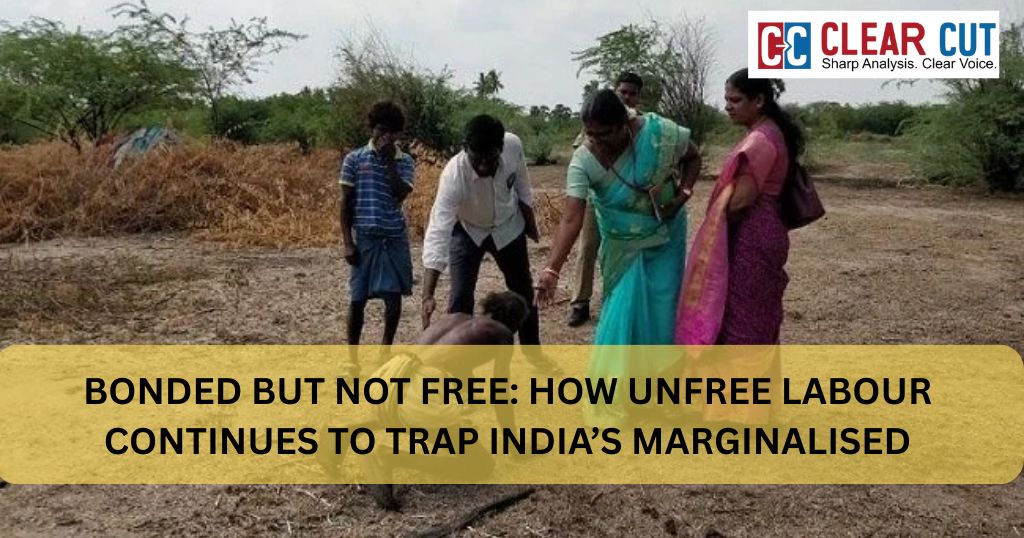
Fifty years after the abolition of bonded labour in India, thousands remain trapped in exploitative conditions due to weak enforcement, poverty, caste and gender inequalities, and migration-linked debt bondage. Rehabilitation is often delayed or incomplete, and civil society plays a crucial role in rescues and advocacy.
Fifty years after India legally abolished bonded labour, thousands of workers across the country remain trapped in exploitative arrangements that deny them freedom, wages, and dignity. According to data placed before Parliament by the Ministry of Labour and Employment, over 3,15,000 bonded labourers have been officially identified and released since 1976, yet activists estimate that the actual number of people in conditions of debt bondage remains significantly higher due to under-identification. Recent field assessments, state reviews, survivor testimonies, and expert consultations point to a stark reality: bonded labour has not disappeared, it has adapted.
The Bonded Labour System (Abolition) Act, 1976, promised liberation from debt-based servitude. However, evaluations conducted in 2025–26 by labour departments, district vigilance committees, and the National Human Rights Commission (NHRC) reveal that the failure lies not in the law’s intent, but in its weak and uneven implementation.
How Bonded Labour Operates Today
Bonded labour in contemporary India rarely appears as lifelong, openly declared servitude. Instead, it operates through advance payments, verbal agreements, inflated interest, and control over workers’ mobility.
Labour department rescue records in Tamil Nadu document families borrowing ₹5,000–₹10,000 for medical emergencies and being forced to work for years in rice mills, where wages were arbitrarily adjusted against interest that kept rising. Data backing is important. It will increase the credibility of the article

In West Bengal, district vigilance committees constituted under the 1976 Act have identified brick kiln workers recruited through labour contractors who confiscated Aadhaar cards, ration cards, and voter IDs, effectively preventing escape. Officials involved in these rescues confirmed that movement restrictions and debt manipulation are now the primary tools of bondage.
During regional consultations convened by the NHRC in late 2025, Commission members noted that many workers did not identify themselves as bonded labourers. Officials attributed this to deep normalisation of exploitation shaped by poverty, caste hierarchy, and lack of alternatives.
West Bengal, Odisha, and Tamil Nadu as Source and Destination States
State-level reviews conducted by labour secretaries and inter-departmental task forces show that West Bengal functions both as a source and destination for bonded labour. According to state labour department data shared during inter-state coordination meetings in 2025, over 1,200 bonded labourers were identified and released in West Bengal over the last five years, with a large proportion linked to brick kilns and agricultural migration chains. Tribal and rural workers migrate to farms, brick kilns, and small manufacturing units, often entering debt bondage through intermediaries.
In Odisha, during consultations marking 50 years of the abolition law, senior labour officials acknowledged that bonded labour continues in brick kilns, stone quarries, and seasonal industries, disproportionately affecting Scheduled Tribe families. State review reports indicate that more than 60% of rescued bonded labourers in recent years belonged to Scheduled Tribe communities. Migration, officials admitted, makes identification difficult and allows contractors to evade scrutiny.
Tamil Nadu’s Special Task Force on Bonded Labour has rescued workers from spinning mills and powerloom units, many of them adolescent girls employed under long-term “training” or “hostel” arrangements. Reports submitted to the state labour department show that these schemes restrict mobility and suppress wages under the guise of skill development. Between 2021 and 2025, over 3,000 workers were identified in Tamil Nadu under bonded labour and trafficking-linked provisions, according to state enforcement data.
These patterns were discussed in inter-state coordination meetings involving labour secretaries, district collectors, and rehabilitation officers, who acknowledged that lack of coordination across states weakens enforcement.
Why Enforcement Fails Despite a Strong Law
Under the 1976 Act, district magistrates hold primary responsibility for identifying bonded labourers, initiating prosecutions, and ensuring rehabilitation. However, senior labour officials have admitted in review meetings that identification largely depends on complaints, even though bonded workers fear retaliation.
Legal experts associated with constitutional litigation on labour rights point out that prosecutions under bonded labour provisions remain rare. Police often register cases under minor labour violations or wage-related offences instead of invoking bonded labour or trafficking laws, which carry stronger penalties.
A former advisor to a Supreme Court–appointed committee on labour reforms has repeatedly stated that without criminal accountability for employers and contractors, bonded labour continues to be treated as a welfare issue rather than a constitutional violation of Article 21.

Rehabilitation: A Promise Rarely Fulfilled
Government rehabilitation guidelines mandate immediate cash assistance, housing support, land allotment, and livelihood rehabilitation for rescued bonded labourers. Yet district-level audits reviewed by state governments reveal delays stretching from months to years.
In Tamil Nadu and West Bengal, social workers assisting district administrations report that many survivors receive only partial compensation. According to Ministry of Labour data, a significant proportion of identified bonded labourers over 30% in certain states, face delays in receiving full rehabilitation packages. Without stable livelihoods, several families return to exploitative conditions.
Women face deeper exclusion. Rehabilitation benefits are often issued in the names of male relatives, leaving women without direct financial control. Child rights organisations working with district authorities have documented cases where rescued children struggle to re-enter education due to age gaps, trauma, and lack of bridge schooling.
Caste and Gender at the Core of Bondage
Data compiled by state vigilance committees shows that over 80% of identified bonded labourers nationally belong to Scheduled Castes and Scheduled Tribes, according to consolidated figures submitted to the Ministry of Labour in recent years. Dependence on dominant-caste landowners and contractors restricts resistance and reinforces silence.
Women bonded labourers also face layered exploitation. State rescue records and NHRC consultations indicate that women constitute nearly 40–45% of identified bonded labourers in several rescue operations, especially in brick kilns, spinning mills, and agricultural work. Apart from unpaid or underpaid labour, they endure harassment, restricted mobility, and social isolation. Gender rights advocates argue that bonded labour cannot be eradicated without addressing caste-based power structures and gender inequality embedded in rural economies.
Survivors and Civil Society as the First Responders
Survivors interviewed during rehabilitation reviews describe working 12–14 hours a day, living under constant surveillance, and facing threats if they attempted to leave. In many cases, rescues occurred only after intervention by civil society organisations that alerted district authorities.
Officials involved in bonded labour enforcement acknowledge that NGOs play a critical role in identification, legal aid, and follow-up. However, policy experts caution that dependence on voluntary actors without strengthening state accountability risks institutionalising failure.
What Experts Say Must Change
Governance experts, human rights commissioners, and labour law scholars consistently recommend:
• Proactive labour inspections instead of complaint-driven action
• Time-bound rehabilitation monitored by district courts
• Strong inter-state coordination mechanisms
• Criminal prosecution of employers and contractors
• Recognition of bonded labour as a direct violation of the right to life and dignity
The NHRC has repeatedly advised states to analyse bonded labour data to identify systemic governance failures rather than treating cases as isolated incidents.
Freedom Still Deferred
Five decades after abolition, bonded labour remains one of India’s most enduring human rights failures. It survives where poverty intersects with caste power, where migration creates invisibility, and where laws exist without enforcement.
Across states, survivors, administrators, and experts deliver the same message: bonded labour will not end through legislation alone. It requires political will, administrative accountability, inter-state coordination, and sustained investment in dignity, livelihoods, and justice.
Until then, freedom for thousands remains promised but not delivered.
Clear Cut Child Protection Desk
New Delhi, UPDATED: Feb 13, 2026 09:00 IST
Written By: Samiksha Shambharkar

