

Rising Middle East conflict has pushed crude oil above $100 and weakened the rupee to a record low, triggering inflation and higher LPG prices in India. The government is taking emergency measures, but the crisis highlights India’s heavy dependence on imported energy.
The economic tremors started before India could prepare. On February 28, 2026, the United States and Israel launched coordinated airstrikes on Iran under Operation Epic Fury. Iran responded with missile and drone attacks on US military bases, Israeli territory, and Gulf states, while its Islamic Revolutionary Guard Corps issued warnings prohibiting vessel passage through the Strait of Hormuz, leading to an effective halt in shipping traffic.
The consequences were immediate and severe. Before the war, roughly twenty million barrels of oil and petroleum products moved each day through the Strait of Hormuz. Those flows have now slowed to a trickle. Brent crude surged above $100 per barrel, up from roughly $65 when tensions began heating up last month.
The International Energy Agency’s head did not mince words. The IEA characterised the disruption as the “greatest global energy and food security challenge in history.”
India in the Crosshairs
No major economy sits more exposed. India imports nearly 88 to 90 percent of its crude oil. India maintained a critical stake in the Persian Gulf, relying on the region for nearly 60% of its petroleum imports and as the primary source for over $125 billion in annual remittances sent by a diaspora of primarily low-income workers whose earnings support millions of families back home.
The World Economic Forum stated the risk plainly. “India, with thinner reserves and a heavy reliance on Middle Eastern crude, is more vulnerable to a prolonged disruption. Higher energy prices are feeding inflation, weakening the rupee and threatening growth,” the WEF said.
India’s own Finance Ministry did not wait to sound the alarm. The Department of Economic Affairs’ Monthly Economic Review for February, released on March 6, warned that “even if only latent for now, the risks to India’s balance of payments may have become elevated due to this conflict.”
LPG Hits Indian Kitchens
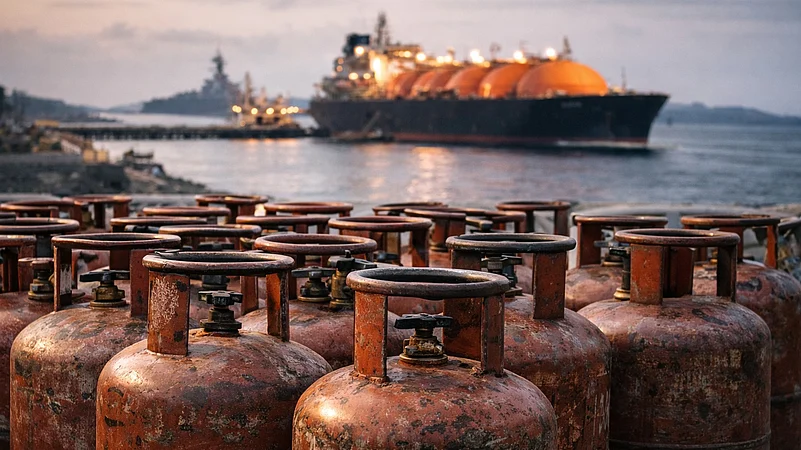
The war arrived at the Indian household on March 7, 2026. Effective Saturday, March 7, the price of a 14.2-kg domestic LPG cylinder was hiked by ₹60 across the country. In Delhi, it now costs ₹913, up from ₹853. Mumbai residents pay ₹912.50, Kolkata ₹939, and Chennai ₹928.50. Simultaneously, the 19-kg commercial LPG cylinder went up by ₹114.50, now costing ₹1,883 in Delhi.
This is the second domestic LPG hike in under a year, following a ₹50 increase in April 2025. The hit to restaurants, hotels, and small businesses has been sharper. Commercial LPG prices have risen cumulatively by more than ₹300 so far in 2026.
The supply chain stress runs deeper than prices. About 55% of India’s natural gas imports are now under force majeure, a clause that absolves suppliers from contractual obligations due to uncontrollable events like war, and downstream industries are facing immense pressure.
Duttatreya Das of the think tank Ember warned that the situation could deteriorate rapidly. The situation could worsen within a week if government subsidies lapse, he said, noting gas supplies were the most immediate concern.
The Rupee Breaks a Psychological Wall
Currency markets delivered a verdict that numbers rarely lie about. On Friday, March 20, the rupee crashed 108 paise to settle at a staggering all-time low of 93.71 against the US dollar, breaching the psychological 93 mark for the very first time. The entire month of March has been punishing, with the Indian currency shedding 266 paise since the month began, marking its steepest depreciation phase in recent history.
Global funds have sold over $9 billion in Indian equities this year, adding to the record $19 billion withdrawals in 2025. They have also been selling local debt, with outflows from index-eligible bonds at $1.4 billion in March alone.
Vivek Rajpal, Asia macro strategist at JB Drax Honore, identified the core vulnerability. “Could be more vulnerable if the conflict drags on, which mainly reflects its exposure to higher energy prices,” Rajpal said.
Nomura has taken a directional position. Going long on the dollar against the rupee is one of Nomura’s key trades amid higher crude prices. It expects the rupee to fall to 96 to a dollar by end-June, citing India’s high exposure to energy prices, foreign fund outflows, and the RBI likely being amenable to gradual rupee depreciation.
Anil Kumar Bhansali, Head of Treasury at Finrex Treasury Advisors, offered a sobering market assessment. “The rupee looks vulnerable with the RBI the only one protecting it from further fall by selling dollars,” he said. The RBI has already sold an estimated $15 billion in March to support the currency and spent $11.68 billion from forex reserves as of March 7 alone.
Government Response: Calm Signals, Wartime Actions
Petroleum Minister Hardeep Singh Puri chose his words carefully. On March 6, he posted on X: “Our priority is to ensure availability of affordable and sustainable fuel for our citizens, and we are doing it comfortably.” On March 12, he told Parliament there was no shortage of petrol, diesel, cooking gas, aviation fuel, or kerosene.
Behind the reassurances, however, operational reality tells a different story. India has deployed two naval task forces to the Gulf of Oman to escort tankers. The US granted India a 30-day waiver to purchase Russian crude to offset Gulf shortages. The government invoked the Essential Commodities Act, implemented a 25-day minimum inter-booking rule to curb LPG hoarding, and directed refineries to prioritise household cooking gas over industrial supply. A high-level panel chaired by Home Minister Amit Shah and including External Affairs Minister S. Jaishankar and Puri himself was constituted to monitor supply chains daily.
Jaishankar, speaking to Parliament on India’s diplomatic stance, laid out the challenge in plain terms. He noted there is no blanket arrangement with Iran for Indian-flagged vessels, and India does not have a “blanket arrangement” with Iran for transit of Indian-flagged ships through the Strait of Hormuz, and “every ship movement is an individual happening.”
The Opposition and the Economic Warning
Leader of Opposition Rahul Gandhi used X to connect the currency and energy crisis directly. “The rupee weakening against the dollar and heading towards 100, along with a sharp rise in industrial fuel prices these aren’t just numbers; they’re clear signals of the inflation to come,” he wrote. He listed rising production costs, MSME stress, higher everyday prices, and faster FII outflows as the four direct consequences already underway.
Congress MP Shashi Tharoor urged a more active Indian diplomatic role. “There have been tremendous disruptions, particularly of the economy, because if you look at the fact that so many oil and gas supplies have been affected. Gas, something like 60 to 80 per cent of our LNG and LPG is coming from Qatar and other countries in that region, and we are not able to receive it anymore, except in very small instalments,” he said.
The Structural Question India Must Answer
Morgan Stanley has quantified the stakes: every $10 per barrel sustained rise in oil hits Asia’s GDP growth by 20 to 30 basis points. Brent is currently trading $20 to $40 above pre-war levels even after partial retreat. That erases 40 to 60 basis points of GDP growth before accounting for inflation, rupee pressure, current account widening, and downstream price effects across the economy.
India’s government has absorbed more than half of the increase driven by global market disruptions under a federal scheme to keep prices low for poor households, Petroleum Minister Hardeep Singh Puri told the Associated Press. That absorptive capacity is finite. With LNG from Qatar effectively at zero, 22 India-flagged vessels still stranded in the Persian Gulf as of mid-March, and the Strait showing no sign of reopening, this is a crisis being managed, not one that has passed.
The Strait of Hormuz crisis of 2026 has delivered a verdict on India’s energy dependency that two decades of policy discussions never quite forced. The question now is whether it finally triggers the diversification and strategic reserve-deepening that analysts have long called for.
Clear Cut Research Desk
New Delhi, UPDATED: March 25, 2026 09:00 IST
Written By: Ayushman Meena