
India’s Gender Budget 2026–27 shows modest growth and improved reporting, but remains largely welfare-focused with limited impact on structural gender inequalities. A lack of outcome-based accountability, weak care economy reforms, and fiscal volatility continue to constrain meaningful progress toward gender equity.
Persistent gender discrepancies in political representation, education, health, and labour markets coexist with India’s macroeconomic success story. Despite making up about 48.4% of India’s population, women still participate in the labour field at a much lower rate than men. The Female Labour Force Participation Rate (FLFPR) for women aged 15 and over was 32.8%, while the FLFPR for men was 77.2%, according to the Periodic Labour Force Survey (PLFS) 2021–2022. Provisional estimates for 2023–2024 show that this percentage will rise to about 37%, primarily due to rural self-employment. There are still gaps in literacy: According to figures from the 2011 Census, 77% of women and 84.7% of males are literate.
Similar asymmetries are reflected in political representation. According to figures from the Department of Personnel and Training (DoPT) and the Election Commission of India, women make up 13.8% of the members of the 17th Lok Sabha, and are still under 14% represented in high bureaucratic posts. These numbers highlight how entrenched gender disadvantage is and how crucial fiscal policy is as a tool for correction and redistribution.
India implemented Gender-Responsive Budgeting (GRB) in 2005–06 in recognition of this. Every year, the Union Budget is accompanied by the Gender Budget Statement (GBS), which aims to map public spending using a gender perspective. In contrast to welfare-based methods, GRB seeks to investigate how financial distributions impact men and women differently and if they address systemic limitations such as time poverty, asset access, and unpaid caregiving. But even after twenty years, there are still important concerns regarding its capacity for transformation.
Using the paradigm of gender budgeting, this analysis looks at the Union Budget 2026–2027, evaluating allocation trends, structural constraints, and any policy shift from incremental welfare to revolutionary gender justice.
Architecture of the Gender Budget 2026–27
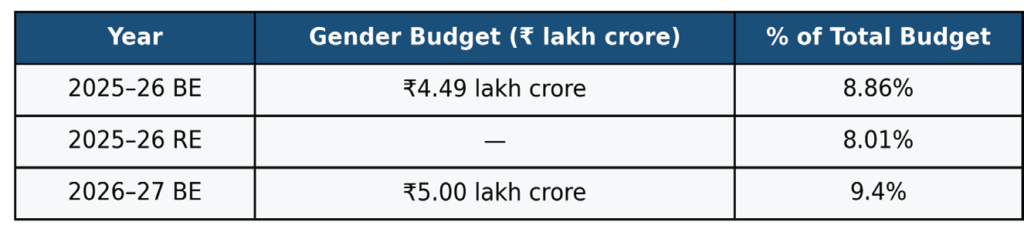
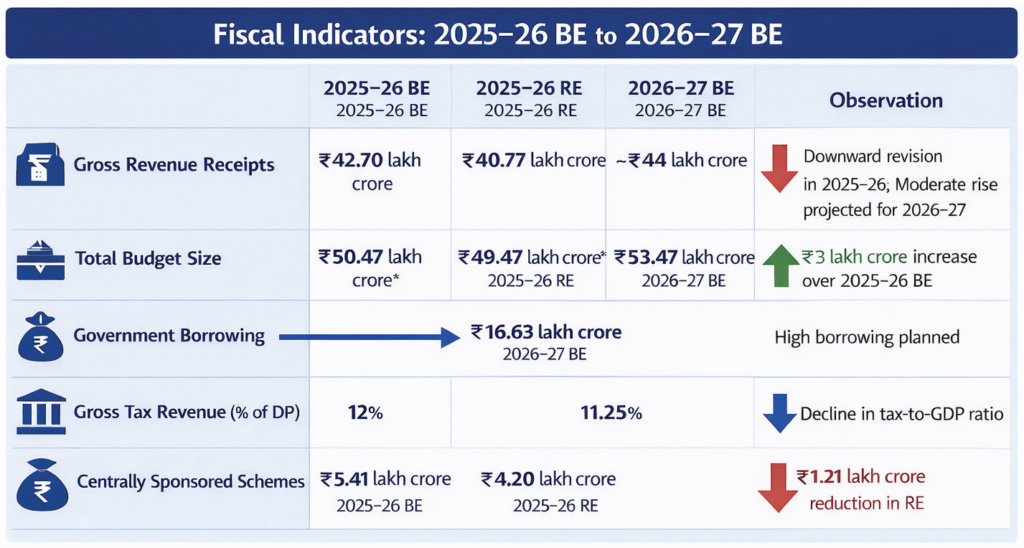
The Gender Budget for 2026–27 is estimated at approximately ₹5.00 lakh crore, up from ₹4.49 lakh crore in the 2025–26 Budget Estimates (BE). It makes up approximately 9.37 to 9.4 percent of all Union spending, which is a slight rise from 8.86 percent in 2025–2026 BE.
The Gender Budget Statement continues to classify allocations under three categories:
- Part A: Schemes exclusively for women (100 per cent allocation counted).
- Part B: Schemes where 30–99 per cent of benefits accrue to women.
- Part C: Schemes with less than 30 per cent gender component.

Part A contributes for 21.49 per cent of the overall gender budget in 2026–2027, while Part B accounts for 72.56 percent and Part C for 5.95 percent. According to this breakdown, most reporting entails allocations come from mainstream programs that partially assist women rather than those solely focused on women.
Housing and livelihood programs like PMAY-Gramin, PMAY-Urban, DAY-NRLM, LPG connections, and Mission Shakti are among the major allocations under Part A. PMGKY, Jal Jeevan Mission (JJM), Saksham Anganwadi and POSHAN 2.0, Reproductive and Child Health (RCH), and rural employment-linked programs like Deen Dayal Upadhyaya Grameen Kaushalya Yojana (DDU-GKY) are important elements under Part B.
Instead of redirection, the structure shows continuity. The mix is still largely welfare-oriented and infrastructure-heavy, even though nominal amounts have increased.
Revised Estimates and Fiscal Volatility
A closer look at the Revised Estimates (RE) for 2025–2026 reveals issues with underutilization and volatility. The RE decreased the share to 8.01 percent, an 11.6% decrease from the previous year. The BE estimated gender allocations at 8.86 percent of overall expenditure.
The 31% decrease in Part A allocations in the revised stage was especially noticeable. Mission Shakti, DAY-NRLM, PMAY-Urban, and PMAY-Gramin were among the schemes that underwent downward adjustments. This reduction could coincide with broader fiscal compression, as total expenditures were cut by almost ₹1 lakh crore and overall revenue receipts also fell from ₹42.70 lakh crore to ₹40.77 lakh crore. From ₹51 lakh crore to ₹40.24 lakh crore, Central government Schemes had a decrease.
The trend suggests that social sector and gender-focused programs continue to be at risk during periods of fiscal restraint. Program continuity is disrupted and the legitimacy of gender pledges is weakened by such uncertainties. Budget instability risks translating into decreased service delivery, delayed payments for recipient households, and especially low-income groups.
Expansion through Reclassification: Accounting or Additionality?
Although there is a notional rise of about ₹51,000 crore in the 2026–2027 Gender Budget, the source of the expansion may be overstated. Instead of large new investments in women-specific programs, a large share results from an improved reporting in Parts B and C.
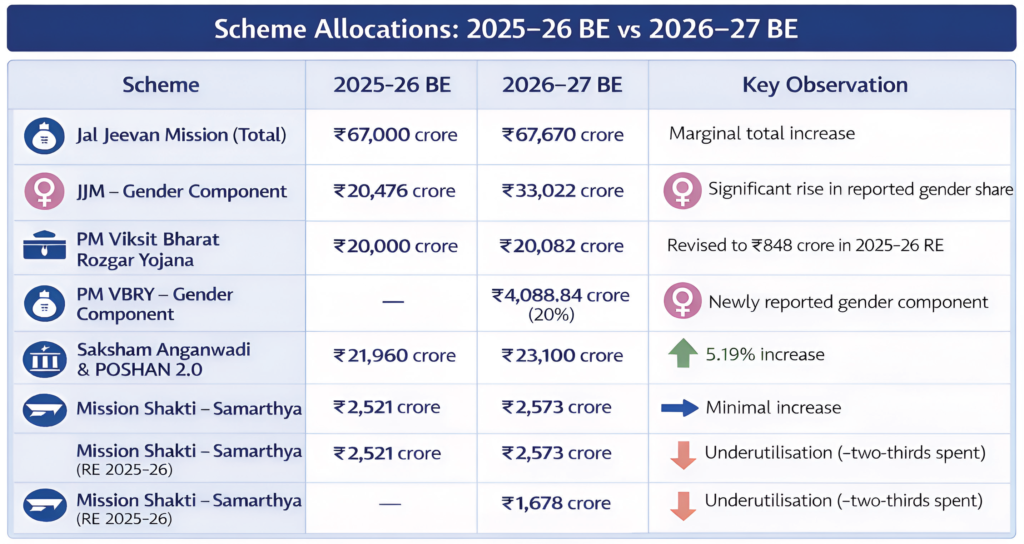
This problem is exemplified by the Jal Jeevan Mission (JJM) restated gender component jumped significantly from ₹20,476 crore to ₹33,022 crore, but its overall allocation climbed somewhat from ₹67,000 crore to ₹67,670 crore. There is no methodological explanation for this recalibration in the Gender Budget Statement. Such increases run the danger of exaggerating the true incremental benefits to women if gender shares are simply re-estimated retrospectively.
A similar 20% gender component (₹40,888.4 crore of ₹2,0082 crore) is reported by the Pradhan Mantri Awas Yojana (PMAY) under Part C. However, the claim of a 20% gender share (₹40,888.4 crore) raises questions regarding continued and accurate reporting classification.
These illustrations imply that advancements in classification procedures could account for a portion of the GBS’s expansion. Although better reporting is a good thing, it cannot replace more focused investments.
Housing, Water, and Convergence
The gender budget’s core pillars continue to be housing and essential services. The focus placed by PMAY on registering houses in women’s names and asset ownership. Funding for the Jal Jeevan Mission was also boosted by ₹12,500 crore in the 2026–2027 Budget, indicating a continuous focus on piped water provision.
However, effective convergence is necessary for such infrastructure to have a gendered impact. Water, sanitation, electricity, and waste systems must all be integrated into a functional home. Seasonal disturbances, like “dry taps,” run the risk of putting the onus of collecting water back on women. Time poverty endures in the absence of dependable last-mile connectivity and maintenance.
Rekindled interest in clean cooking energy is shown in the 2026 Budget’s mention of ₹9,200 crore for LPG connections, following no allocation in 2025. However, the cost of refills continues to be a barrier, especially for homes with low incomes. Price stability and predictable subsidy schemes are essential for the behavioral shift from biomass to LPG to be sustainable.
Infrastructure improvements have the potential to decrease women’s unpaid labor, but their revolutionary power depends on their affordability and dependability.
The Care Economy: Recognition without Restructuring
Women’s “dual burden” of unpaid caregiving and paid employment is specifically acknowledged in the Economic Survey 2026. However, fiscal measures continue to be gradual.
From 2025–2026 BE to 2026–2027 BE, Saksham Anganwadi and POSHAN 2.0 had a 5.19 percent growth, from ₹21,960 crore to ₹23,100 crore. Approximately 40 crore per day beneficiaries, access more over a lack supplemental nutrition benefits, with this ₹1,140 crore increase seems a absolute terms.
Crucially, despite food inflation, supplemental nutrition unit cost norms have not been updated since 2018.
Since 2018. The quality of services is compromised by this stagnation, which is a reflection of the system’s underinvestment of caregiving.
There are still operational holes in Mission Shakti’s Palna scheme, which provides crèche facilities. Due to labor shortages and delayed financial flows, only around 2,800–3,100 of the 14,599 sanctioned centers were completely functioning by 2025. Anganwadi’s ability to facilitate women’s employment in formal employment is limited because the majority of them operate as part-time feeding centers rather than full-day childcare centers.
Recognizing demographic shifts is incidental by the plan to provide geriatric services training to 1.5 lakh caregivers. Instead of reorganizing the care economy as a formal employment sector, such initiatives run the risk of increasing low-paid informal labor if frameworks guaranteeing appropriate salaries, formalization, and social security are not in place.
Urban Blind Spots and Safety
The gender budget is still mostly focused on rural areas despite the fast urbanization and the existence of low urban FLFPR. There is little focus on workplace-connected crèches, safe public transportation, and urban childcare infrastructure.
In 2026–2027, Mission Sambal, which comprises One Stop Centers (OSCs) for victims of violence, only got a ₹50 crore boost. Such small increases seem insufficient in light of empirical data that links women’s labor force involvement and perceptions of safety.
Urban women confront unique challenges, such as precarious housing, informal work, and a lack of childcare options, but these factors are still not given enough consideration when allocating resources.
Marginalised Groups
Allocations for Scheduled Tribes (STs) and Scheduled Castes (SCs) are tracked in Statements 10A and 10B of the Union Budget. These allocations have slightly decreased since 2022–2023 and still fall short of their population share as a percentage of overall scheme spending.
Limited growth is projected in the 2026–2027 budgets for the Ministries of Women & Child Development, Tribal Affairs, Minority Affairs, and Social Justice & Empowerment. The Samarthya component of Mission Shakti increased somewhat from ₹2,321 crore to ₹2,573 crore; nevertheless, RE 2025–26 shows that only ₹1,678 crore was actually spent.
Limited fiscal expansion limits transformative impact because caste, poverty, and gender disadvantage are intertwined.
Outcome Deficit and Accountability
The design of India’s gender budgeting may be its most basic drawback. Instead of being an evaluation instrument focused on results, the GBS continues to be a beneficiary-accounting exercise. It does not systematically assess changes in time usage, safety, asset ownership, or labor market results; instead, it tracks allocations and projected female beneficiaries.
For instance, the FLFPR for women aged 15–29 stays at about 32.8% despite increases in allocations (PLFS 2021–22). The transformative impact of gender budgeting is unclear if spending is not tied to quantifiable increases in employment, income parity, or the decrease in unpaid care time.
According to Time-Use Surveys, which were last carried out nationally in 2019, women devote over five times as many hours to unpaid caregiving and household duties as men do. It would be possible to go from infrastructure provisioning to structural transformation by incorporating Time-Use Impact Assessments into budget appraisal.
From Incrementalism to Transformational Reform
The Union Budget 2026–27 introduces initiatives such as SHS forms, Lakshpati Didi 2.0, and district-level girls’ hostels to support livelihoods and STEM education. These measures reflect continuity in promoting credit-linked income generation and asset ownership.
However, transformative gender budgeting requires deeper shifts:
- Stabilising allocations to protect women-specific schemes during fiscal compression;
- Revising cost norms and honoraria to reflect inflation;
- Formalising and professionalising the care economy;
- Strengthening urban childcare and safety infrastructure;
- Institutionalising outcome-based monitoring, including time-use metrics;
- Aligning allocations proportionately with population needs, especially for marginalised communities.
Absent these reforms, the Gender Budget risks evolving into an increasingly sophisticated reporting framework with limited qualitative change in women’s lived realities.
Conclusion
India’s gender-responsive budgeting framework has developed significantly but still has significant limitations twenty years after it was first implemented. The Union Budget 2026–2027 exhibits enhanced classification procedures, continuity, and minor expansion. However, the lack of outcome-based accountability, limited care-economy restructuring, and instability in updated estimates limit the possibility for transformation.
The next stage of gender budgeting needs to measure structural change instead of just counting beneficiaries. The Gender Budget can only move from incremental benefit provisioning to true gender equity through convergence, fiscal stability, and explicit investment in the care sector.
Clear Cut Gender Desk
New Delhi, UPDATED: March 26, 2026 3:00 IST
Written By: Nidhi Chandrikapure