
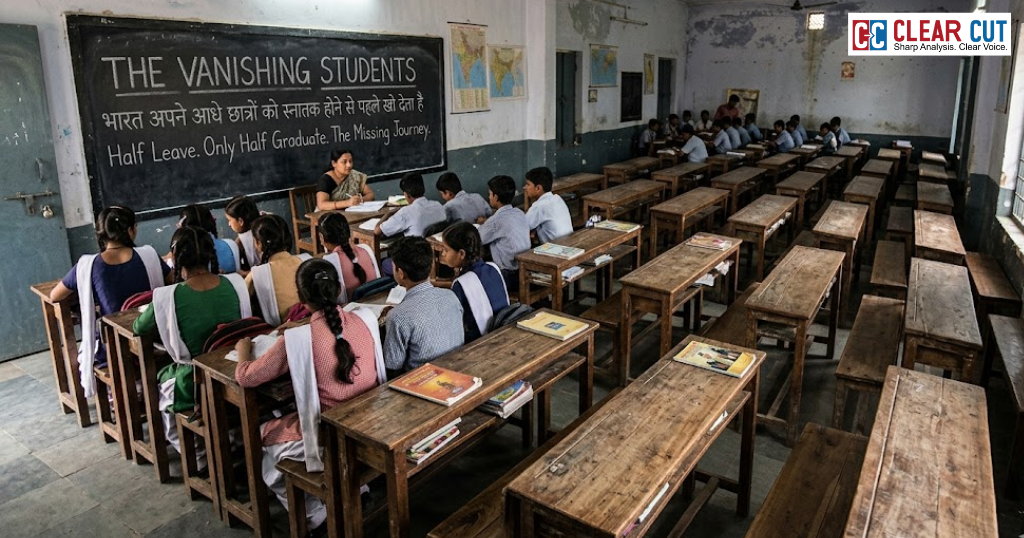
India’s education system sees high initial enrolment, but nearly half of students drop out before completing secondary school and very few reach higher education. This silent crisis, driven by economic pressures, gender barriers, and poor infrastructure, threatens the country’s future workforce and growth.
Education is the most powerful weapon which you can use to change the world.” – Nelson Mandela. India has over 250 million school-going children, the largest student population globally. Nearly all begin school in the early years, with about 247 million enrolled in primary grades (UDISE+ 2024-25).
As students advance, enrolment drops sharply. By secondary school (Classes 9–12), only 47.2%, which is about 118 million, remain. In higher education, just 70 million continue to colleges and universities (AISHE 2022).
The story of India’s education system, then, is not one of children never entering school, but of nearly 180 million dropping out before graduation. This silent exodus has profound consequences for employment, gender equality, and the nation’s demographic dividend.
The Great Secondary Cliff
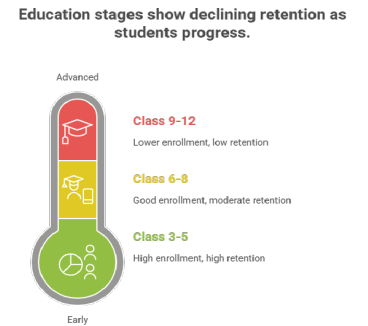
At first glance, India’s schooling journey looks like a triumph of access. In the early years, nearly all children remain in school. Even through the preparatory stage (Classes 3-5), retention is healthy, and by the middle stage (Classes 6-8), it remains above 82%. But as the transition to secondary arrives, the curve nosedives. Less than half the children who started school make it to Class 12.
This sharp drop is not a matter of chance. Secondary school years bring greater academic demands and high-stakes examinations (UDISE+ 2024-25). Financial pressures also weigh heavily: children, especially in rural, low-income families, are frequently expected to contribute to household income. For girls, the barriers are often gendered; early marriage, domestic responsibilities, and inadequate school infrastructure (such as toilets and menstrual hygiene facilities), and safety concerns push many out of classrooms (Education for All in India). A study by DevInsights for CRY titled – Educating the Girl Child: Role of Incentivisation and Other Enablers and Disablers, also confirms these patterns. Conducted across four states with 1,604 respondents, girls identified their own decision to stop schooling (54%), household chores (42%), and distance to schools as the leading reasons. Interestingly, more than half of these girls wished to continue education if given the opportunity, showing that aspirations remain strong but are curtailed by barriers at home and in the community.
An analysis of state-level UDISE+ 2024-25 data compared student retention rates with the availability of school infrastructure. The results demonstrate a strong correlation between infrastructure and retention. The presence of computers (r = 0.633, p < 0.001) and functional toilets (r = 0.577, p < 0.001) is particularly significant, especially for adolescent girls. Access to drinking water (r = 0.469, p = 0.003) also positively influences retention. These findings suggest that infrastructure is as critical as pedagogy for maintaining student enrolment To understand the drivers behind these steep dropout rates, an analysis, using state-level UDISE+ 2024-25 data, compared retention rates with the availability of school infrastructure. The results demonstrate a strong correlation between infrastructure and retention.
The presence of computers (r = 0.633, p < 0.001) and functional toilets (r = 0.577, p < 0.001) is particularly influential, especially for adolescent girls. Additionally, access to drinking water (r = 0.469, p = 0.003) also supports retention. These findings indicate that infrastructure is as important as pedagogy in keeping students enrolled.
The Vanishing College Cohort
the narrowing funnel. The Gross Enrolment Ratio (GER) in higher education stands at 28.4% (PIB). This figure lags behind the global average of around 40%, and far below countries like China (over 60%). This simply means that out of 100 children who enter Class 1, fewer than 30 will eventually step into a college lecture hall. The rest will navigate adulthood with far fewer chances for secure, well-paying employment. For a country banking on its youth bulge to fuel growth, this is not just an educational concern; it is also an economic warning bell.
A Gendered Story
The picture shifts when seen through the lens of gender. Interestingly, UDISE+ figures suggest girls slightly outperform boys in secondary retention (49.6% vs 45%). The GPI at the all-India level is measured as a ratio of GER of girls to GER of boys, stood at above one at all levels, indicating a more proportionally higher participation of girls compared to boys. But data points cannot capture lived realities. Girls may enrol, but many face constraints that limit their full participation: lack of safe transport, inadequate sanitation facilities, the, the stigma around menstruation, and societal pressure to marry early. Even when they continue into higher education, they are clustered in the humanities and teacher-training courses,
underrepresented in STEM,law, and professional tracks (IERJ, 2025).
As per NFHS 5, boys, meanwhile, are more likely to drop out due to economic pressure to contribute to family income. The gendered reasons differ, but the outcome is the same: millions of young people never make it to graduation.
A Tale of Two Indias: Regional Contrasts
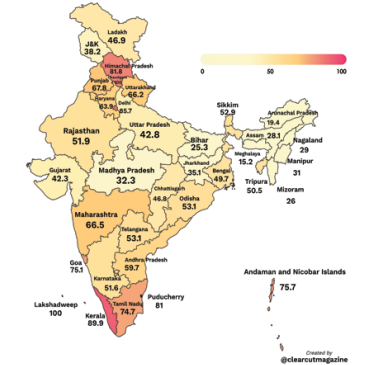
The national averages mask stark regional inequalities. Southern and western states consistently outperform the north, east, and northeast.
- Kerala (89.9%), Tamil Nadu (74.7%), and Himachal Pradesh (81.8%) boast some of the highest retention rates at the secondary stage. These states benefit from decades of investment in public education, mid-day meal schemes, strong community involvement, and better gender-friendly
infrastructure. - In contrast, Bihar (25.3%), Assam (28.1%), Meghalaya (15.2%), and Madhya Pradesh (32.3%) show alarmingly low figures. Here, poverty, distance to schools, weaker infrastructure, and entrenched social barriers drive attrition.
- Maharashtra (66.5%) and Goa (75.1%) stand out as western success stories, while Uttar Pradesh (42.8%) and Jharkhand (35.1%) reveal the northern struggle.
- Union Territories like Chandigarh, Lakshadweep, Puducherry, and Delhi post retention rates above 80-100%, highlighting the advantage of smaller populations and urban concentration.
The regional gender story is equally nuanced. In Chhattisgarh, girls (54.7%) significantly outperform boys (39.3%). In Tamil Nadu, the gap is also wide (80.2% vs 69.4%). Yet in states like Bihar and Uttar Pradesh, both genders record low retention, suggesting systemic issues that go beyond gender.In short, where a child is born can determine whether he/she reaches Class 12 or not. The geography of education is, in many ways, the geography of opportunity.
The Cost of Dropouts
The consequences of this broken pipeline reverberate far beyond the classrooms. With half of students dropping out before Class 12, and three-quarters of young adults never entering higher education, India risks a workforce that is under-skilled for the modern economy. Most dropouts are absorbed into informal, low-wage jobs with little security or upward mobility. For women, the stakes are even higher. Education is strongly correlated with delayed marriage, reduced fertility, improved maternal and child health, and greater labour force participation. Each girl who leaves school before Class 12 loses not just her chance at a degree, but also the broader empowerment education brings.
Closing the Gap
The consequences of this broken pipeline reverberate far beyond the classrooms. With half of students dropping out before Class 12, and three-quarters of young adults never entering higher education, India risks a workforce that is under-skilled for the modern economy. Most dropouts are absorbed into informal, low-wage jobs with little security or upward mobility. For women, the stakes are even higher. Education is strongly correlated with delayed marriage, reduced fertility, improved maternal and child health, and greater labour.
Conclusion
India’s education story is one of paradox. Nearly every child begins the journey, but half vanish before finishing school, and three-fourths vanish till enrolling in higher education. The dropout is silent but devastating, draining the country of talent and narrowing the possibilities for millions. The question is not whether India can enrol children in schools; it can, and it has. The question is whether it can keep them there long enough for education to truly transform lives. Unless the “missing class” of secondary and college students is reclaimed, the promise of India’s demographic dividend will remain unfulfilled.
Clear Cut Education, Gender Desk
New Delhi, UPDATED: May 06, 2026 09:00 IST
Written By: Asmita Yadav