The OECD Anti-Corruption Outlook 2026 reveals a significant gap between strong anti-corruption laws and their weak implementation across countries, undermining public trust and governance. It emphasizes the need for better enforcement, use of AI, and stronger accountability systems to effectively combat corruption.
The OECD released its Anti-Corruption and Integrity Outlook 2026 on March 24 in Paris, presenting one of the most comprehensive assessments of global governance integrity ever conducted. Titled “Harnessing the Integrity Advantage,” the report lands at a moment when public trust in governments is at a historic low and the cost of corruption continues to drain economies, distort development, and widen inequality.
The report was unveiled at the 2026 OECD Global Anti-Corruption and Integrity Forum, a five-day event running March 23 to 27 at the OECD Conference Centre in Paris.
The Implementation Gap: Laws Exist, Action Does Not
The Outlook assesses the strengths and gaps in 62 OECD member and partner countries’ integrity systems and finds that, despite recent progress, implementation of integrity measures remains uneven.
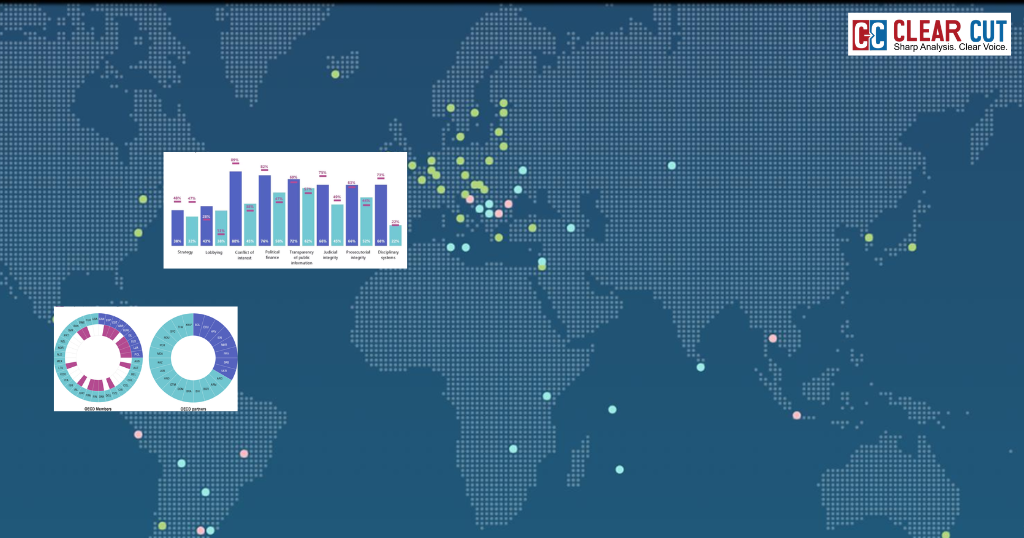
The numbers are stark. Across all areas, the average gap between the strength of integrity regulations at 63 percent and their actual implementation at 44 percent stands at 19 percentage points in OECD countries, and a wider 26 percentage points in partner countries. Only around one in four OECD members, and roughly half of partner countries, track the implementation of their own anti-corruption strategies.
OECD Secretary-General Mathias Cormann did not mince words at the Forum’s opening. He stated: “Strong anti-corruption and integrity safeguards are the foundation for effective public policy, the efficient use of public resources and a sound environment for business certainty and investment. Governments need to step up implementation and close gaps in their frameworks to meet citizens’ expectations for efficient and trustworthy public services and to tackle the growing threat of organised crime. To do this, they can leverage innovative tools such as AI and strengthen engagement with business and civil society.”
Seven Areas Under the Microscope
The Outlook analyses national integrity systems across seven thematic areas: anti-corruption and integrity strategies, lobbying, conflict of interest, political finance, transparency of public information, integrity of the disciplinary system for civil servants, and integrity of the justice system.

Justice system integrity emerges as a particular weak spot. While most countries have conflict-of-interest policies in place for judges and prosecutors, these officials consistently submit required interest declarations in fewer than one-third of OECD countries. The report recommends that monitoring of conflicts of interest focus on the highest-risk situations, and that disclosure of interests be substantially strengthened.
Most OECD member and partner countries have clear regulations on disciplinary procedures for civil servants, yet these could be better supported through stronger fairness guarantees. Improved training on disciplinary investigations and the use of digital tools could significantly strengthen implementation of disciplinary measures in practice.
AI as Both Threat and Tool
The 2026 edition places artificial intelligence at the centre of the governance conversation. Improving dataflows and integrating digital tools such as AI and analytics in day-to-day integrity functions are identified as key to improving implementation and monitoring. OECD member and partner countries could continue to develop data quality, interoperability, and effective governance for stronger oversight, enforcement, and accountability.

The Outlook highlights that countries are increasingly using data and digital technologies to strengthen integrity. Examples include the growing use of machine learning and data analytics to improve risk management and auditing, as well as expanded use of AI tools to detect fraud, waste, and other irregularities.
However, the report also flags a troubling gap. Only 44 percent of OECD member countries use digital systems to facilitate the submission and verification of interest and asset declarations, compared to 63 percent of OECD partner countries. Developed economies are, paradoxically, behind on digitising their own transparency infrastructure.
The Global South and Development Cooperation
The report carries direct implications for development cooperation and rural governance in the Global South. The number of people with low or no trust in national government now exceeds those who express trust. Fewer than one in three people find it likely that government would refuse a corporation’s demand if it went against the public interest.
This trust deficit has real development consequences. Transparency International’s 2025 Corruption Perceptions Index, released in February 2026, provides sobering context. The global average CPI score fell to a new low of 42, with more than two-thirds of countries scoring below 50. Only 31 countries have significantly reduced their corruption levels since 2012; the rest have stagnated or worsened.
François Valérian, Chair of Transparency International, issued a direct call to action alongside those findings. He stated: “Corruption is not inevitable. Our research and experience as a global movement fighting corruption show there is a clear blueprint for how to hold power to account for the common good, from democratic processes and independent oversight to a free and open civil society.”
Private Sector and Procurement Risks
The Outlook shows that alongside government measures, OECD members and partners are setting specific strategic objectives to target corruption in the private sector. While this is a positive development, it should be accompanied by additional efforts to safeguard other vulnerable areas such as state-owned enterprises and public-private partnerships.
Public procurement remains a high-risk zone. The report recommends a risk-based approach to protect procurement systems from fraud and organised crime, particularly as fiscal constraints tighten government budgets globally.
The Forum and What Comes Next
The report was presented by OECD Director for Public Governance Elsa Pilichowski, followed by a panel discussion on “The Integrity Advantage,” which explored how robust integrity systems can curb corruption, strengthen economic performance, and build trust in public institutions.
The 2026 Forum focused on the role of strong enforcement, effective governance, and data-driven, adaptive integrity systems in preventing fraud, improving decision-making, and enabling ethical business environments. It highlighted innovative approaches that demonstrate how anti-corruption efforts can enhance economic efficiency, boost investor confidence, and drive long-term value creation.
The message from Paris is clear and urgent. Governments have already put the legal frameworks for integrity in place. What is needed now is the political will to enforce them decisively and deliver on their promise to citizens.
Clear Cut Research Desk
New Delhi, UPDATED: March 28, 2026 09:00 IST
Written By: Ayushman Meena