
Hearing loss affects both children and adults, impacting speech, communication, and cognitive health if left untreated. Early diagnosis and treatments like hearing aids and cochlear implants can significantly improve the quality of life.
Hearing loss in children is common and by 18 years, it affects nearly 1 of every 5 children. Without hearing rehabilitation, hearing loss can cause detrimental effects on speech, language, developmental, educational and cognitive outcomes in children. Hearing rehabilitation can mitigate those detrimental effects for many children, particularly when identified soon after birth or onset.
Incidence And Prevalence
The prevalence of permanent bilateral severe to profound hearing loss in newborns is 1.1per 1000 newborns and has not changed significantly over time. In addition, another 1 to 2 per 1000 newborns have bilateral mild to moderate hearing loss or unilateral hearing loss of any degree. Management Options Hearing Devices for Children with Bilateral Sensorineural Hearing Loss Both physiological and behavioural evidence suggest bilateral input to the auditory system, as opposed to unilateral input, facilitates in aural listening skills necessary for developing spoken language skills, effective communication in daily listening and learning environments, and ultimately for academic success. Device Candidacy Audiometric Guidelines have been developed to determine the hearing level (unaided pure tone average), at which point children with hearing aids should be considered for a cochlear implant in the United States. Initially, cochlear implants were only recommended for children with profound sensorineural hearing loss who demonstrated no benefit from conventional hearing aids; however, the guidelines have been expanded to consider cochlear implants for children with less severe loss. Recent studies have shown improved speech perception and language results with cochlear implants compared with conventional hearing aids for children with less severe loss.
Hearing Aid
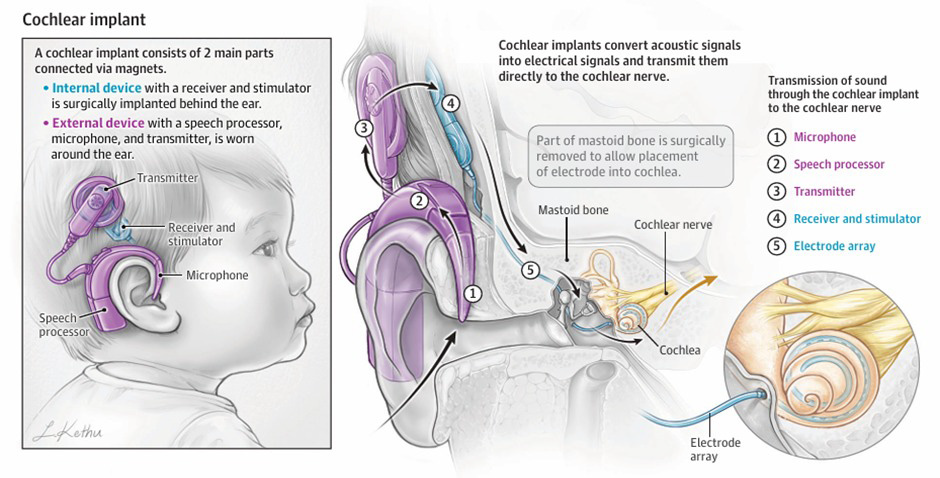
A personal device that is worn by the child to allow amplification of a sound; conventional hearing aids are fitted to the child’s ear and use the external auditory canal to transmit the amplified sound to the cochlea. Implantable Devices Cochlear implants bypass the normal transduction mechanisms of the peripheral auditory system and directly stimulate the auditory nerve using an electrical signal through a surgically placed electrode directly in the cochlea.
Conclusions:
Hearing loss in children is common, and there has been substantial progress in the diagnosis and management of these patients. Early identification of hearing loss and understanding its aetiology can assist with prognosis and counselling of families. In addition, awareness of treatment strategies, including the many hearing aids options, cochlear implants, and assistive devices can help direct management of the patient to optimize outcomes.
Hearing Loss in Adults
For adults, hearing loss often creeps in slowly, making it easy to dismiss until it significantly impacts quality of life.
- Primary Causes
● Presbycusis (Age-Related): This is the leading cause, characterized by the natural deterioration of inner ear hair cells over time. It typically affects both ears and starts with high-frequency sounds.
● Noise-Induced Hearing Loss (NIHL): Long-term exposure to loud work environments (construction, factories) or recreational sounds (loud music, firearms) causes permanent damage.
● Ototoxicity: Certain medications, including some antibiotics and chemotherapy drugs, can damage hearing as a side effect. - Identifying the Decline
Adults often develop coping mechanisms, such as lip-reading, which can mask the problem.
Early warning signs include:
● Difficulty hearing in crowded restaurants or background noise.
● The feeling that people are “mumbling” or that speech is muffled.
● Difficulty hearing high-pitched voices (women and children).
● Social withdrawal to avoid the embarrassment of misunderstanding conversations.
Health Complications
Recent studies have established a strong link between untreated hearing loss in older adults and cognitive decline or dementia. The brain must work harder to process sound, leaving fewer resources for memory and thinking, while social isolation further accelerates decline. Management and Technological Aids We are currently in a “golden age” of auditory rehabilitation, with technologies that go far beyond simple amplification.
● Hearing Aids: Modern devices are essentially miniature computers. Features now include AI-driven noise cancellation that can isolate a single voice in a crowd and Bluetooth connectivity for streaming audio directly from smartphones.
● Cochlear Implants: For those with severe-to-profound loss where hearing aids are ineffective, these surgically implanted devices bypass damaged parts of the ear to stimulate the auditory nerve directly.
Prevention:
Protecting hearing is a lifelong responsibility. Key strategies include:
● The 60/60 Rule: Listen to headphones at no more than 60% volume for no more than 60 minutes at a time.
● Ear Protection: Using earplugs at concerts or while using loud machinery.
● Routine Screenings: Children should be screened at birth and during school years; adults should get a baseline test and follow-up every few years as they age.
Conclusion:
Hearing loss is a growing problem which not only affects a person’s life but also his social skills, personality development and daily routine. Sparing none this problem is making people disable in a way that initially goes unnoticed but affecting them for lifelong. Its very important to take note of hearing problems initially so that preventive measures can be taken for maximum results. In case of children with congenital deafness, cochlear implants integrated with behaviour therapy can help children immensely. Hearing aid and hearing loss awareness is as essential as other problems which should be promoted and people should be educated about hearing loss.
About the Writer:
Dr. P Pritam Hansraj, MBBS, MS ENT, is a distinguished Consultant ENT Surgeon with over 25 years of clinical expertise. He specializes in advanced surgical care for ear, nose, and throat disorders. His career is defined by a deep commitment to the health of the Jharkhand region, blending veteran surgical skill with decades of dedicated patient service.
Clear Cut Health Desk
New Delhi, UPDATED: April 13, 2026 05:11 IST
Written By: Dr. P Pritam Hansraj