

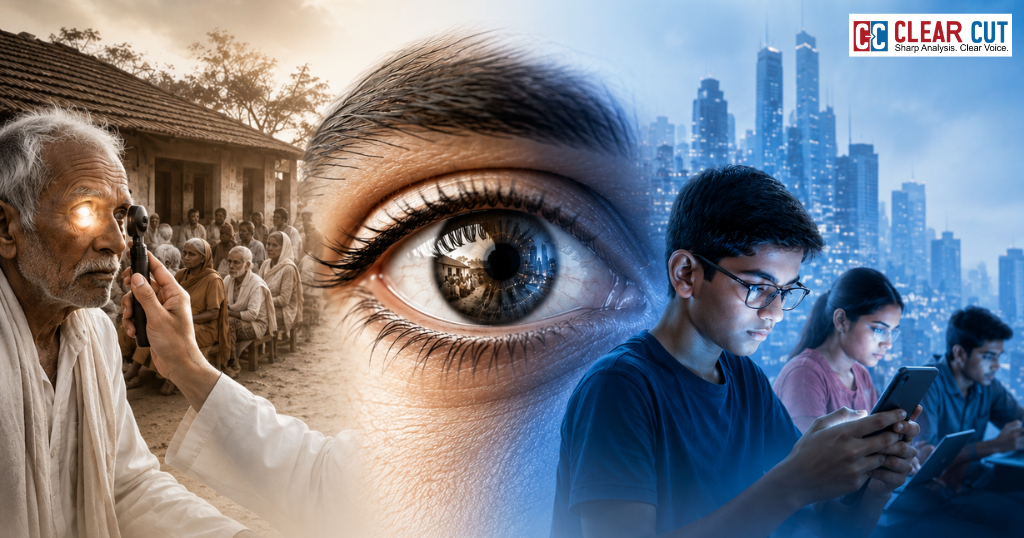
- India has reduced blindness rates over the decades, yet nearly 93% of blindness cases remain preventable, with cataracts continuing to be the leading cause, especially in rural areas.
- A new eye health crisis is emerging among children, as increased screen time and digital device use are driving a sharp rise in myopia (short-sightedness) across urban and rural India.
- While government programs have expanded eye care services and screenings, gaps in specialist availability, rural access, diabetic eye care, and childhood vision prevention continue to pose major challenges.
More than half a century since India started the first blindness prevention programme in the world, the nation still carries one of the greatest burdens of avoidable blindness anywhere in the world. While clinicians fight their usual foe of blindness caused by cataract in rural clinics, a new enemy has appeared on the horizon, in schools and homes across the country – kids as young as six years old are developing blurred vision not from illness but from long hours gazing into screens.
A Burden That Was Always Preventable
Statistics are alarming. As per the National Blindness and Visual Impairment Survey, carried out between 2015 and 2019, shows that the percentage of individuals who are blind in India is 0.36%, which equals 4.8 million individuals suffering from blindness. 74 million Indians suffer from some form of visual disability. This figure is higher than the total population of France, all of whom cannot see properly.
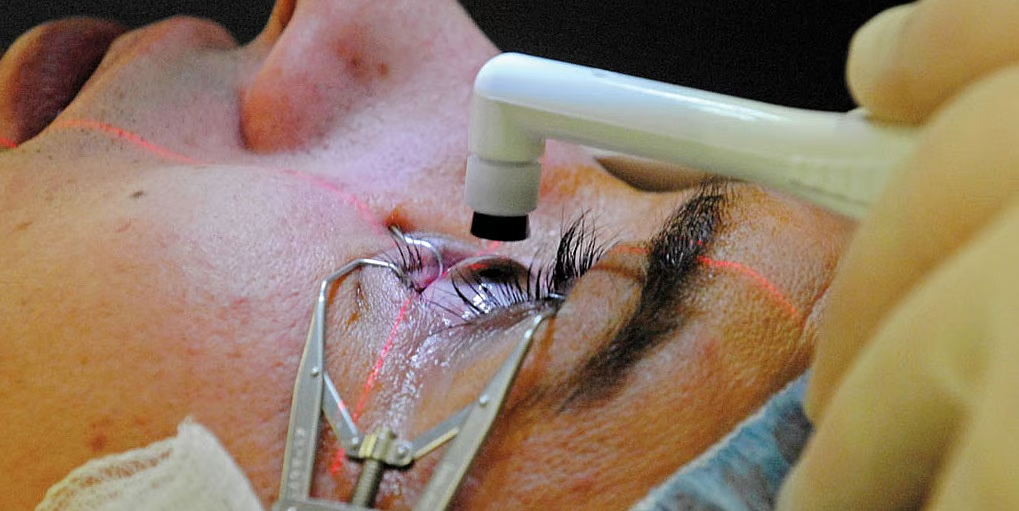
Even more heartbreaking about this issue is the fact that this is largely preventable. One study, which was conducted on a national level and was published in PLOS ONE, reported that cataracts, or the opacification of the lens of the eye that is correctable within thirty minutes with surgery, are responsible for 66.2% of all cases of blindness, with corneal opacities at 8.2%, complications after cataract surgery at 7.2 %, and glaucoma at 5.5%. All in all, 92.7 per cent of all blindness in India occurs due to preventable reasons.
There is inequality of distribution. This is revealed by the same national study, which shows that blindness occurs 1.37 times more often in rural areas than in urban settings, and visual impairment occurs 1.22 times more often in rural locations. Other factors include age, illiteracy, and poverty.
A fresh dimension to the problem is being added by diabetes. According to an unprecedented study that appeared in The Lancet Global Health in 2024, around 21 million persons with diabetes suffer from poor eyesight in India, out of which 2.4 million are blind – a cohort of individuals with specific needs, which the conventional model of eye camps could not possibly cater to.
The Smartphone in the Classroom
Although the threat of cataract continues to haunt adults, another danger is lurking amidst the young population. The prevalence of myopia, a condition characterised by difficulty seeing distant objects clearly, is quietly emerging as a public health problem in Indian schools.
According to a meta-analysis carried out in 2020 in the journal PLOS ONE involving studies from 40 years in India, the rate of myopia amongst urban schoolchildren was 8.5%. Amongst rural children, it was 6.1%, with the highest percentage, 15%, amongst urban adolescents between the ages of 11 and 15. This trend is worrying; according to a modelling study carried out in 2021 in the journal Ophthalmic and Physiological Optics, the prevalence of myopia amongst urban Indian children aged 5 to 15 increased from 4.44% in 1999 to 21.15% in 2019, and predicts that it will rise to 48% by 2050.
According to a large study across multiple states carried out in 2023 and featured in the British Journal of Ophthalmology, a total of 2,216,305 children were screened, revealing that there is an increase in the rate of myopia with age – from 1.57% in the age range of 5 to 9 years old, to 3.13% between the ages of 10 to 14, and 4.8% in children aged 15 to 19 years old, with increased likelihood being seen in those who live in urban areas, attend private schools, and have high literacy rates.
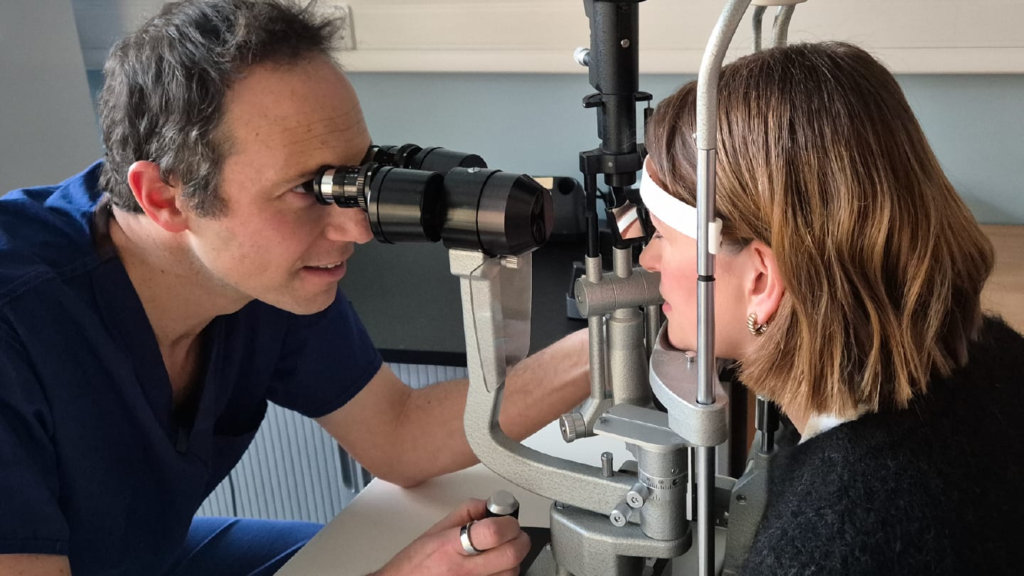
This is further exacerbated by near work through screens. According to a meta-analysis carried out in 2024 and published in BMC Public Health, involving 19 studies, there was a statistically significant relationship between screen time exposure and myopia among children and adolescents. In India, the COVID-19 pandemic acted as an inflexion point for children – a study involving 217 families where children had been attending virtual classes found that more than half suffered from digital eye strain, 11% severely.
It is important to note that high myopia not only creates difficulties for individuals. If left untreated, it can lead to retinal detachment and even glaucoma in the future.
Why Geography Decides Who Can See
Despite the treatment availability, access to it remains dependent on geography and socio-economic status. A national survey conducted in 2025 by the AIIMS, Delhi, showed that in India, there are only 15 ophthalmologists per million of the population – one for every 65,000 people, while according to the WHO, the figure should be one for every 20,000 people. The difference between states is dramatic. While in Puducherry, there is 127 per million, in Ladakh, the number drops to just two.
In relation to diabetic retinopathy, a survey conducted among eye health professionals in Haryana state of India, revealed that more than 85 per cent of ophthalmologists practised in cities despite most of the population living in rural areas. In rural India, where it is expected to have a diabetes prevalence rate of 10 per cent by 2030, 11 million individuals will be affected by diabetic retinopathy.
Increased awareness is another factor that creates distance. Most people living in villages visit traditional healers before seeking modern treatment, while the taboo associated with wearing glasses, particularly for females, results in delaying corrective treatment.
What Is Being Done, and What Remains
Being the pioneer in the field, India is credited with being the first nation to implement a national program to control blindness, with NPCB & VI making notable progress towards its goals. The percentage of blindness has been reduced to 0.36 from 1.4 per cent recorded between 1986 and 1989. As part of its plan to perform six million cataract surgeries annually, the Government has also implemented the Netra Jyoti Abhiyan Mission Mode Cataract Surgeries campaign from 2022-25 to eliminate backlog cases. The School Eye Screening Program provides free spectacles to children with refractive errors, with an annual target of 900,000 pairs.
The scheme, however, does not lack structural constraints. The uptake rate for referrals following the screening process is still low. Screening for diabetic retinopathy has only been formalised recently. Tele-ophthalmology has not been maximised as an alternative, though it could fill the gap in the countryside by utilising affordable retinal cameras with smartphones. The myopia among children lacks its own strategy akin to that of cataracts.
India finds itself in a paradoxical situation, whereby despite having shown political will and organised efficiency in addressing blindness, there exist two challenges: that of completing the ongoing process of preventing blindness among adults and an imminent epidemic of myopia in children owing to excessive exposure to screens. The first challenge demands greater efforts towards rural access and creation of more specialists, while the latter calls for what is difficult to mandate – that of increasing outdoor activities, limiting screen time, and eye screening in schools across India.
Without being able to see the blackboard today, she will be unable to see her way out of poverty tomorrow.
Clear Cut Health, Research Desk
New Delhi, UPDATED: June 05, 2026 09:00 IST
Written By: Jyoti Aggarwal