
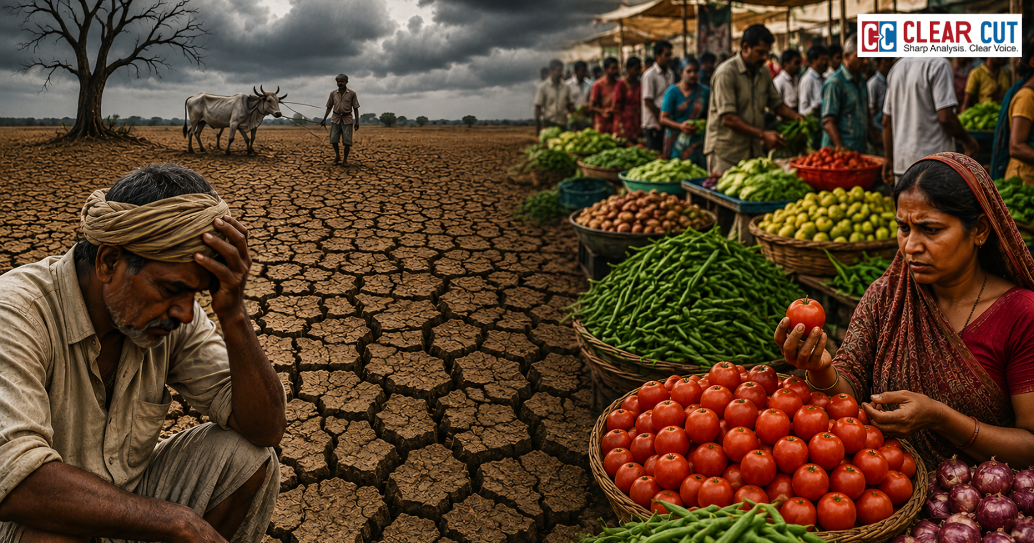
- India could experience its driest monsoon since 2015 as El Niño raises the likelihood of below-normal rainfall, threatening kharif crops, farm incomes, and rural livelihoods across rain-fed regions.
- A weak monsoon may push up food prices for essentials such as tomatoes, pulses, onions, and milk, adding pressure on household budgets and complicating inflation management.
- While improved irrigation, crop insurance, and higher reservoir levels provide some resilience, marginal farmers and rural communities remain highly vulnerable to rainfall shortages.
The India Meteorological Department’s revised forecast for 2026 places the southwest monsoon at its weakest in over a decade and the consequences will ripple from paddy fields to grocery shelves.

The onset of the monsoons is as significant an annual event as the results of any election and as much talked about as any budget in India over the centuries. It is the beat of a culture. So, when the India Meteorological Department, without a murmur, lowered its Long Period Average (LPA) Monsoon forecast from 92% to 90% and increased the chances of a deficient season to 60%, the farming villages from Gujarat to Odisha spoke volumes.
“This could be India’s driest monsoon since 2015 – and six of the last seven El Niño events have delivered below-normal rainfall.”
The forecast and its driver
The IMD’s warning is based on a familiar yet formidable villain – El Niño. The equatorial Pacific is moving toward neutral conditions, and the weather community is warning of an impending transition into El Niño, which is expected to make a strong transition in the very critical period between June and September for rainfall. The southwest monsoon is the lifeblood of a $4 trillion economy, as it provides almost 70% of the annual rainfall in India. In the abstract, the current forecast of 10% deficit might appear small. In practice, it only requires breaking the earth in the Monsoon Core Zone from Gujarat to Odisha, the country’s agricultural heartland where rain-fed agriculture makes the difference between a family feeding well or not.
Fields at risk
The maths of agriculture is clear. The impact of 1% reduction in rainfall on the growth of agriculture is around 0.4%, according to an HDFC Bank report on Treasury Research. The most vulnerable crops are rain-fed crops like paddy, maize, groundnut, soybean and millet. The poor kharif crop sowing season (June-August) would further impact the sowing level and limit the rural farmer income, at a time when rural India attempts to spend more. Indeed, private forecaster Skymet has already forecasted a “dismal outlook” for the next four weeks till early July and described it as a “critical mismatch with sowing calendar”.
If farmers wait too long, they may lose the whole season and if they plant on hope, they will lose their investments. It is noteworthy of a countervailing buffer. The reservoirs in India were also at their highest levels for the month of April since 2022, having finished the season at 41% of capacity after two years of surplus rainfall. This retained water provides some value of protection to kharif (summer) crops, even if kharif is unsuccessful. However, reservoirs cannot water rain-fed fields in real time. They are not a cure for the condition of a drought.
Inflation and the household budget
The impact on consumers comes gradually and suddenly. A weak monsoon could accelerate this rise in tomato prices as they were already 34% up in May because of heat wave conditions. Next are pulses, onions and milk, with milk prices likely to be further affected by the impact of extreme heat on dairy production and increasing fodder costs, and pulses and oilseeds being directly linked to kharif rains. Food prices account for about 50% of the country’s consumer price index, and any disruption in the supply of food will have an immediate impact on the household budgets, especially those of the rural and urban poor. The weak monsoon could drive up food inflation by 50 to 60 basis points, which would make the RBI’s monetary policy stance a bit more complicated, economists warn and would also reduce the space for the RBI to cut rates.
Rural livelihoods and the wider economy
All these pressures converge on the rural economy. Lower monsoons make farm incomes flatter, slow down rural wage growth and dampen rural spending on FMCG products, two wheelers, tractors and entry level housing – the currency of which is pivotal to these industries. The RBI’s study has revealed that over the years the link between rainfall deficiencies and macro-outcomes has weakened, owing to increased irrigation, improved crop insurance, and diversified incomes of the rural population. India is better equipped to withstand the jolts this season as compared to 2015. Despite this, the most vulnerable are those who are the first to feel the strenuous shortage of water, such as marginal farmers who are not irrigated, daily-wage agricultural labourers, and women in rural households who are the first to suffer the impact of scarcity. A 10% rainfall shortfall is a tolerable macro level figure but a personal reality in a rain-fed village in Vidarbha or Bundelkhand.
Weak monsoons have happened in the past in India. It will get through this one as well. But now it’s not just surviving but prospering and for the hundreds of millions of Indians whose fate is tied to each seed planted in June, the sky above is anything but empty in 2026.
Clear Cut Climate, Research Desk
New Delhi, UPDATED: June 05, 2026 01:00 IST
Written By: Subhanshu Jaiswal