

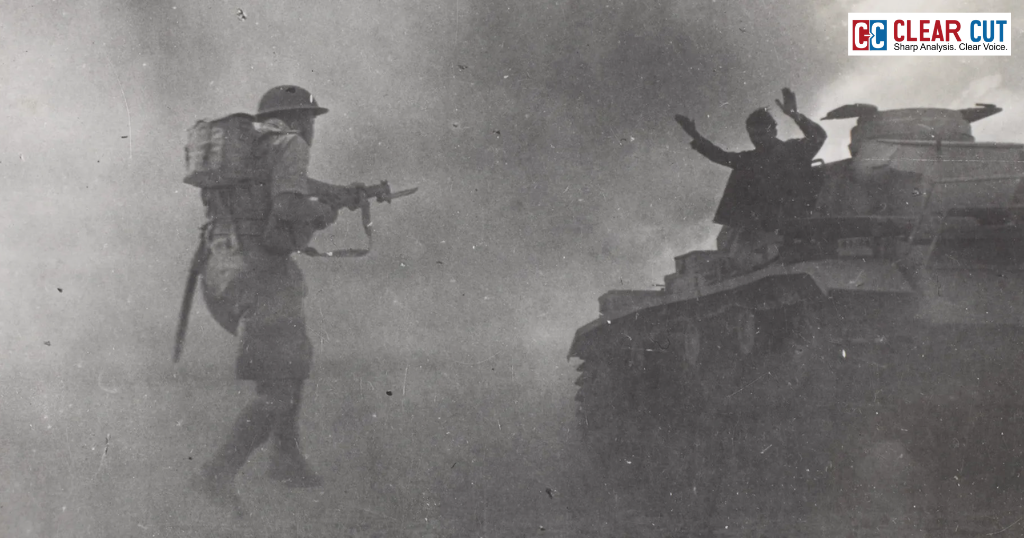
Defence spending and military capacity are increasingly shaping economic production, innovation, and global power, challenging traditional economic theory. The article explores how security has become a key factor influencing development, while also raising concerns about its trade-offs with social investment.
Traditional economic theory explains production through the interaction of land, labour, capital, and organization or entrepreneurship. This classical formulation assumes that national wealth is generated primarily through economic activity in agriculture, industry, and services. In that framework, productive capacity is associated with the organization of resources for socially and economically useful output. In the contemporary global order, however, this framework appears increasingly incomplete.
Defence expenditure, military technology, strategic infrastructure, and security systems now influence industrial policy, technological advancement, state capacity, and international economic positioning in ways that classical formulations did not adequately capture.
As a result, economic production in many countries can no longer be understood entirely without considering defence-related investment.
The Classical Production Function Under Strain
Traditional economic theory explains production through the interaction of land, labour, capital, and organization or entrepreneurship. This classical formulation assumes that national wealth is generated primarily through economic activity in agriculture, industry, and services. In that framework, productive capacity is associated with the organization of resources for socially and economically useful output.
In the contemporary global order, however, this framework appears increasingly incomplete. Defence expenditure, military technology, strategic infrastructure, and security systems now influence industrial policy, technological advancement, state capacity, and international economic positioning in ways that classical formulations did not adequately capture. As a result, economic production in many countries can no longer be understood entirely without considering defence-related investment.
War, Security, and Economic Strategy
In the 21st century, war and military preparedness are not only matters of territorial defence or diplomatic rivalry. They are also connected to industrial production, export markets, technological innovation, employment generation, and geopolitical influence. The global arms sector functions as a large industrial ecosystem that includes weapons systems, aircraft, naval platforms, AI and robotics, cyber capabilities, surveillance technologies, and strategic supply chains.
This does not mean that war should be viewed simply as an economic policy. However, it does suggest that in many national contexts, defence preparedness and military-industrial capacity have become integrated into wider economic and strategic planning. Arms exports can generate foreign exchange, strengthen alliances, support domestic industries, and reinforce a country’s position within regional and global power structures. The scale of this expansion is substantial. The global arms trade has reached unprecedented heights.
According to the Stockholm International Peace Research Institute (SIPRI), revenues from the world’s 100 largest arms-producing companies reached to a record $679 billion in 2024, a 5.9% increase over the previous year (SIPRI 2025). Global military expenditure reached $2.718 trillion in 2024, representing a 9.4% increase from the previous year and the highest level ever recorded, with spending rising continuously for a decade (Liang et al., 2025).
Rethinking the Production Function
These developments raise an important conceptual question for contemporary political economy. If production depends not only on classical economic inputs but also on the ability of the state to secure territory, protect infrastructure, support technological innovation, and maintain strategic stability, then military capability may increasingly operate as an enabling condition for production.
For that reason, it may be useful to revisit the classical production function and consider whether it now requires analytical expansion. Rather than declaring military power to be a universally accepted fifth factor of production, a more careful position is that defence capacity has become a significant background condition shaping investment, innovation, logistics, trade security, and state power in the modern era.
This is especially relevant in a world marked by geopolitical conflict, supply-chain vulnerability, cyber insecurity, and strategic competition. Military expenditure accounted for 2.5% of global GDP in 2024, highlighting the scale at which defence spending interacts with the global economic system (Liang et al., 2025).
The Development Paradox
Defence-related sectors also generate spillover effects that extend beyond the military sphere. Research and development associated with military priorities has historically contributed to innovations in communications, navigation, aerospace, computing, and dual-use technologies. From this perspective, defence expenditure may serve not only protective functions but also developmental and technological ones under specific institutional conditions. This creates a significant conceptual tension. On the one hand, national security may be understood as a prerequisite for development, since no economy can function effectively without stability, territorial integrity, and institutional protection. On the other hand, excessive defence spending may reduce investment space for public health, education, nutrition, social protection, and infrastructure, all of which are central to long-term development.
In this context, human capital development remains a critical foundation of long-term economic growth. Investments in education, health, and skills formation expand labour productivity, technological capacity, and innovation potential-factors that ultimately determine whether security investments translate into sustainable development.
Even in technologically advanced military systems, highly trained human capital remains indispensable for research, command, and operational effectiveness.
The issue, therefore, is not whether defence matters, but what role it should play in the development process. A state that underinvests in security may expose its economy to external threat, strategic coercion, or disruption of trade and investment. Yet a state that overprioritizes military expenditure at the expense of social investment may weaken the very foundations of sustainable development it seeks to defend.
Development in a Militarized World Recent geopolitical developments have intensified this debate. The Russia-Ukraine war, tensions in the Middle East, and rapid military modernization by major powers have all reinforced the view that economic systems require credible security arrangements. In such a context, defence expenditure cannot always be interpreted as a fiscal burden; it may also function as a protective investment in sovereignty, strategic autonomy, and economic continuity.
This is particularly important in an age of globalized production and interdependence. Trade corridors, energy routes, digital networks, critical minerals, ports, and communication systems all depend on security architecture. Modern economies rely not only on markets and institutions but also on the capacity to deter aggression, manage risk, and protect infrastructure.
In that sense, economic activity in the present era is inseparable from questions of defence and strategic security. At the same time, recognition of the economic role of defence should not eliminate concern about its trade-offs. The developmental value of defence expenditure depends on scale, purpose, governance, and opportunity cost.
Expenditure directed toward national security, technological resilience, and strategic stability differs significantly from militarization invested for prolonged conflict, or prestige. The five largest military spenders-the United States (37%), China (12%), Russia (5.5%), Germany (3.3%), and India (3.2%)-accounted for around 60% of total global military expenditure in 2024 (Liang et al., 2025).
Key Questions for Policy and Political Economy
The rise of the war economy therefore, raises a series of questions that deserve serious academic and policy attention. Should military expenditure be treated only as a consumption cost, or can it in some contexts be understood as a productive or enabling investment? Can the concept of development remain fully adequate if it overlooks the growing role of security capacity in sustaining economic systems? How should policymakers evaluate defence-related technological gains against the social costs of expanding military budgets?
A further question concerns the changing relationship between economic power and strategic power. In many cases, countries with advanced defence industries enjoy advantages not only in military capability but also in diplomacy, trade negotiations, technological leadership, and alliance formation. This suggests that military-industrial capacity may increasingly shape the global distribution of economic opportunity and political influence.
How should policymakers evaluate defence-related technological gains against the social costs of expanding military budgets? A further question concerns the changing relationship between economic power and strategic power. In many cases, countries with advanced defence industries enjoy advantages not only in military capability but also in diplomacy, trade negotiations, technological leadership, and alliance formation. This suggests that military-industrial capacity may increasingly shape the global distribution of economic opportunity and political influence.
About the writer:
Dr. Sushanta Kumar Banerjee is a public health expert with over three decades of experience spanning research, policy, and programme implementation. He holds a PhD in Demography and a master’s degree in Economics, bringing a strong analytical lens to complex development challenges. He recently retired as Chief Technical Officer at Ipas Development Foundation. Dr. Banerjee has authored multiple research papers in peer-reviewed international journals and UN publications, and has contributed economic analyses to the Economic and Political Weekly (EPW). He is also a contributing author to Clear Cut.
Clear Cut Research Desk
New Delhi, UPDATED: April 18, 2026 09:00 IST
Written By: Dr. Sushanta Kumar Banerjee