A footpath cobbler’s quiet skill and dignity reveal a life shaped by hardship, caste identity, and resilience, as he supports his family and prioritizes his children’s education despite earning barely enough to survive.
“Cobbler, cobbler, mend my shoe, Give it a stitch, and that will do.”
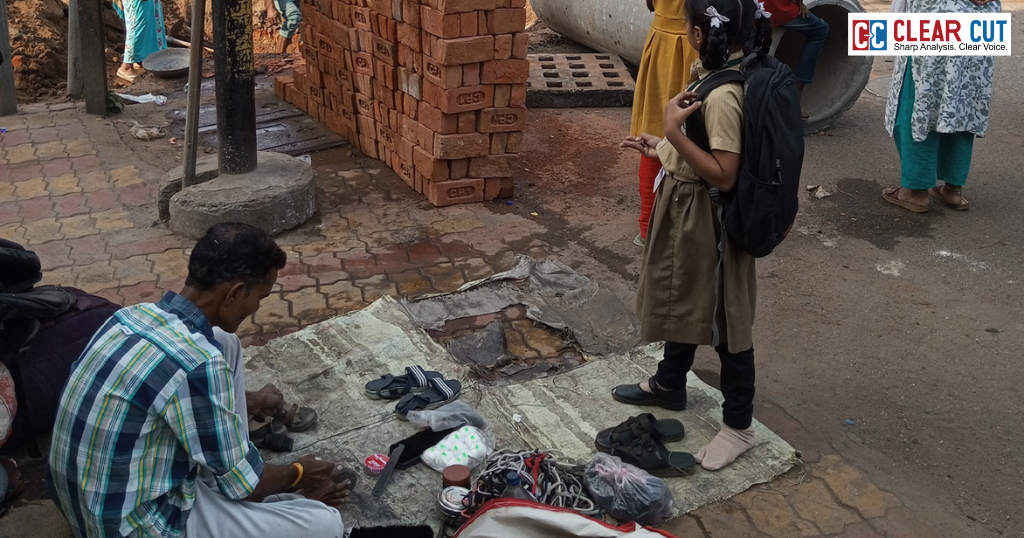
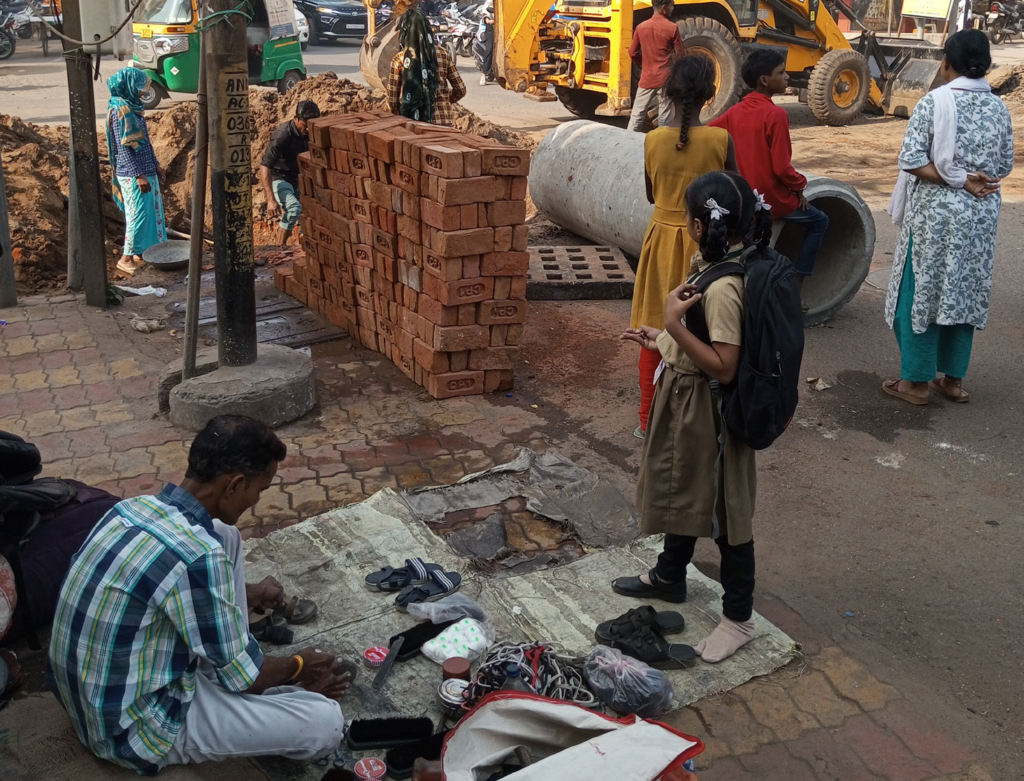
The kindergarten poem lines reverberated in my mind as I noticed a small child in navy-blue tunic and crisp white shirt school uniform quickly got down from the scooter. She took out her left black ballerina shoe and extended it to the cobbler sitting at the corner of a busy intersection of the city. Her mother followed after putting the scooter on stands on the side of the road, on the footpath.
“Would you please mend the shoe? She has to attend tuition classes, and I am already late,” the mother said, showing the gap between the upper and the insole close to the toes.
The cobbler was polishing shoes. He looked at the ballerina shoe. He took a length of waxed black thread lying on the torn mat spread over the newly laid red and white inter-locking concrete blocks and began to stitch. In his right hand, the cobbler held awl; in left hand the thread. First, he inserted awl into the sole, created a loop in the thread with his left hand, and pulled it up with the help of awl. Then, with his left hand positioned inside the shoe, he guided the stitches with rhythmic precision; poking awl and pulling out thread. Finally, he tied the threads and sliced them with cutter.
“The awl might hurt your fingers,” I said.
“No, working over the years, it becomes normal,” the cobbler said looking at me and added, “both hands know what they have to do.”
“I guess different type of soles may create difference,” I said.
“Yes, some times the soles are very hard. The ones they make for the army personnel shoes. A different process is followed to mend those shoes. Stitching is for softer soles. Otherwise, these awls would break and I have to make new ones,” he said as he completed mending shoe of the child.
“How much?” The child’s mother asked.
“Rs 20/-,” he said.
For the last three months, I am trying to understand lives of the cobblers working on the footpath or side walk of Anand, Gujarat. I was keen to know about them for a long time but my limited conversational Gujarati stood in the way. Since I planned to conduct this self-sponsored research, hiring a translator was a problem. Thankfully, a friend volunteered to assist me. I agreed on a term that he would accept a small gift from me.
This was the second time I came to meet this cobbler. Last time a pneumatic breaker was breaking the concrete road for a new construction and the scheduled meeting was postponed. The translator had already taken his consent for an interview. He was informed about the purpose and was verbally informed that he may refuse to answer any uncomfortable question or he may refuse without citing any reasons.
After introducing my self I asked, “What is your name?” After a long wait for the cacophony of traffic and the incessant flow of customers to subside before speaking. Our deal was that interview will not stop him from attending to his business. There was a slight pause as the cobbler rubbed wax (called meed in Gujarati) onto a thread.
“Mahendra Macwana,” he said (pseudonym)
“You sit by the side of the road with the constant movement of traffic,” I observed. “There is so much dust and pollution here.”
“Yes, there is dust, but I cannot do anything,” Mahendra responded calmly. “I have become habituated to it.”
“Since how long are you sitting here?” I asked.
“More than two decades,” said Mahendra.
“Are you from this city?”
“No, I am from a nearby city named Nadiad” he said.
“You live here?”
“No, I travel daily from Nadiad to this place. I take morning train and reach here in the morning. I start arranging all the goods and tool box and by 9 AM the shop is ready. I start working,” he said.
“You carry everything daily,” I asked.
“No, I wind up my shop and places everything in a box and keep it in front of that shop. A security person takes care of the box. I pay him money every month,” he said indicating towards a permanent shop.
“What are you doing with the thread? I asked.
“I am rubbing wax on the thread,” he said as he held a small, around one inch diameter, wax ball in his right hand and held thread between toe of his left leg and right hand. He rubbed the brown wax quickly over a two-foot section, then pulled a fresh length of thread to repeat the process.
“Are you making it stronger?”
“No, the nylon thread is already strong,” he said.
“Would you please explain the significance of rubbing wax on thread?”
“You see the thread? It is loose and supple. You cannot use it for stitching shoes. How would the awl hold it? The pointed end of the awl can pierce the unwaxed thread and break it while pulling. Waxing prevents fraying of the thread. It also stops tangling of thread,” he said, demonstrating how untreated thread bunches up while waxed thread remains smooth.
I was listening.
“The wax coating creates a layer that makes thread tight and holds the strands of thread together. The awl picks up the tight thread easily. The wax also acts as a lubricant, making the pulling of thread easier. The coating of wax also protects the thread from decaying because it makes the thread waterproof,” he explained as he continued rubbing the wax on the black thread.
“Please tell me, what brought you to this city?”
“I have two brothers. I was previously working at Nadiad. My father had a shop there. I worked with him for some time and I learnt shoe mending while working with him. After the death of my father, my elder brother also died. I gave that shop to my brother’s son and decided to open shop here,” he said.
“Your father had a shop in Nadiad,” I said.
“Yes, just like this,” he said.
“Please tell me how you chose this location,” I requested.
“When I first arrived to this city by train I went to a tea shop. There, I picked up a conversation. A man told me he hadn’t seen the local cobbler near the cinema hall opening his shop for more than six months. I thanked him and came to this location. The nearby shopkeepers told me not to sit here. They mentioned about the cobbler who sat here. I promised that I will shift to another location if the previous cobbler returned. I was apprehensive but my luck helped me. The previous cobbler did not return,” he said.
“Do you have to pay fees for sitting here?” I asked.
“No,” Mahendra replied.
A person came and asked for insoles.
“Rs 30/- per pair,” Mahendra said.
“What all do you deal in?” I asked.
“I polish shoes, mend shoes and bags, replace trolley wheels, zippers and runners. I sell insole and laces,” he said.
“Which one is your favourite?”
“Every work is my favourite,” he said.
“I guess some work pays better?”
“Replacing a runner pays more. However, a cobbler cannot afford to be selective. You must do all the work equally well,” he insisted.
“Please tell me about your daily routine.”
“I wake up early, have tea and khari (a type of snack – plain puff pastry), and leave home. I told you earlier that I set my shop by 9 AM. I work whole day and return home at 6PM by train,” he said.
“It must be very difficult during the monsoon,” I suggested.
“Yes,” Mahendra admitted. “For those two months, there is no earning. I have to depend on what I saved during the other months of the year.”
“Which is your best month for business?” I asked.
“April and May,” he replied.
“Isn’t it too hot then?” I asked, thinking of the searing Gujarat summer.
“Yes,” Mahendra said, “but it is also the marriage season, and there are many more customers.”
“What about lunch?”
“I only have tea and snacks here,” he said.
“You should have brought tiffin from home,” I said looking at his thin, emaciated frame.
“My wife died during the corona. My mother has to go for work, and my children are in college. They have to go to college. I manage food here,” he said.
“Technically, you only eat one full meal a day – at dinner,” I remarked.
He remained silent.
“Who is in your family?” I asked.
“I, mother, and three children,” he said.
“Please tell me about your children.”
“My eldest daughter is in the first year of MA in Economics. My second daughter is in her second year of graduation, and my son is studying for a diploma in engineering,” he said.
“Do you have to pay fees for their education?”
“Yes, education is very expensive. My mother’s wages go towards their fees,” he said.
“How much do you earn?”
“Around Rs 12000/- per month,” he said.
“What is your caste?”
“I am caste Rohit,” he said.
“Would you please explain it?”
“Rohit is a Schedule Caste,” he said.
“Is it different from the caste Mochi?”
“Mochi is profession; Rohit is the caste. People call us Mochi, but we are Rohit,” he repeated and further added, “Within Rohit there are various ataks (surnames) like Makwana, Solanki, Parmar, and many more.”
“How are marriages conducted in your community?”
“A Makwana can marry Solanki or Parmar or any other atak within caste Rohit,” he said.
“How are marriages arranged?” I asked.
“I did not get you,” he said.
“I want to know whether brides father go to grooms house or vice versa,” I said.
“No, in our community there is a third person who knows both parties. He will speak to both the sides and in case there is an agreement the boy and the girl meet and marriage is solemnised in a ceremony. The third person is paid honorarium,” he said.
“Who conducts ceremony?” I asked.
“We conduct the ceremony ourselves,” he said.
“Are you planning to marry your children?”
“My eldest daughter would complete her Master’s in next two months. First, she should complete her education and then only I will marry her. I could not finish my education, but I want my children to study as much as they can,” he said.
“Please tell me about your education,” I said.
“I completed BA in Economics. Then, I took admission for an LLB in a law college in Nadiad…” Before he could complete, I exclaimed, “Wow!”. I tried my best to control my emotions but could not.
“I left LLB after the first year. My father died, and the conditions became too tough. By that time, I had also completed a course in CNC machine operation. The machine that runs on computer and cuts pattern in metal sheets,” said Mahendra.
“I can understand that you might not have got job after BA in Economics but CNC operation course is a vocational skill course. In state like Gujarat CNC operators get job easily,” I said.
“With some difficulty I got a job of CNC apprenticeship. You know, the factory owners employ people of their choice. I worked in the factory for some time. My monthly wages were Rs 60/-. It was too less to maintain the family for entire month. Money was required every day, and I already knew my father’s trade. I decided to work as a cobbler,” said Mahendra.
Clear Cut Livelihood Desk
New Delhi, UPDATED: April 22, 2026 05:00 IST
Written By: Dr. Ram Manohar Vikas