


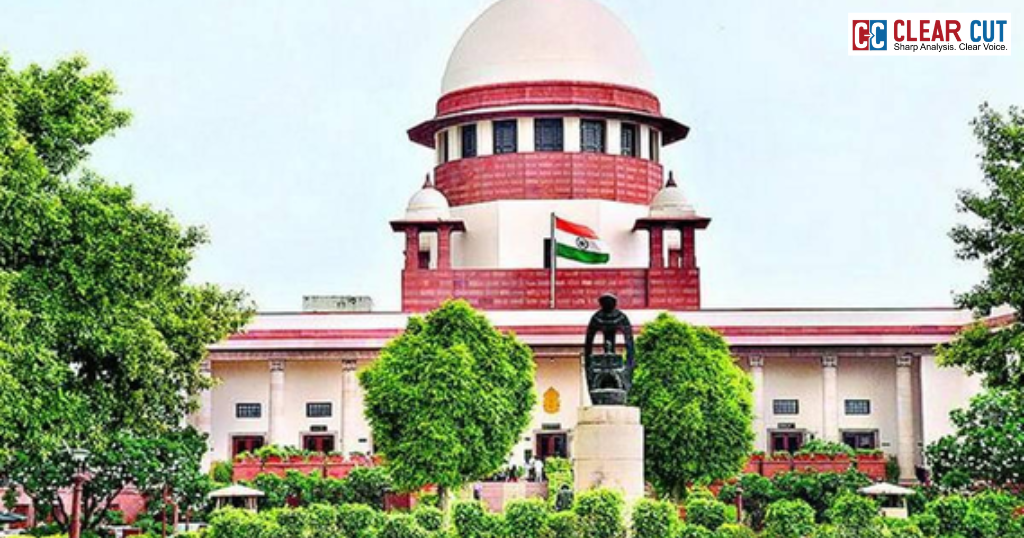
India’s corporate environmental responsibility debate is shifting from voluntary CSR to a constitutional duty under Articles 21 and 51A(g), backed by decades of Supreme Court rulings. The real challenge now is whether regulators and companies will move beyond symbolic green projects toward measurable environmental accountability.
There’s a constitutional argument about corporate environmental responsibility in India that’s not getting the attention it deserves. Back in December 2025, The Hindu ran an editorial, “Step up: On corporate environmental responsibility,” which made a clear point: companies shouldn’t just view environmental action as voluntary charity under CSR. Instead, their obligations should be grounded in the Constitution, specifically Article 51A(g), which makes protecting the environment a fundamental duty for every citizen. Drishti IAS’s analysis, which has been circulating among policymakers, gets even more specific: the Supreme Court has repeatedly ruled that the right to a clean environment is part of the right to life under Article 21. Corporations in India, the argument goes, share these constitutional duties just like individuals do.

You can’t dismiss this as some fringe theory. Look at the Supreme Court’s track record. In the Vellore Citizens Welfare Forum case, it brought the Precautionary Principle and the Polluter Pays Principle into Indian law. In M.C. Mehta v. Kamal Nath, the Court said natural resources belonged to the public, not to businesses or the government. And in the Indian Council for Enviro-Legal Action v. Union of India, the Court made chemical companies strictly liable for environmental damage. So, the foundation for treating corporate environmental responsibility as a legal duty is decades old. Yet, ever since the CSR framework arrived in 2013, public debate shifted: environmental investment became a matter of generosity, not obligation.
So what does environmental CSR look like? Well, according to Drishti IAS, most CSR projects in the environmental space are short-term and sit on the sidelines nowhere near the company’s core decisions. Enforcement is weak, greenwashing is common, and hardly anyone measures real outcomes. The Smile Foundation analysis backs this up: spending on environment and climate is growing, with renewable energy, water security, and afforestation the headline acts. But they’re not central to business strategy, they’re bolt-ons.
Take afforestation. It’s probably the most popular form of environmental CSR, easy to showcase, easy to photograph for the annual report. But when you dig in, problems are everywhere. Survival rates for planted trees can be as low as 20–40 percent; companies often plant monocultures that don’t support local ecosystems; hardly anyone checks whether those saplings are still around years later. So when you see a big number GHCL reported planting 3 lakh saplings in 2024-25 you can’t say what it accomplished without survival data. It’s activity, not necessarily impact.
This is where the constitutional argument matters. If environmental responsibility is philanthropy, companies ask how much to give. If it’s a duty grounded in Article 51A(g) and Article 21, the question becomes whether the company has actually met its obligation and that’s a whole different standard. The BRSR framework, for example, requires disclosure of Scope 1 and 2 emissions but ignores Scope 3 and doesn’t demand outcome data for plantation projects. It tracks how much companies spend, not whether their projects work. That’s the charity model. The Supreme Court case’s law points the other way.
Drishti IAS says the way forward isn’t complicated, it’s about regulation, transparency, and making environmental safeguards part of everyday business decisions. Three changes stand out. First, companies should report Scope 3 emissions: get real about supply chain impacts, not just their factories or offices. Second, make outcome verification mandatory, require survival audits for plantations and actual tracked savings for other interventions. Third, bring the Polluter Pays Principle into CSR design. If a company does business in a polluted or sensitive area, it should direct its CSR to fixing actual harms, not just funding unrelated green projects.

None of this is legally radical. The Supreme Court already said as much. The real question is whether regulators Ministry of Corporate Affairs, SEBI, MoEFCC will abandon the old charity model and enforce a duty-based one, and whether companies will accept that.
In the last decade, corporate environmental CSR in India got bigger and more sophisticated, but it never truly shaped core business behavior. The Supreme Court laid out a constitutional pathway Article 51A(g), Article 21 for making environmental stewardship a legal duty. The frameworks on the books are stuck in charity mode; the law provides tools for a duty. Whether India makes the shift is a decision yet to be made, and with each heatwave, every dry monsoon, and the mounting plastic in our rivers, the price of delay gets steeper.
Clear Cut Climate, CSR Desk
New Delhi, UPDATED: May 08, 2026 01:00 IST
Written By: Jay


Spot on with this write-up, I seriously believe
this website needs a lot more attention.I’ll probably be back again to see more,
thanks for the advice!
Thank you so much for your kind words! 😊
We’re really happy to hear that you enjoyed the article. Your support and feedback motivate us to keep creating better content. Hope to see you back on our blog again soon! 🙌