
- The Scientist Entrepreneur follows Dr. Kalpana Sankar’s journey from nuclear physicist to co-founder of Hand in Hand India, tackling child labour and rural poverty.
- The book highlights her data-driven, step-by-step approach to building women-led self-help groups, microfinance systems, and livelihood programs.
- It blends personal field experiences with large-scale impact, showing how disciplined, scientific thinking can drive grassroots social change.
Picture the scene: a woman with a PhD in Nuclear Physics from the University of Madras, sitting in a modest room in Kanchipuram back in 2002, her mind turning over the problem of child labour. At first glance, the leap is almost surreal. You’ve got atomic particles on one side, rural kids out of school on the other.
Controlled nuclear reactions set against the unpredictable messiness of poverty. But Dr. Kalpana Sankar’s memoir, The Scientist Entrepreneur, quietly insists that these worlds bear more resemblance than you think. Both demand discipline. Both demand a clear-eyed look at facts. Both are brutal to wishful thinkers and reward those who build real understanding layer by layer.
This is, at its heart, a book about building something substantial and lasting. More specifically, it’s about co-founding and growing Hand in Hand India, an organization that began by tackling child labour in Tamil Nadu, then expanded far beyond, eventually reaching 18 states and several other countries, empowering over 10 million rural women and helping launch more than 112,000 women-led businesses. The scale is staggering. Yet, Sankar doesn’t hide behind the numbers. This book roots itself in lived experience, the process, the people, the day-to-day fog of uncertainty and incremental wins.
She’s blunt about where she started. Sankar didn’t come from the standard NGO circuit; she was a nuclear physicist and had a stint as Monitoring and Evaluation Officer at the Tamil Nadu Women’s Development Corporation. This unlikely combination gave her a rare balance: she knew how to chase data but also recognized that numbers alone aren’t enough to move the hearts or habits of a community. Her entrance into social entrepreneurship wasn’t some grand ideological pivot, it was tangled, a little unplanned, fuelled mainly by the faces and stories of real kids stuck working when they should have been learning. The first chapters read like notes from a field diary lots of confusion, plenty of mistakes, and a real willingness to say, “I didn’t know what I was doing, but I had to figure it out.”
With her co-founder Percy Barnevik, they set up eight residential schools to pull children out of labour. Then the tough realization: without fixing the household’s ability to earn, the solution would never last. So they moved to organizing women’s self-help groups and microfinance. But credit alone wasn’t enough—so they began focusing on skill-building. This stepby-step learning ended up as their f ive-pillar model: group formation, child labour elimination, healthcare, livelihood skills, job creation.
Each new pillar was a direct response to a problem uncovered by earlier efforts. It’s messy, honest, and nothing like the tidy, vision-drenched planning you’d find in a business school case study. This is trial-and-error, survival, and learning in real time.
Some of the book’s most compelling moments have nothing to do with program design and everything to do with what it means to be a woman leading change in a world still uneasy about women in charge. Sankar writes in a balanced, measured way almost as if she’s g r own used to recounting it over the years about the continual scrutiny, the double s t a ndards, and the persistent questions about her leadership that her male peers never faced. The facts were on her side: two doctorates, a track record of building things that worked, global recognition.
But people still asked, “Are you really leading this?” That silent challenge, that hum of doubt, is not the book’s headline argument, but it pulses underneath every page. Awards like the Nari Shakti Puraskar and the Global Award for Women’s Empowerment aren’t just shiny proof of Sankar’s work they’re acknowledgment that what she built matters. The resistance she faced? It only underscores the substance of her achievement.
Then comes the part where her scientific background really shines. Scaling up social impact, as she describes it, becomes an exercise in disciplined thinking, experimentation, and constant adjustment much like science itself.
The five-pillar approach wasn’t just a creative flash. It was what the data and the women themselves demanded. Most organizations pick a single lane finance, education, health. Sankar’s team chose integration, recognizing that for rural women, these problems are tangled up together. You can’t boost incomes without making health care work. You can’t keep girls in school if families are desperate for the extra income. The multi-pronged approach wasn’t an abstract idea, but a faithful response to the complexity on the ground.
She’s frank about another contentious issue in development: microf inance. Give a loan to someone without the skills or support to make the most of it, and you just create new problems. Debt grows, not opportunity. So, Hand in Hand created a ‘graduated entrepreneur’ model: first group formation and training, then support, and only after that, credit. She doesn’t dive into academic debates; she just shows, in story after story, what happens when this sequence is right and what happens when it isn’t.
Still, there are places where the book pulls punches. Sankar delivers rich detail on the nuts and bolts of running an organization and navigating rural social life, but she’s softer on the larger forces at play land rights, caste systems, political structures, and policy moves that have both helped and hindered grassroots progress.
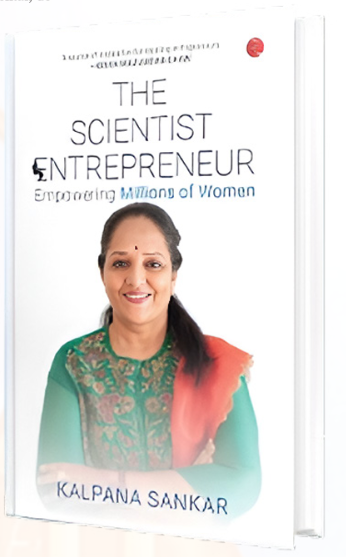
If you come looking for a scathing critique of how microfinance intersects with rural poverty or how state policy shapes grassroots realities, you’ll have to look elsewhere. This book sticks to the personal, the practical, the lived-in appropriate for a memoir, but you can’t help wanting her to dig deeper into the systemic barriers beyond individual reach.
What she absolutely nails are the everyday moments the small victories, the hesitations and breakthroughs that really make change visible. There’s the skeptical woman who slipped quietly into a selfhelp group meeting and wound up leading it. A child’s first day at school becomes a kind of revolution for a struggling family. A Rs 5,000 loan seeds a business that changes a household’s fate. These stories refuse to be washed out by statistics. Ten million women is a number too big to feel. But the woman in Kanchipuram who started a business and sent her daughter to school—that sticks with you. The book shuttles smoothly (and movingly) between the macro and the micro, never letting you lose sight of the real lives behind the staggering figures.
The Scientist Entrepreneur is rare in the world of Indian social development. It’s rigorous enough for policy wonks and social sector insiders, grounded and personal enough to pull in more casual readers, truthful about what failed and what didn’t, and never gets lost in buzzwords or glossy PR language.
This isn’t a book that sets out to tear down the system or pitch a grand theory of change. It’s more valuable than that: a detailed, credible map of real progress, the kind that only incremental, determined, science-minded work makes possible.
In the end, the physicist’s best habit of refusing to accept something just because you want it to be true turns out to be exactly what drives true change where it mat ters most. For three decades, Kalpana Sankar kept testing, iterat ing, learning, and building institutions for women who’d been left out for too long. The book opens that world to the rest of us.
If you’re curious about what it takes to really build something for marginalized women from the ground up, you should read this, whether you’re a social entrepreneur, a CSR strategist, a development economist, or simply hungry for a story about methodical, transparent, human-driven grassroots innovation.
Clear Cut Livelihood, Gender Desk
New Delhi, UPDATED: May 29, 2026 09:00 IST
Written By: Janmojaya Barik