
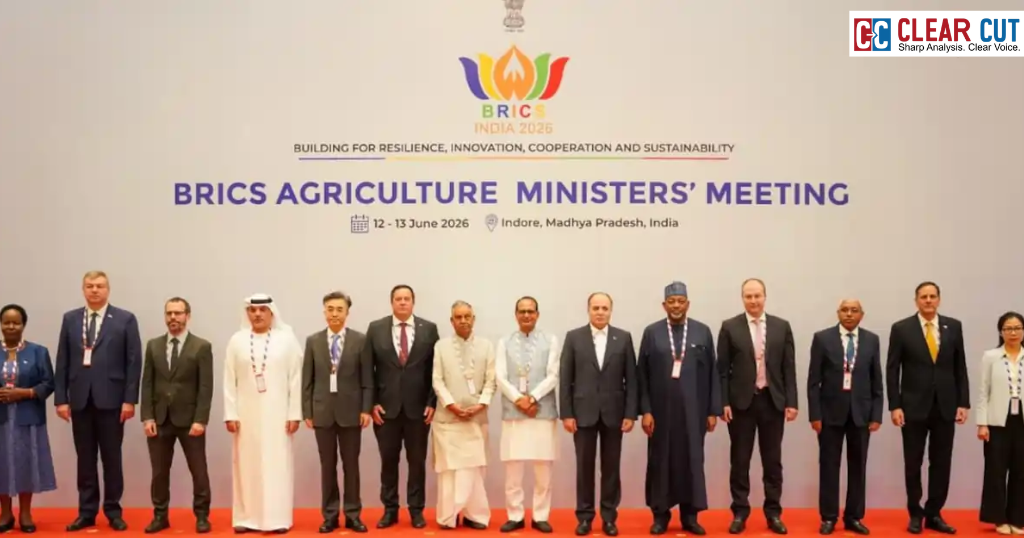
- The Indore Declaration 2026 was unanimously adopted by BRICS nations, placing smallholder farmers at the center of efforts to strengthen food security, climate resilience, and sustainable agriculture.
- The agreement establishes four new platforms focused on regenerative farming, digital agriculture, farmers’ rights in seed systems, and cooperation on agricultural resources and inputs.
- Representing around 42% of global agricultural land and foodgrain production, BRICS aims to enhance agricultural collaboration and create more resilient food systems for the future.
THE ROOM WHERE IT HAPPENED
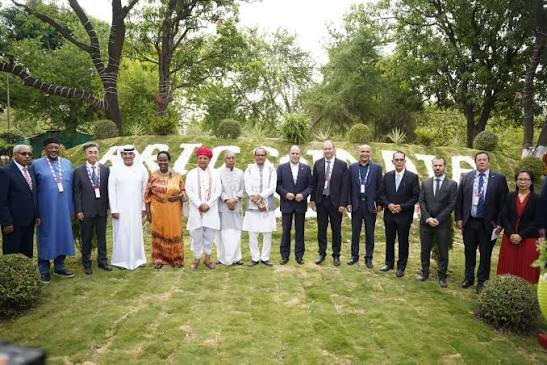
Indore, June 13, 2026. Eleven nations. One room. One unanimous vote. The 16th BRICS Agriculture Ministers’ Meeting produced the Indore Declaration. It was a farmer-centric compact, adopted without dissent, binding nearly half the world’s agricultural land under a shared commitment to food security, climate resilience, and seed sovereignty.
Under India’s BRICS Presidency, approximately 100 delegates including roughly 60 representatives from full member and partner countries signed onto a document that puts the smallholder farmer at the centre of global agricultural governance. Not the agri-corporation. Not the export index. The farmer.
| ~42% BRICS Share of Global Agri Land | ~42% Share of Global Foodgrain Output | 11 BRICS Full Members (2026) | 4 New Institutional Platforms |
FOUR PILLARS, NOT FOUR PROMISES
The Indore Declaration launched 4 concrete institutional mechanisms, each with named nodal coordinators. This a deliberate design choice to prevent declarations from dying on paper.
First, the BRICS Network of Centres of Excellence on Agroecology and Regenerative Agriculture — coordinated by ICAR-IIFSR, Modipuram, will drive research into natural and organic farming. Second, the BRICS Network on Digital Agriculture, led by IIT Delhi, will integrate AI, geospatial tools, and data-driven decision systems across member nations. Third, the Global Forum on Farmers’ Rights in Seed Systems, coordinated by India’s PPV&FRA protects indigenous seed diversity and traditional knowledge from being erased by commercial pressures. Fourth, the BRICS AgriN platform strengthens cooperation on seeds, inputs, and genetic resources.
“BRICS nations hold 42% of global agricultural land. The Indore Declaration is the first time that weight has been wielded in the interest of the smallest farmer.”
WHAT THE NUMBERS MEAN
The BRICS bloc, with 11 full members and a new category of partner countries introduced at the Kazan Summit in October 2024, represents nearly half of the world’s population. Its agricultural footprint is staggering roughly 42% of global agricultural land and an equivalent share of foodgrain production. That scale gives the Indore Declaration a practical weight that most multilateral agricultural agreements do not have.
The existing BRICS Agricultural Research Platform (BARP), established under India’s earlier BRICS presidency in 2016, is now being transformed into a ‘Knowledge-to-Action Hub’. A deliberate shift from producing research to delivering farm-level solutions. A Special Dialogue on the BRICS Grain Exchange built operational momentum around stabilising food supply chains, particularly for member countries vulnerable to import-price shocks.
POLICY-FORWARD VISION
This is India’s moment to shape the global food governance narrative. India coordinates three of the four new institutional initiatives. This is a quiet assertion of agricultural soft power that deserves to be recognised for what it is: strategic leadership. The road to Viksit Bharat 2047 runs through its farms, and the Indore Declaration ensures that road is paved with multilateral support.
But declarations age quickly without delivery architecture. The government must publish a one-year roadmap for each platform, including funding commitments, research milestones, and farmer-reach targets. The BRICS Grain Exchange must move from ministerial dialogue to operational design. The farmers’ rights forum must produce model legislation that member nations can adopt. Words have been signed. Now the work begins.
Clear Cut Climate, Research Desk
New Delhi, UPDATED: June 16, 2026 05:45 IST
Written By: Tanmay Urs