

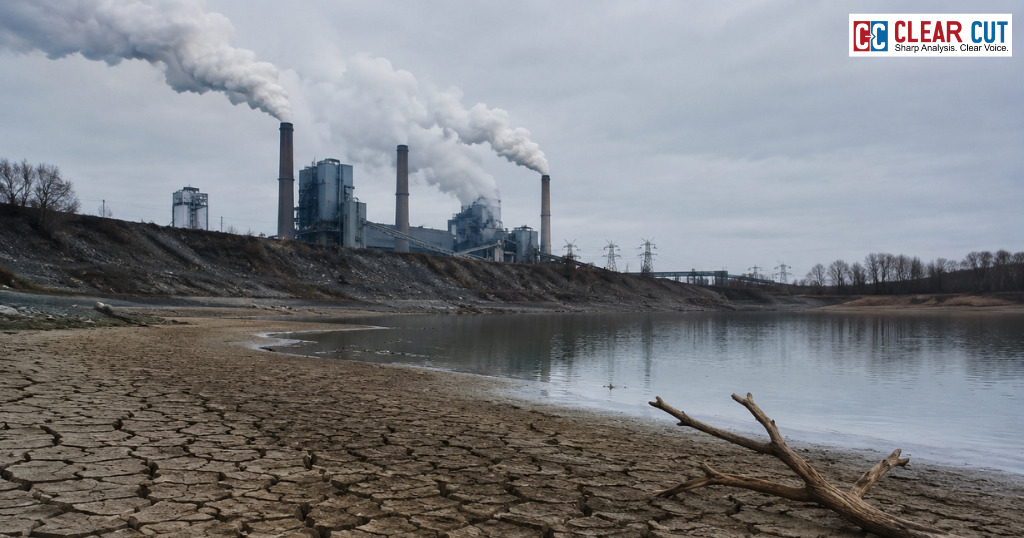
- Artificial intelligence relies on massive data centres that consume significant amounts of water and electricity, primarily for cooling servers and powering AI operations.
- As AI adoption grows, its water footprint is expected to increase substantially, raising concerns in water-stressed countries like India, where data centre expansion is accelerating.
- While companies are developing water-efficient cooling technologies and sustainability initiatives, experts argue that greater transparency and responsible infrastructure planning are essential.
Every AI query has a physical footprint – and it is measured in something far more scarce than electricity
The query you send to a chatbot seems like nothing. Not using any paper, fuel or obvious resources in any way. However, behind your query, deep inside some climate-controlled data centre full of buzzing computers, there’s some evaporation going on. As reported in a peer-reviewed paper by the University of California, Riverside scientists, in the Communications of the ACM journal, one answer of just 100 words generated by an artificial intelligence algorithm would require approximately 519 ml of water which equals one full-size bottle. This amount accounts for water that goes directly towards the server cooling as well as water indirectly used at the source of producing electricity. Estimates vary depending on location and technology, yet the fact remains that artificial intelligence uses water.
The Invisible Infrastructure Behind AI
Understanding AI’s demand for water requires an understanding of where AI really resides. The AI systems and large language models run on the computers known as servers that are placed inside warehouses called data centers, which cover spaces as large as several football fields, equipped with powerful processors. This is more than just computation; it is industrial infrastructure. According to a recent report from the International Energy Agency (Energy and AI, 2025), global electricity consumption by data centers stood at about 415 terawatt-hours in 2024 – or 1.5% of global electricity consumption – with a projection of doubling to 945 terawatt-hours by 2030. Data center energy consumption driven by AI rose by 50% in 2025, according to the IEA.

To cool such systems, water needs to be used. The mechanism is rather simple: server rooms release heat and, for the purposes of maximum energy efficiency, the most optimal way to get rid of that heat is using evaporative cooling, similar to sweating. Water is taking up the heat and transporting it somewhere else, with a major portion of the fluid evaporating into the air. This water never returns to its origin. That is what scientists and engineers refer to as consumptive water use as opposed to water withdrawal and consumed water is permanently removed from local supplies.
Why Data Centres Consume So Much Water
AI workload and water have a deeper connection compared to regular computing. The AI chips used in servers to perform large model computations create far greater thermal load per unit area compared to traditional server hardware, which results in a need for more rigorous cooling measures. A single hyperscale data centre can use up to hundreds of thousands of litres of water daily.
The most cited figures for the water footprint of AI were produced by Li et al., who conducted a study that was published in Communications of the ACM in 2025. According to their findings, GPT-3 trained at Microsoft’s US-based data centres consumed 700,000 litres of freshwater as part of a single training process. Training GPT-3 at an Asian data centre, which is characterized by higher intensity in terms of energy, carbon emission and water usage, would have increased the water footprint threefold. Their projection regarding global AI demand suggests that AI would require withdrawals of 4.2 to 6.6 billion cubic metres of water globally by 2027, which would surpass the yearly withdrawal of four to six countries the size of Denmark or even half of the UK’s annual withdrawal.
What should be emphasised is that this is projected information, not measured, and the researchers have admitted that the estimates differ greatly based on the scale, version of the model, and geographical location of the data centre. The water used per AI search request is considerably smaller than the cost of training, but it is repeated billions of times every day.
The water footprint is made up of two parts. The first part is called direct, or onsite, consumption, which involves water that gets evaporated using cooling towers. Indirect consumption is the second part, which is the amount of water used by the power plant in producing electricity, be it coal or nuclear power. A report done in 2025 by Patterns (Cell Press) revealed that the indirect water footprint of data centers in the US in 2023 related to electricity production was 800 billion litres, around twelve times more than the direct on-site cooling figure.
The Growing Environmental Footprint of the AI Boom
The magnitude of the problem becomes apparent when the trend is seen in terms of the total growth in data centre investments. According to the IEA, the total investment in data centres around the world has almost doubled from 2022 levels and touched half a trillion dollars in 2024. Reports of major tech companies confirm the trend in practice. The data centre of one major technology company had consumed over 23 billion litres of fresh water for its on-site cooling operations in 2023, which was a 17 % increase over last year, and the company itself claimed increased use due to higher AI workloads. In another leading company, data centre water consumption increased by 34% in one year and 22% in the next year.
According to a report in 2024 by the US Lawrence Berkeley National Laboratory, total on-site water use for US data centres would range from 150 to 280 billion litres per year by 2028, which is two to four times more than the use in 2023.

Water Stress, Local Communities, and India
The location of such infrastructures becomes very significant here. A data centre based in a water-rich area with power supplied through renewable energy sources can have a totally different environmental impact compared to one that is based in a dry environment using coal as a source of power supply. But the nature of infrastructure construction often results in placing the centres in areas with limited water resources.
The situation in India makes the issue even more pressing. “According to the World Bank,” India houses 18% of the world’s population but receives just 4% of the world’s water resources. This means that India is one of the water-scarce nations in the world. The World Resources Institute’s Aqueduct Water Risk Atlas ranks India in the top 25 nations for water stress.”
However, India happens to be among the top growing data centre markets in the Asia-Pacific region. According to Deloitte India’s 2025 report, which discusses AI data centre infrastructure investments, India has been home to roughly 150 operating data centres, which have a total capacity for handling IT operations that range between 1,200 and 1,300 megawatts. India’s data centre IT capacity has increased four times since 2020, according to government sources. Project estimates show that India’s data centre water consumption will increase two-fold from around 150 billion litres in 2025 to 358 billion litres in 2030 in cities like Mumbai, Hyderabad, Chennai, and Bangalore, where there is already competition for water resources.
Can AI Become More Sustainable?
The answer, as research indicates, is a cautious yes, but how quickly the transition is made is critical. Major technology firms have made major commitments. Starting in August 2024, Microsoft rolled out a new data centre design in which no water is used for cooling purposes by pumping coolant straight into the chip in a closed-loop cycle without any need for evaporation. The design has been successfully tested in the states of Arizona and Wisconsin, where it has been estimated that the facility will save up to 125 million litres of water every year. The objective that Google has set for itself is to be water-positive by 2030, where it will return more water than what its facilities use. By 2030, Amazon Web Services plans to increase facilities that utilise wastewater to 120 from 20.
But one problem pointed out by analysts is that promises to be water-positive, similar to carbon-offsetting, are often made using water from other watersheds, which do not contribute directly to replenishment of the aquifers from which the water is being extracted in order to service their operations.
Increases in computational efficiency through the development of compact and specialised AI chips, enhanced software that decreases the required number of calculations per query, and efficient scheduling of jobs to take advantage of cooler periods during the day are structural measures that can be taken to decrease the amount of water and energy used without relying on new infrastructure. The results from the University of California, Riverside research team indicate that temporal and spatial job scheduling can decrease water usage and emissions. AI is one of the most significant technologies of our time. But consequences go both ways. If a technology can make a doctor’s work easier, increase productivity, and speed up climate predictions, it must be subjected to the same scrutiny as it demands from itself. There are physical costs involved in running those servers and using all that energy. There is also the use of water for cooling, and in a planet where water is a scarce resource for a large population, who pays that price is no small consideration.
Clear Cut Climate, Research Desk
New Delhi, UPDATED: June 16, 2026 02:45 IST
Written By: Jyoti Aggarwal