

- Despite rising female labour force participation, millions of Indian women leave paid work after marriage and motherhood, with childcare responsibilities being the primary reason.
- While most women return after maternity leave, many struggle to remain employed due to inadequate childcare support, limited flexible work options, and workplace barriers.
- Existing maternity protections have limited reach and enforcement, especially for informal workers.
- The article highlights the need for stronger childcare infrastructure, flexible work policies, and supportive workplace practices to reduce permanent workforce exits among women.
The Career Break That Often Becomes Permanent
In March 2026, the Periodic Labour Force Survey’s annual report recorded the Worker Population Ratio for Indian women aged 15 and above at 38.8 per cent. For men, the same figure was 76.6 per cent. Among women not in the labour force, 44.4 per cent cited child care or home-making commitments as the primary reason the single largest category, ahead of any other explanation the survey offered.
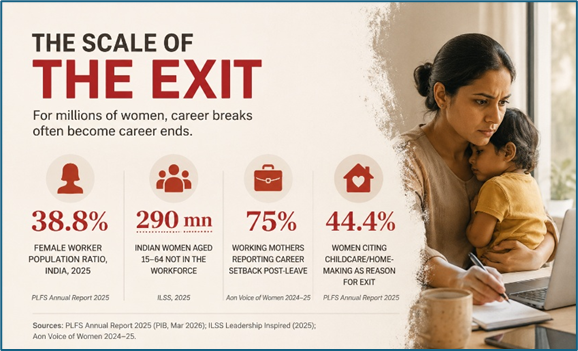
These are not numbers from an NGO report or an opposition press release. They are the government’s own data, collected through its own national survey, published by its own Ministry of Statistics and Programme Implementation. The gap they describe between men’s and women’s presence in paid work is not a marginal statistical footnote. It is one of the largest, most persistent gender gaps in the Indian economy, and it is concentrated almost entirely around two life events: marriage and childbirth.
The Rise in Women’s Work: What the Data Reveals and Conceals
Government communication on FLFPR over the past three years has been, on its own terms, a genuine good-news story. In March 2025, the Ministry of Labour & Employment cited a Female Labour Force Participation Rate of 41.7 per cent for 2023-24, framing it within the Viksit Bharat 2047 vision of reaching 70 per cent FLFPR. The PLFS Quarterly Bulletin for July-September 2025 reported overall female LFPR rising to 33.7 per cent, driven largely by rural participation increasing from 37.0 to 37.5 per cent.
Both figures are accurate. Both are also measuring different things, in different ways, at different points in a methodology that itself changed in 2025 when PLFS began including rural areas in its quarterly bulletins for the first time. The annual usual-status FLFPR of 41.7 per cent and the quarterly current-weekly-status figure of 33.7 per cent are not directly comparable a distinction that gets lost when both numbers appear in headlines as evidence of the same trend.
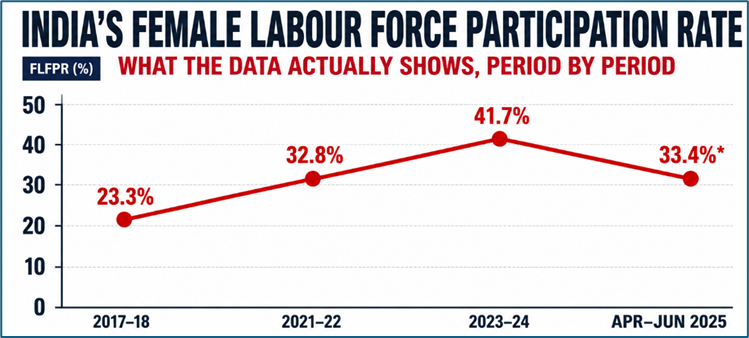
Sources: DGE, Ministry of Labour & Employment (2023); PIB (Mar 2025, Nov 2025, Mar 2026). Note: PLFS revised its quarterly methodology in 2025 to include rural areas -figures across periods use different bases and are not strictly comparable.
What is consistent across every measurement, regardless of methodology, is the underlying driver of the rural gains: more than 80 per cent of working women in India are in agriculture. Independent researchers have flagged this as a marker of “distress-driven employment” rather than expanding opportunity women entering low-paid, often unpaid family agricultural labour, not the formal salaried jobs that the Viksit Bharat 2047 target implies.
The Age Curve: Where Marriage and Motherhood Actually Bite
Aggregate national figures obscure a pattern that becomes visible the moment you disaggregate by age. Female labour force participation in India follows what researchers describe as a bell-shaped or inverted-U curve: participation rises through the early twenties, and for many cohorts peaks somewhere in the 30–40 age range before declining, often sharply, for urban and more educated women specifically.
A 2026 peer-reviewed study using four decades of National Sample Survey data found that the prime reproductive age roughly the years in which Indian women marry and have their first children is the single strongest determinant of when women exit the labour force, more so than education, caste, or region.The same study found something counterintuitive: beyond this prime reproductive window, the participation rate of urban and higher-educated women falls further, while participation among rural,lower-caste, and less-educated women tends to rise a divergence the researchers attribute to differing economic necessity rather than differing opportunity.
Marriage reduces FLFPR more sharply in urban India than in rural India a pattern researchers attribute to household responsibility norms that are, somewhat counterintuitively, more rigidly enforced in urban middle-class households than in rural ones where economic necessity often overrides social preference.
The Return-to-Work Funnel
If the marriage-and-motherhood exit were simply a pause a temporary step back followed by a return it would be a less urgent policy problem. The data on what happens after the exit suggests it is not simply a pause for most women who attempt to return.
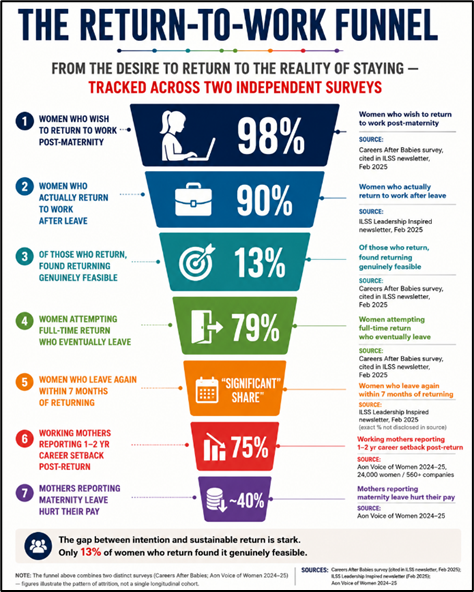
A survey by Careers After Babies, cited in a 2025 newsletter from India Leaders for Social Sector, found that 98 per cent of new mothers wanted to return to work. Only 13 per cent found returning genuinely feasible. Of those who did attempt a full-time return, 79 per cent eventually left unable to sustain the balance between professional and caregiving responsibilities.
Separately, Aon’s 2024-25 Voice of Women survey one of the largest pan-India workplace surveys of its kind, covering 24,000 women across more than 560 companies found that 75 per cent of working mothers experienced a career setback of one to two years after returning from maternity leave, and nearly 40 per cent said the leave itself had hurt their pay.
Read end to end, the funnel describes something closer to attrition by attrition: most women want to return, most do return at least once, and then the structural absence of flexible work, affordable childcare, and bias-free reintegration pushes a majority of them back out sometimes within months, often for good.
What the Law Actually Provides and Where It Stops
India’s statutory framework for working mothers is, on paper, unusually generous by global standards. The Maternity Benefit (Amendment) Act, 2017 raised paid maternity leave from 12 to 26 weeks, placing India third globally in maternity leave duration after Canada and Norway. Section 11A mandates crèche facilities at establishments with 50 or more employees. Section 5(5) permits work-from-home arrangements after leave ends.Each of these provisions, examined closely, narrows considerably in practice. The 26-week entitlement applies only to establishments with ten or more employees in the formal sector a category that excludes the majority of India’s working women, since more than 80 per cent of female workers are in agriculture or informal, unorganised work where no such protections reach them.
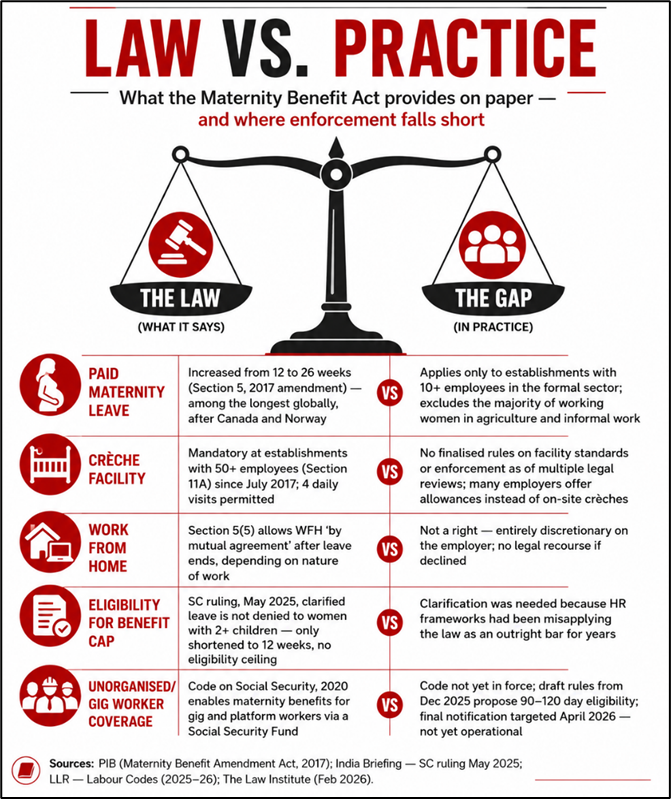
The crèche mandate has existed in law since July 2017. As of multiple legal reviews published as recently as 2026, no finalised rules govern facility standards, location requirements, or enforcement mechanisms leaving many employers to substitute a cash allowance for an actual on-site facility and leaving the obligation largely unenforced where employers choose not to comply.
Work-from-home after maternity leave is not a right under Indian law. It is, in the words of the statute itself, available only “by mutual agreement” between employer and employee meaning it can be declined with no legal consequence.
Coverage for India’s vast unorganised and gig workforce remains, as of mid-2026, a promise rather than a reality. The Code on Social Security, 2020 contains enabling provisions for maternity benefit schemes covering gig and platform workers, funded through a dedicated Social Security Fund. Draft rules published in December 2025 propose eligibility after 90 to 120 days of engagement, with final notification targeted for April 2026 a date that, as of this writing, has not yet produced an operational scheme.
What a Career Break Becomes, Without Intervention
The phrase “career break” implies a pause with a return built in. For the majority of Indian women the data describes, it is closer to an exit ramp with no clearly marked way back. Ninety per cent return after maternity leave. Within months, a significant share have left again. Of those who fight to stay, three-quarters report a setback that costs them one to two years of career progress they will likely never fully recover, given how steep the climb back to parity already is.
The legal framework exists. The 26-week leave, the crèche mandate, the work-from-home provision each represents a genuine legislative attempt to keep the break temporary. What the data shows, six years after the Maternity Benefit Amendment Act and nine years after its crèche mandate, is that legislation alone has not been sufficient to close the gap between what the law promises and what 290 million women outside India’s workforce actually experience.
The question the next decade of policy will have to answer is not whether Indian women want to work every survey cited here says they overwhelmingly do. It is whether India is willing to build the unglamorous infrastructure — enforced crèches, real flexible work, accountable HR practices that turns a temporary break back into what it was always supposed to be.
Clear Cut Gender Desk
New Delhi, UPDATED: June 24, 2026 02:00 IST
Written By: Shivangi Mishra
Designation: Assistant Manager – MLE at Devinsights