

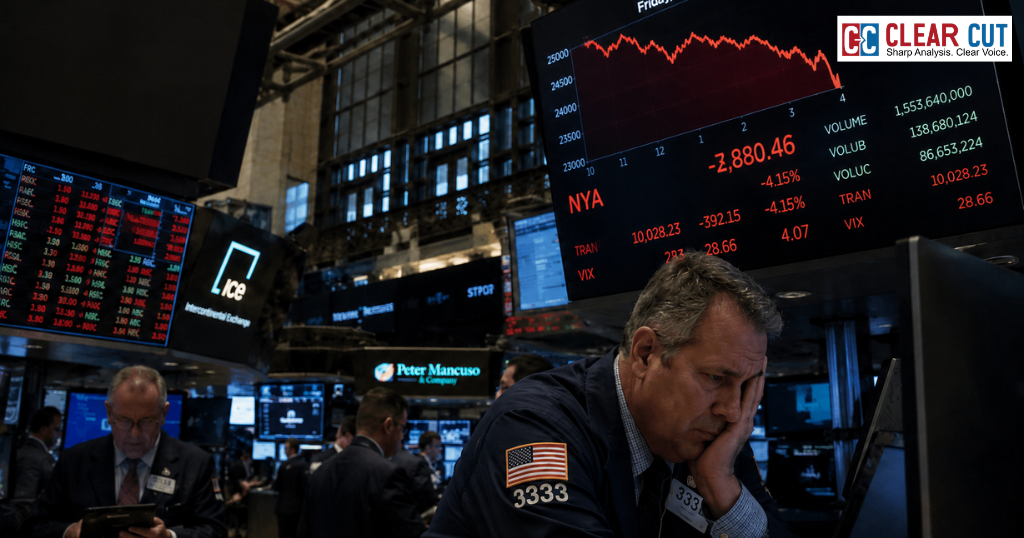
- Major AI and technology stocks, including Nvidia, Broadcom, and Alphabet, experienced sharp declines as investors began questioning whether massive AI investments can generate enough profits to justify current valuations.
- Rising expectations of Federal Reserve rate hikes have added pressure on growth stocks, making the AI sector vulnerable to both valuation concerns and a tougher monetary environment.
- While this is not considered a dot-com-style crash, the selloff highlights growing concerns about concentration risk and the long-term sustainability of the AI-driven market rally.
TWO DAYS, ONE QUESTION NOBODY COULD ANSWER
There was no single headline that explained it. No earnings miss, no regulatory bombshell, no executive resignation. And yet over two consecutive trading sessions this week, the Nasdaq Composite shed 580 points on Tuesday alone, layering onto Monday’s 1.3% decline, as investors across Wall Street simultaneously, almost wordlessly, began asking the same uncomfortable question: is the artificial intelligence spending boom actually going to generate the profits its valuations assume?

James Reilly, senior market economist at Capital Economics, captured the unease precisely in a note to clients: ‘Today’s big falls in tech stocks without any major catalyst are another illustration of rising volatility in these stocks, a result of what increasingly looks like frothy earnings expectations and/or valuations.’
| -2.2% Nasdaq Decline (Tuesday) | -4.2% Nvidia Decline (Tuesday) | -16% SpaceX Decline (Monday) | ~90% Fed Hike Odds (Year-End) |
WHERE THE DAMAGE CONCENTRATED
Chipmakers bore the heaviest losses. Nvidia tumbled 4.2%, Broadcom sank 3.1%, and memory chip stocks including Micron plunged after steep losses in South Korean semiconductor names overnight in Asia spread directly into US trading. Communication Services was by far the worst-performing S&P 500 sector on Monday, falling more than 4 percent on weakness in Alphabet, whose shares dropped 5 percent after Reuters reported a well-known AI scientist planned to leave Google DeepMind for a rival AI lab.
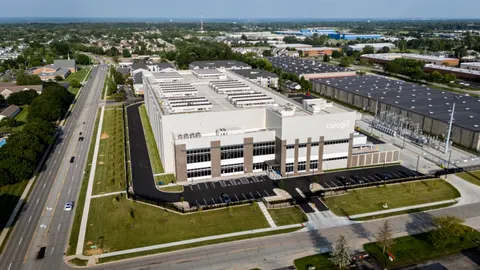
SpaceX presented the starkest individual case study in valuation anxiety. The company’s shares had soared above $200 within days of its initial public offering earlier in June, only to plunge 16 percent on Monday alone as investors began openly questioning whether a valuation exceeding $2 trillion could be justified by current fundamentals, regardless of the company’s technical achievements.
| “It’s not necessarily the start of a full-market breakdown unless selling broadens. But a crowded leadership group built almost entirely on one investment thesis — AI — getting stress-tested twice in a row is not nothing either.” |
THE MACRO BACKDROP MAKING IT WORSE
This selloff did not happen in isolation from broader monetary policy anxiety. The Federal Reserve’s rate-setting committee had recently opened the door to a possible interest rate increase later in 2026, driven by inflation concerns tied partly to months of elevated oil prices stemming from the ongoing US-Iran conflict. Traders are now pricing in a nearly 90 percent probability of at least one Fed rate hike by year-end with Bank of America economist Aditya Bhave forecasting three separate 25-basis-point hikes across September, October, and December.
Higher rates disproportionately compress valuations for growth and technology stocks, whose worth depends heavily on future earnings discounted back to the present. The AI trade is now being squeezed from two directions simultaneously: investors questioning the revenue payoff timeline, and a monetary backdrop making patient capital structurally more expensive to hold.
WHAT INVESTORS AND REGULATORS SHOULD WATCH NEXT
This is not, on the available evidence, a 2000-style dot-com collapse. The underlying AI companies generate genuine revenue and the technology has demonstrated real commercial utility, unlike many speculative internet ventures of that earlier era. But the concentration risk is real and worth naming plainly: a handful of mega-cap technology names, the so-called ‘Magnificent Seven,’ have driven an outsized share of broader market gains over the past several years, meaning a sustained AI-sector correction would not stay contained to tech investors. Corporate boards at AI-heavy companies owe shareholders clearer, more specific disclosure about the actual revenue timelines. Their massive capital expenditure commitments are projected against vague assurances about ‘addressable market’ expansion are no longer sufficient when the market itself is visibly losing patience. Regulators, meanwhile, should be watching concentration risk in passive index funds, where AI-sector exposure has quietly become far larger than most retail investors likely realise. The bill for the AI boom may not be due in full just yet. But this week was the first real notice that one is coming.
Clear Cut Research, Startups Desk
New Delhi, UPDATED: June 25, 2026 05:00 IST
Written By: Tanmay J. Urs