
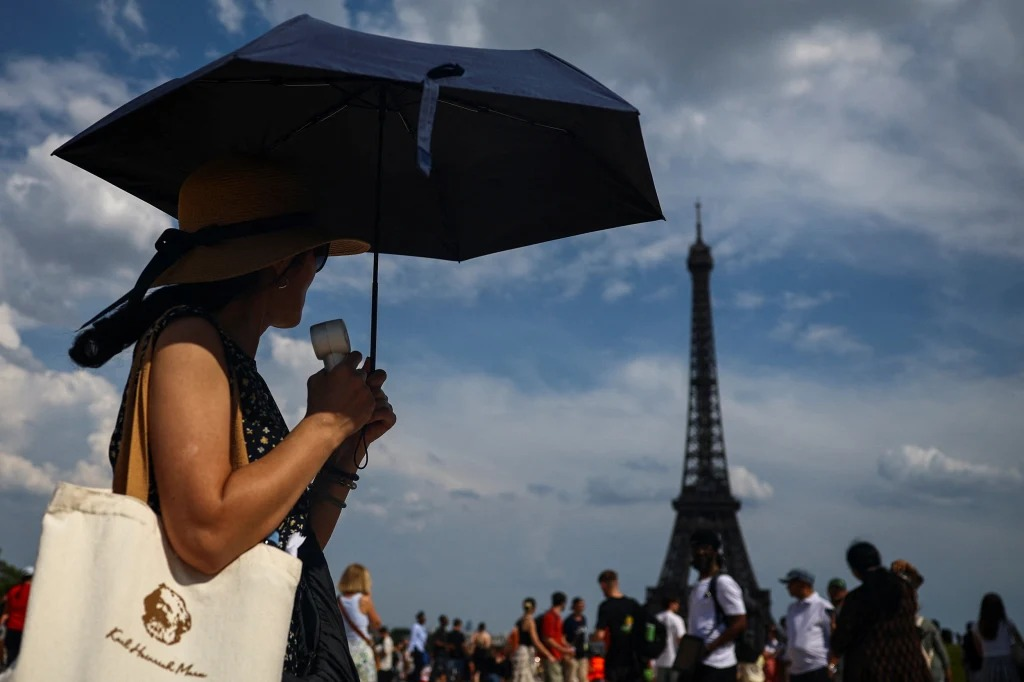
- France’s record-breaking heatwave has caused more than 45 deaths since June 18, including 40 drowning fatalities as people sought relief from extreme temperatures that reached 44.3°C.
- The crisis has strained infrastructure, forced school and landmark closures, and highlighted the growing impact of climate change, with experts calling for stronger climate adaptation and public safety measures.
THE RIVER AS THE ONLY REFUGE
In a country where most homes and even many offices have no air conditioning, the river becomes the only democratic relief from heat that has nowhere else to go. Such is the story behind France’s deadliest heatwave-driven drowning toll in recent memory. At least 45 deaths since June 18, 2026, with 40 of them drowning. Several desperate residents plunged into rivers and lakes seeking a few minutes of relief from temperatures that shattered the country’s all-time heat record.
French Prime Minister Sébastien Lecornu addressed the country after a crisis meeting. He called the fatalities a ‘tragic scourge,’ and was careful to name the demographic truth plainly. The victims were mainly young people, drawn to unsupervised water in a desperate, ordinary act of trying to cool down that, this week, has repeatedly turned fatal.
| 45+ Total Deaths (Since June 18) | 40 Drowning Deaths | 44.3°C Peak Temperature Recorded | 54 of 96 Departments Under Red Alert |
A HEAT DOME THAT WON’T MOVE
Meteo France confirmed the country recorded its hottest-ever day and hottest-ever night between Monday and Tuesday this week. The southwestern city of Les Herbiers touching 43 degrees Celsius and other areas climbing past 44.3 degrees. It is the highest temperature in French recorded history, dating back to 1947. Among the dead are two children, aged two and four, found unconscious and later confirmed dead in a parked car in Carpentras. 3 elderly residents aged 80-95 died of heat-related causes in the Bordeaux region. A 13-year-old girl drowned in the Seine. A professional footballer remains in critical condition after being pulled from the Rhône.
Meteorologists describe the cause as an ‘Omega block‘. A slow-moving, high-pressure weather system pulling hot Saharan air northward and trapping it over Western Europe, suppressing cloud cover and wind for days at a stretch. The same system has pushed Spain past 44 degrees Celsius in places and is forecast to push the United Kingdom past its all-time June temperature record of 35.6 degrees, set in 1957 and 1976.
INFRASTRUCTURE STRAIN BEYOND THE DEATH TOLL
The heatwave’s reach extends well past mortality statistics into the basic functioning of French infrastructure. A nuclear power plant in southwestern France was forced to shut down after the River Garonne, used for reactor cooling, exceeded safety temperature thresholds. A small but telling sign of how thoroughly heat extremes are now testing systems designed for a cooler climate baseline. The Louvre and the Eiffel Tower both announced reduced hours, closing at 4pm rather than risk visitor and staff safety during the hottest part of the day. Schools across dozens of departments shut early or adjusted timetables; the UK’s Met Office, watching the same weather system approach, ordered schools to close as a precaution as well.
Data from the European Union’s Copernicus Climate Change Service places this event within an unmistakable trend: Europe is warming roughly twice as fast as the global average since the 1980s, and more than 200,000 people across the continent have died from heat-related causes over the last 4 years. This is a toll the World Health Organization’s Europe office describes as ‘mostly preventable.’
THE ACTION THIS CRISIS DEMANDS
France introduced its heat watch warning system after the catastrophic 2003 heatwave, and that system is functioning as designed. Red alerts were issued, crisis meetings were held, public warnings were broadcasted. What has not kept pace is the physical infrastructure of French homes, the vast majority of which remain without air conditioning by design choice and building tradition, not technical limitation.
Climate adaptation experts, including University College London lecturer Oscar Brousse, are blunt that warning systems alone cannot substitute for addressing the underlying warming trend. The French government must accelerate retrofit incentives for vulnerable housing. They can pair it with the kind of aggressive public water-safety messaging that could have prevented at least some of this week’s 40 drowning deaths, most involving young people who simply had nowhere else to go to escape the heat.
Clear Cut Climate Desk
New Delhi, UPDATED: June 25, 2026 02:55 IST
Written By: Tanmay J. Urs